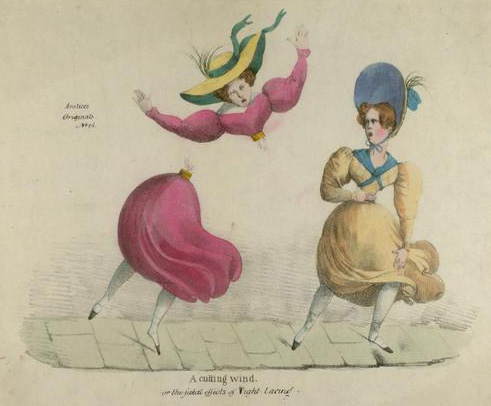
Tightlacing, also called corset training, is not simply wearing a corset. It is lacing a corset tighter over time, to change the figure and the posture, or to live inside the feeling of being cinched. The practice starts in mid-nineteenth-century Europe and was an argument from the first day. Doctors wrote tracts about the health risk. Dress reformers organized. Cartoonists drew wasp-waisted women as vain slaves of fashion. When that silhouette left everyday dress, the hardware moved to where fetish, restriction play, runway quotation, and the small number of people who still train a waist as a long body project already were.
A corset is not tightlacing. From the late sixteenth century into the early twentieth, Western women wore some form of stays for about four hundred years. Tightlacing as a named, escalating discipline shows up in the late 1820s and the 1830s, once the steel eyelet arrived in 1827. Steel in the grommets and steel in the boning let a wearer haul the laces down without tearing the cloth. That is the technical fact under the moral panic. You cannot train a thirteen-inch waist in corded jumps. Extreme reduction becomes possible only when the garment will take the load.
Corsets were also among the first clothes to come off an assembly line. Dress historian David Kunzle argues that tightlacing was largely a middle-class to lower-middle-class project, a way to look as if you had climbed. He estimated the typical corseted waist of the 1880s at about 21 inches (53 cm), against an uncorseted 27 inches (69 cm). That pair is more useful than the freak-show waists that still circulate on corset forums. Most women who laced were not circus posters. They were taking a few inches off a torso that fashion had already decided should look smaller than life.
The public fight, then the fashion exit
Late Victorian medicine and rumor treated tightlacing as a path to death. The dress-reform movement made the waist a political organ. Women who suffered for a small circumference were condemned as vain and scolded from the pulpit as slaves. Reformers told them to throw off the tyranny of the corset, free the waist for work and exercise, and protect the reproductive system doctors said the corset was crushing. The language is half anatomy and half property law: a body that could not labor or bear children on male terms was a body out of order. Women kept lacing.
Makers answered with corsets they claimed were kinder. By the 1910s and 1920s the whole apparatus was leaving fashion. Two world wars needed steel, and a full corset became a luxury. First-wave feminism, the Artistic Dress movement, and the flapper line all preferred a less sculpted torso. Elastic girdles and brassieres took over the shaping, without the rigid cage. After the Second World War, Dior’s New Look brought the wasp waist back as couture memory. Hippie culture knocked it down again. Fitness culture then sold diet, exercise, and later liposuction as the modern route to a thin middle. The corset left the department store for the same underground as bondage gear and vinyl catsuits, and for the alternative and runway quotation you can see in Vivienne Westwood and in goth club dress. Today it is often a top, not an undergarment. Historical reenactors still wear corsets. Few of them tightlace.
What “training” meant, and what it was not
An extremely small waist is not a weekend project. Period accounts describe a long run of successively smaller corsets, ideally begun in adolescence, sometimes earlier, under a mother’s or guardian’s eye. Finishing-school memoirs treat a reduced waist as polish: a girl who could show a fashionable circumference was supposed to be more marriageable. There was no single certified system. What remains is letters, shop talk, and a few diaries. Start ages in those accounts vary widely. Some households began stays while a daughter was still a child. Others waited until the late teens.
One much-quoted nineteenth-century mother wrote that each of her four daughters received a snug pair of corsets on her seventh birthday and wore them day and night except in clear illness. As the girl grew, more bones were added. Chest and hip measures were allowed to increase. The waist measure was held. Because the waist was not allowed to expand in sleep, she said, there was no later need for the violent tightlacing required when stays began on an already grown figure. Read that as a historical claim about fashion and child-rearing. It is not an erotic script. It is not a license to treat a child’s body as a fetish object.
Corset shops had their own regimen. Measure snug, tell the client to wear the garment as tight as comfort allowed, then sell a series of slightly smaller corsets so the drop happened slowly. Sleeping in the corset was common advice, on the logic that a night of expansion undid a day of work. Some guardians, afraid of cheating, used ugly methods to stop a girl loosening or cutting laces at night: a knot she could not retie, a padlock and chain, even tying the hands. Other voices in the same period called night-lacing cruel and recommended a looser night stay, or none. The argument is the one modern trainers still have: how much time under compression is training, and how much is refusing the body a rest. Those locked nights are a historical record of abuse. They are not a method to copy.
In 1895 The West Australian printed a piece presented as an early-1860s boarding-school diary. The women’s trained waists, it said, fell between 14 inches (36 cm) and 19 inches (48 cm), at a rate of a quarter-inch a month. The narrator claimed a drop from 23 inches (58 cm) to 14 inches (36 cm). A follow-up interview with a corset-making firm said such sizes were not rare then. Another memoir, from a “fashionable school in London,” remembers the same culture as rivalry among the students, reductions on the order of an inch a month, and a final waist of 13 inches (33 cm) from 23. A governess watched. After the first minutes, the writer said, there was no pain, only occasional headaches and lost appetite. Girls urged a harder pull even when they barely had breath to speak, and they watched the lace so it would not slip. Parents later blamed the school. The memoirist said the students were often the ones competing. Those narratives are Victorian media as much as they are physiology. They show what the culture wanted to believe about discipline, class, and a girl’s value on the marriage market. They do not give a safe protocol, and they do not permit treating a child’s body as a fetish object.
The smallest recorded adult waists need that context. Many of the extreme numbers belong to people who started young, and the sources are proud, defensive, or selling something. Adults did train later, with more difficulty. A number of documented older women were pushed into tightlacing by husbands. Ethel Granger is the name that always comes up, and the sexual-fetish current in that marriage is not a secret. As far as the record can see, the typical participant in the historical craze was a teenager or a young adult. Extreme museum waists are the tail of the curve, not the mean.
Pleasure, one shop’s hundred, and the move into fetish
Tightlacing was something to boast about. For some people it was also pleasure. Not everyone could do it. In 1896 a fashion-house employee said that among shop girls trying to reach a 19-inch (48 cm) waist, out of every hundred she found three who could not lace at all, six who laced with difficulty, eight who eventually quit, ten who endured it as bondage, seventy who actually enjoyed it, and three who laced to excess. That is one worker’s headcount, not a clinical trial. It is the most honest period statistic on hand: a majority who liked it, a minority who suffered it, a handful who could not, a handful who went past the rest.
Kunzle suggested that some enthusiasts got sexual pleasure from the cinch itself, or from rubbing against the front of the corset, and that this erotic leak fed the moral rage. Testimonials still talk about a pleasant numbness or tingling under the bones. Anyone who has worn a belt, a cincher, or a bondage corset for a scene already knows the sensation those writers were circling: restriction as arousal, pressure as a mood, the world narrowed to breath and waist.
Once fashion dropped the wasp waist, the sensation did not vanish. It changed address. The corset stayed with other skin-tight and restrictive kit. People wore it as club armor, as a negotiated limit on breath and movement, as a long-term body-mod project, or as a photograph. The Victorian finishing school is gone. An adult who chooses a 20-inch training corset and a lacing partner is doing a different thing, even when the steel bones look like a costume drama.
Doctors, reformers, and the “health corset”
Satire got there first. Newspaper cartoons made tightlacing look frivolous, ugly, and lethal. Serious politics followed. American women already practiced in anti-slavery and temperance work, women who knew how to speak in public, argued for clothes they could move in. They did not always abandon the corset. They wanted a garment that was not a trap. Fashion’s defenders said stays produced an upright “good figure” and were the physical frame of a moral society. Dress reformers answered that fashionable dress was a male conspiracy to keep women subservient by training them in slave psychology. Change the clothes, they said, and you change the possible life: more movement, wage work, independence from marriage, a body that was not a husband’s ornament.
Doctors piled on. One Dr. Lewis, in an 1882 North American Review, wrote that a girl who had indulged in tight lacing should not marry. She might be a devoted wife, but her husband would secretly regret the match. “Physicians of experience know what is meant,” he added, “while thousands of husbands will not only know, but deeply feel the meaning of this hint.” He was talking, in the choked language of the time, about reproductive damage, and he was talking to men. The patient is a failed purchase.
The backlash produced design as well as sermons. Some physicians became corsetieres, fitting patients to avoid the injuries of a bad pattern, or drawing stays themselves. Roxey Ann Caplin became a known maker by working patterns with her husband, a physician, and advertising them as more respectful of anatomy. “Health corsets” and “rational corsets” offered wool linings, watch-spring boning, elastic panels, and other features sold as less destructive. Whether they saved livers is a separate question. They show that the market heard the panic and tried to keep the silhouette while changing the copy. Training girls into extreme tightlacing as routine upbringing appears to have died out by the early twentieth century, filed under the foolishness of a closed era. Modern medical talk is blunter than Dr. Lewis and less usefully documented in the nineteenth-century sources this account is built from. What those sources will support is this: contemporaries already blamed tightlacing for digestive trouble, fainting, reduced appetite, headaches, and injury to childbearing. Reformers already used those claims to argue for women’s mobility. Fetish wearers who treat a training corset as edge play are not meeting a new risk. They are volunteering for a risk their great-great-grandmothers were told to fear. Breath, circulation, and pain stay in the picture.
Waists that got measured in public
A few names keep returning in the inch-count literature. Empress Elisabeth of Austria, Sisi, is cited at 16 inches (41 cm). The French performer Polaire, around 1914, is put at 13 to 14 inches (33–36 cm). Cathie Jung, measured in 2006, is listed at 15 inches (38 cm). Dita Von Teese, who did as much as anyone to put the corset back on a modern stage, is often given 16.5 inches (42 cm). Maud of Wales, later queen of Norway, is listed at 18 inches (45 cm). Ethel Granger is the hard-fetish pole: 13 inches (33 cm), in a marriage where the reduction was not a debutante’s hobby.
Treat the tape as theater. Some of those numbers are period publicity. Some are modern training under medical-adjacent caution. Some are the point where fashion history and sexual fetish occupy the same rib cage. Granger’s waist is not a royal portrait. Von Teese’s is not a finishing-school diary. Jung’s is a twenty-first-century body-mod claim. What they share is the decision to make the waist a public measurement. Even when the subject is a monarch, that decision is already halfway to fetish.
After fashion stopped wearing it underneath
For BDSM readers the usable history is not a method for a 16-inch waist. It is the grammar of restriction. A corset limits breath, posture, eating, and how long a scene can run. Tightlacing is that garment used as a program. Consenting adults who train do it with time, incremental sizing, and an exit. That is the opposite of a padlocked Victorian night. A play corset that comes off after a party is closer to bondage tape than to Kunzle’s 21-inch average. Twenty-four-hour training is closer to a negotiated protocol, with the circulation and pain questions that implies.
The nineteenth-century hundred already splits the modern room. Seventy “really enjoyed it.” Ten “endured the bondage.” Three went excessive. Swap the shop for a dungeon and you still have people who lace for the look, people who lace because the look is a cage they asked for, and people who will wreck themselves if nobody holds a limit. Dress reform’s “slave psychology” was an insult. Consensual M/s borrowed the hardware and reversed the politics: the cage is chosen, timed, and praised.
If you want the historians rather than shop copy: Valerie Steele’s The Corset: A Cultural History (Yale, 2001); Kunzle’s Fashion and Fetishism (1982), which is where the class analysis and the erotic-tingle thesis live; Leigh Summers’s Bound to Please: A History of the Victorian Corset (2001); Peter Farrer’s Tight Lacing; the 1869 compilation The Corset and the Crinoline; and the French physiological study Le corset. They disagree with each other. The wasp waist was never only a measurement. It was a fight about what a torso is for.
Tightlacing began when steel eyelets made extreme reduction possible, peaked as a classed Victorian fashion under medical and clerical fire, and survived as fetish after elastic, war rationing, and feminism killed it as underwear. People who still lace for inches are doing body modification. People who lace for a scene are doing restriction play. Both sit downstream of a garment that spent a century being accused of vanity, infertility, and moral rot, and that women, then fetishists, kept tightening anyway.
The hourglass corset, the patterned cousin that makes the waist look smaller by pushing volume to bust and hip, is the silhouette most people mean by “Victorian.” Skin-tight garments and even full-body zentai sit in the same modern catalog of restriction and do a different job: they enclose rather than sculpt. A training corset is a vise with a fashion history. A catsuit is a second skin. Fetish closets keep both because the sensations rhyme, less breath, a shorter stride, the feeling of being packed, while the politics come from different centuries. Westwood and goth runway quotation put the vise back on top of clothes. Club nights put it over bare skin. Historical reenactment, as the sources note, usually stops at “looks right” and does not chase Granger’s numbers.
What the Victorian record will not give you, and what this page will not invent, is a safe reduction schedule with fake percentages and guaranteed inches. The quarter-inch-a-month boarding-school diary and the inch-a-month London memoir are period boasts. Kunzle’s 21-versus-27-inch pair is a historian’s estimate for ordinary fashionable lacing, not a target. The 1896 shop-girl hundred is one employee’s tally. Use those figures as evidence that people have been arguing about this garment for 150 years. Use a living fitter, a slow size drop, and a willingness to stop when the risk stops being erotic. The steel eyelet made tightlacing possible. It did not make it free.