
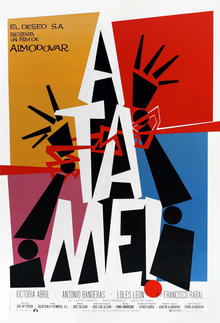
Tie Me Up! Tie Me Down! (Spanish: ¡Átame!, “Tie Me Up!”) is Pedro Almodóvar’s 1989 black romantic comedy about a newly released psychiatric patient who kidnaps a film actress so that she will fall in love with him. Victoria Abril and Antonio Banderas star; Loles León, Francisco Rabal, Julieta Serrano, María Barranco, and Rossy de Palma fill the household and the set around them. Ricky believes his destiny is to marry Marina Osorio and father her children. He binds her to make the destiny happen. She ends up asking to stay tied. Spain turned the film into the year’s biggest domestic hit. The United States turned it into a ratings war that helped kill the X and invent NC-17.
Almodóvar has always denied that the ropes are sadomasochism. There is, he says, no erotic charge in the gags and knots. A BDSM site does not have to take the director’s word as the last word. The movie is still one of the most widely seen bondage narratives of the late 1980s: abduction, handcuffs, tape, a bed, a woman who learns to want the restraint, and an American censor who could not tell that story from porn. Watch it as a dark comedy about forced coupledom. Watch it as a Beauty-and-the-Beast rewrite. Watch it, against the auteur’s protest, as a document of how mainstream cinema looks when it puts a woman in rope and then asks you to root for the knot.
Ricky Leaves the Hospital and Goes Hunting
Ricky is twenty-three. A psychiatric hospital has just declared him cured. Until then he has been the lover of the hospital’s female director. He is an orphan, free, and alone. His idea of a normal life is Marina Osorio, a former porn actress and recovering drug addict with whom he once slept during an escape from the asylum. He does not treat that night as a fling. He treats it as a contract she has forgotten.
Marina is on a studio lot shooting The Midnight Phantom, a Euro-horror picture about a mutilated, masked muscleman in love with her character. The director, Máximo Espejo, uses a wheelchair after a stroke. He is Marina’s mentor. He threatens to throw out a journalist who says “porn” or “junkie” in her presence. He is also secretly attracted to her and wants to enjoy what may be his last time directing a female lead. The set is already a machine for looking at Marina. Ricky just arrives as a second, unauthorized camera.
He steals from the production, including the keys to her apartment, and becomes an unwelcome presence. Wearing a wig, he does a handstand to get her attention. She does not remember him and dismisses him. After the last shot she goes home to change for the wrap party. Ricky follows. When she opens the door he forces his way in, grabs her, and headbutts her silent when she screams. He tapes her mouth and binds her with rope. She wakes with a toothache that ordinary painkillers cannot touch, because she is addicted to stronger drugs. Ricky explains the plot of the rest of his life: he captured her so that, once she knows him, she will fall in love, they will marry, and they will have children. Marina, handcuffed, gagged, and lashed to the bed, says she will never love him. He remains determined to win.
Toothache, Street Drugs, and a Sister at the Door
Marina is shocked and in pain. She talks Ricky into taking her to a doctor who can give her the painkillers she actually needs. Left alone with the doctor, she cannot communicate what is happening. The pharmacy will not supply the drugs. Ricky tries the black market, then refuses the street price and attacks the dealer to steal the tablets. The kidnapper’s idea of care is indistinguishable from a mugging. That is the film’s idea of romance working with the only tools Ricky has.
At the wrap party, Marina’s sister Lola—the film’s assistant director—steals the night with a musical number. Worried about the disappearance, Lola visits the apartment and leaves a note. To avoid being found, Ricky moves Marina into the empty flat next door. The neighbor has left his keys with Lola so she can water the plants while he is away for the summer. The bondage plot is now using the ordinary logistics of a Madrid apartment building: spare keys, summer absence, a sister who will not stop knocking.
In the street again, the dealer Ricky attacked spots him. Ricky is beaten, robbed, and left unconscious. While he is gone, Marina tries to escape. When he comes back covered in blood and cuts, she sees vulnerability and devotion instead of only the headbutt. She cleans and sterilizes the wounds. She realizes she has fallen in love with her captor. They have sex. They decide to visit Ricky’s hometown. As he is about to leave to steal a car for the trip, Marina—who still considers herself his prisoner—tells him to keep her tied so she will not try to run. That request is the scene Spanish critics later treated as the film’s heart. It is also the scene that makes a kink audience sit up. The rope has become a tool she asks for.
In Ricky’s absence Lola re-enters, finds Marina bound, and rescues her. Marina says she is in love with the man who tied her. Lola is astonished, then convinced, and agrees to drive her to Ricky’s hometown. They find him in the ruins of his family house in a deserted village. The three of them climb into Lola’s car. Lola accepts Ricky as family and says she will find him a job within the week. Marina starts to cry. They drive back toward the city singing “Resistiré” (“I will prevail”) in unison. The abduction comedy ends as a road-movie family.
Casting After Carmen Maura
The film marked Almodóvar’s break with his longtime star Carmen Maura, a rift that took years to heal. At forty-four, Maura was also, in the production’s own accounting, too old for a role that wanted a younger woman. Tie Me Up! Tie Me Down! began a run with Victoria Abril, whom Almodóvar had already considered for Cristal, the prostitute neighbor in What Have I Done to Deserve This? (1984), and for Candela, the model fleeing a terrorist lover in Women on the Verge of a Nervous Breakdown (1988). Abril had a cameo in Law of Desire and was already known for hard female leads. Marina needed someone who could be a porn-world survivor, a junkie in withdrawal, a horror-movie scream queen, and a woman who asks to be tied so she will not bolt. Abril is why that stack of roles does not collapse into a joke.
Banderas took the male lead in his fifth and most important Almodóvar collaboration. Ricky launched him toward American films. The performance has to hold a child’s idea of marriage inside a kidnapper’s body: the handstand in a wig, the headbutt, the stolen pills, the bloody return, the ruined village house. Loles León, a stand-up comedian, plays Lola, the sassy sister. She had already been the meddlesome telephonist in Women on the Verge of a Nervous Breakdown. Francisco Rabal, one of Spain’s foremost actors, plays Máximo, the stroke-damaged director who is still trying to look at women through a lens. Almodóvar cast his own mother, Francisca Caballero, as Marina’s mother. Rossy de Palma, the Picassoesque actress he had found in 1986, plays the small, memorable part of the drug dealer Ricky assaults. Julieta Serrano and María Barranco complete the billed company. The household is an Almodóvar troupe even without Maura: sisters, mothers, dealers, directors, all talking too much around a bed with a rope on it.
The Director Says It Is Not SM
The Spanish title ¡Átame! means “Tie Me Up!” The English extra clause, “Tie Me Down!,” is there to suggest a lasting relationship, not only a knot. Almodóvar has consistently denied that the ropes have any link with sadomasochism. There is, in his account, no erotic charge to the ropes and gags. He has explained the film as a love story, or rather a story of how someone tries to construct a love story the way he might study for a degree: by effort, willpower, and persistence. When you have nothing, like Ricky, you have to force everything, including love. Ricky has only—as the flamenco singers say—the night, the day, and the vitality of an animal.
Ricky’s stated ambition is to be a good husband and a good father. The relationship is finally a parody of how such relationships work, as if heterosexuality and its consequence, marriage, were almost inevitably a form of Stockholm syndrome. The cords that tie people to one another become literal rope. In this reading it is not a tale of kinky sex but of “a sweeter human bondage,” loose ends tied into lover’s knots. That is a director defending his film against the charge that he made a bondage picture. It is also a description of bondage. A site that takes SM seriously can hold both. The movie eroticizes capture whether or not the director wants the word. Marina’s request to remain tied is the moment the kidnapping plot and the kink plot occupy the same frame.
Beauty, Beast, Collector, Bride-Thief
The film sits in the Beauty and the Beast myth: the Beast’s savagery is tamed by Beauty into gentler feeling. Cinema had already told that story as King Kong (1933), Tarzan the Ape Man (1932), and Frankenstein (1931). Spanish literature had told it in Calderón de la Barca’s Life Is a Dream, where Segismundo, half-man and half-beast, imprisoned for his first twenty years, finds his violence tamed by female beauty once he is released into the world. Ricky is that figure with a stolen key-ring. Marina is the beauty who first refuses and then nurses the wounds.
The abduction also rhymes with William Wyler’s The Collector (1965), from John Fowles’s novel, in which a butterfly specialist kidnaps a young woman to add her to his collection. In style, theme, and plot detail Almodóvar’s film is very different. Bride kidnapping is also the engine of the Hollywood musical Seven Brides for Seven Brothers (1954). Almodóvar is not hiding the ancestry. He is running a Spanish pop version of a very old theft-as-courtship plot and daring you to find it tender.
Rossy de Palma, who plays the dealer, later said the kidnapping was not to be imitated in real life and was justified only by the “exceptional nature of the characters.” That is the production’s safety label. Modern viewers have been less polite. Some argue that the film condones Ricky’s behavior, suggesting it is acceptable to brutalize and subjugate a woman so long as the man claims sincere passion. A BDSM reading should not dodge that complaint. Consent that arrives after a headbutt is not the consent a dungeon means by a safeword. The movie knows it is playing with that problem. It still wants you to sing in the car with them.
Romantic Comedy Wearing a Horror Mask
Genre here is double: romantic comedy and horror. Despite the dark machinery, Almodóvar has called the film a romantic fairy tale and his clearest love story. Ricky’s violent courtship follows, in grotesque scale, the path of late-1950s Doris Day romances with Rock Hudson (Pillow Talk, 1959), James Garner (Move Over, Darling, 1963), and Cary Grant (That Touch of Mink, 1962): the man who will not accept no, the apartment as battlefield, the eventual couple. The joke is that Ricky’s version of persistence is rope.
The horror inheritance is just as deliberate. Marina’s role in The Midnight Phantom has her defeat the monster’s attempt to kill her, subverting the woman-as-victim template in a way that parallels her relationship with Ricky. While they are shooting that inner film, Lola remarks that they are making “more a love story than a horror story.” Máximo answers that sometimes the two are indistinguishable. The Midnight Phantom is not only a film-within-the-film. As the girl on that set defeats the monster, Marina will tame Ricky. Tie Me Up! Tie Me Down! extends the inner picture. Both movies mix variant Beauty-and-the-Beast stories across horror and romance. The production also points at two specific horror titles: Máximo keeps an Invasion of the Body Snatchers (1956) poster in his editing room, and Marina watches Night of the Living Dead (1968) while Ricky is away. Pod people and the undead are the wallpaper of a movie about a man who wants to replace a woman’s will with his plan for a family.
Morricone, a Bolero, and “Resistiré”
Ennio Morricone wrote the score in thriller mode, close to Bernard Herrmann’s music for Hitchcock’s Psycho (1960). Almodóvar admired Morricone’s western soundtracks but found this music conventional and uninspiring, too near Morricone’s work for Frantic. He used only about half of it. The film is therefore a rare case of a famous composer being partly left on the floor by a director who wanted something less generic than suspense cues.
Two songs do more narrative work than the unused half of the score. The film closes on “Resistiré” (“I Will Resist”) by Dúo Dinámico, a Spanish pop duo from the 1960s. On the soundtrack the tune suggests Marina’s happy resistance inside Ricky’s unconventional courtship—or, if you are less charitable, the movie’s insistence that endurance is the same thing as love. The wrap-party scene breaks the kidnapping’s hardness by giving Loles León a bolero, “Canción del Alma,” a song Alfredo Sadel had popularized in Latin America. Sisterhood gets a nightclub number while the other sister is taped to a bed. That tonal whiplash is the Almodóvar method, not a mistake.
Berlin Cold, Spain Hot
Almodóvar’s eighth film was finished late in 1989. The early 1990 Berlin Film Festival premiere was a mess. The projector broke. At the press conference, in a country that had not understood his films well, he was grilled about his homosexuality, about drug abuse, and about the Spanishness of the picture. The bondage comedy arrived in Germany as a moral questionnaire.
Released in Spain in January 1990, it was an enormous success: the highest-grossing domestic film of its year, with an audience of more than a million, twice the audience of the year’s most critically admired Spanish film, Carlos Saura’s ¡Ay, Carmela!, which starred Almodóvar’s former muse Carmen Maura. The box-office victory over Maura’s other movie is a piece of industry gossip that the production history cannot resist. The public voted for the kidnapping romance.
Spanish critics were generally kind. Lluis Bonet, in La Vanguardia, called it “a terrible tender love story” and agreed with the director that the best scene was Marina, once a hostage, asking to be tied so she would not flee the love Ricky had succeeded in provoking. Javier Maqua, in Cinco Días, called that request evidence of “the greatest intensity of love.” British critics took longer to warm to Almodóvar and dismissed this one. Lawrence O’Toole, in Sight and Sound, found it “fairly banal, schematic and essentially humorless.” The split is familiar: Spain hears a love story with a rope in it; an English magazine hears a schematic gag.
America, the Bathtub Toy, and the X
In the United States the fight was not about tenderness. It was about a long sex scene, two shots of Marina and later Lola sitting on the toilet to urinate, and—especially—Marina in a bathtub using a scuba-diver toy to pleasure herself. The MPAA rating machinery treated those images as a problem that ordinary adult ratings could not hold. The film was finally released unrated. Feminists and women’s advocacy groups denounced the sadomasochist overtones and the portrayal of a successful female abduction. On Rotten Tomatoes the film later sat at 69% approval from 32 reviews, average 6.20/10, with a critics’ consensus that it undermines itself with excess camp but that Almodóvar and an attractive cast make it worth watching. Metacritic logged 55 from 14 reviews, “mixed or average.” North American box office was $4,087,361. Those are decent art-house numbers for a Spanish-language kidnap comedy that many American parents’ groups wanted treated as dirty.
The legal fight was over the X rating. By 1990 that letter had become almost synonymous with pornography. An X marginalized distribution and killed a film’s chance at ordinary theatres. Miramax, the North American distributor, sued the MPAA. When the case reached a New York court it turned into a broader argument about cinema, censorship, and sex in the United States. Miramax’s lawyer said the “Average American Parent” was badly served by a system lenient on hard violence and drug use and harsh on sex. Miramax lost. The film went out unrated. But enough other filmmakers had made the same complaint that in September 1990 the MPAA retired the X and created NC-17. Henry & June was the first film released with the new label. The change was meant to rescue explicit but non-pornographic films from the porn bin. Tie Me Up! Tie Me Down! would eventually receive NC-17 for a “scene of strong adult sensuality with nudity.” A scuba toy in a bathtub had helped force a new American rating category.
For bondage cinema the episode is almost too on the nose. A movie whose director denies any SM charge was, in the United States, treated as too sexual for an R and too respectable to leave in the X ghetto. The thing American censors could see was the body: urine, masturbation, a long sex scene, a woman tied to a bed. The thing Almodóvar wanted them to see was a parable of marriage. Both things are on screen. The MPAA, for once, looked at the rope.
Home Video, Criterion, and the Afterlife of the Knot
The Region 1 DVD offered Spanish audio with English subtitles and a trailer, nothing else. The UK Region 2 disc was more generous: an interview of Almodóvar by Banderas, footage of the Madrid premiere, poster and still galleries, trailers. On 19 August 2014 the Criterion Collection reissued the film on DVD and Blu-ray in the United States, with a new documentary and extras carried over from earlier editions. Criterion’s embrace is the art-house canonization of a picture that American law had once tried to file next to porn. Pedro Almodóvar himself later wrote “The Birth of Tie Me Up! Tie Me Down!” for the Criterion site. The kidnap comedy is now a prestige object you can buy in a spine-numbered box.
That afterlife does not settle the SM argument. It just moves it into a better transfer. You can still watch Ricky tape Marina’s mouth and hear the director insist the tape is not erotic. You can still watch her ask to be left bound and hear Spanish critics call it the greatest intensity of love. You can still hear American feminists call the same beat an alibi for abuse. A BDSM audience does not have to pick one sermon. The useful facts are concrete. In 1989 a major European director made a hit comedy whose central prop is rope. The English title added “Tie Me Down” so nobody would miss the marriage metaphor. The United States answered with an X, a lawsuit, and then NC-17. Banderas walked from that bed into Hollywood. Abril became Almodóvar’s new partner on screen. The song at the end is about resisting, sung by a woman who has decided not to run.
If you came to this page for bondage cinema, the film will give you the imagery and refuse the subculture. There is no dungeon etiquette, no negotiated scene, no community. There is a psychiatric patient, a porn-actress heroine, a sister with a bolero, a director in a wheelchair, a dealer with a Picassoesque face, and a deserted village where a family gets improvised out of a crime. Almodóvar wanted a fairy tale about forcing love when you have nothing. What he also made—what the MPAA, the women’s groups, and every kink viewer can see without his permission—is a movie in which the question “tie me up” becomes, by the last reel, a line a woman says on purpose.


![[不二企画] FUJI-0333 強烈猿轡 乳汁愛虐縛り 望月麻子 -濡木痴夢男- (Duga Full Version)](https://bdsmwild.com/wp-content/uploads/2024/08/02153-FUJI-0333-bdsmwild【Exclusive】不二企画-FUJI-0333-強烈猿轡-乳汁愛虐縛り-望月麻子-濡木痴夢男-Duga-Full-Version.webp)