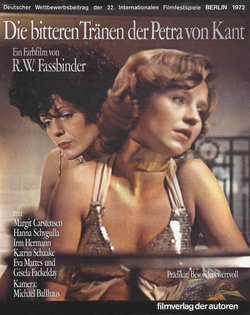
The Bitter Tears of Petra von Kant, German title Die bitteren Tränen der Petra von Kant, is a 1972 West German film written and directed by Rainer Werner Fassbinder, adapted from his own play. The cast is entirely female. Almost the whole picture stays in one cramped space, the bedroom of fashion designer Petra von Kant’s apartment in Bremen. For adult viewers who know BDSM and fetish culture, it is not a lesson in leather or rope. It is a cold look at erotic domination, masochistic service, and the wish to possess someone. The tension is simple: when the person on top finally offers a kinder equality, the partner who was used to being dominated turns and leaves.
The room narrates without speaking. A huge reproduction of Nicolas Poussin’s Midas and Bacchus covers a wall. Camera angles and the placement of the furniture keep commenting on which way the power runs. Petra’s marital history is already wreckage. Her first husband, Pierre, died in a car crash while she was pregnant. The second marriage ended in disgust. She lives with Marlene, her assistant and lover, another designer, and treats her as a slave. This is not a negotiated scene, and there is no safeword. It is emotional and labor servitude dressed up as professional intimacy, running under the whole film. Marlene wakes her, dresses her, and receives the guests. She is the silent witness in the frame. Petra gives the orders at the center. That household servitude is the bass note, until the balance breaks.
The turn starts when the younger model Karin Thimm enters. Karin is twenty-three, newly back from Sydney, attractive, and shallow on the surface. Petra is drawn at once and offers to support her through model training. The backgrounds do not match. Petra’s childhood stressed “the good things in life.” She loves mathematics. She has a daughter she rarely sees, and she comforts herself with the fiction of an excellent boarding school. Karin’s father was a toolmaker, and Karin felt neglected. Laid off because of his age, the father got drunk, killed Karin’s mother, and hanged himself. Karin describes drifting. Her husband in Sydney treated her as a slave. Petra promises change. Karin is married, and the husband stayed in Sydney. That only deters Petra briefly. She still urges Karin to move in. In this phase Petra is fully in control. She wears a larger dark wig and treats Karin as her own work.
About six months later the balance loosens. Petra wears a red wig, cancels a Madrid flight she and Karin were going to take, and insists that Marlene loves her. Karin starts to show a will of her own. She admits she slept with an African-American soldier the night before, and after a call from her husband Freddy she decides to go back to the marriage. Petra calls her a “rotten little whore.” Karin answers that being with Petra is less strenuous than working the streets, and she asks for the fare. Drunk, Petra has Marlene drive Karin to the airport. The dominant who bought a living doll watches the doll choose another master, and still pays the way. Karin used Petra as a soft landing between Sydney and Freddy.
Petra’s birthday is the collapse. The bedroom is almost empty. In a blond wig she lies on the floor drinking, waiting for a call that does not save her. Her daughter Gaby arrives, and Petra says little. Her cousin Sidonie brings a blond doll that looks like Karin and says Karin is in Bremen. Her mother, Valerie, arrives. Petra accuses Valerie of being a whore who never worked, living first off a husband and then off Petra. She tramples china and smashes glasses. Valerie, who did not know about Karin, is shocked that Petra loves a woman. Petra says she hates Gaby and never wants to see Sidonie again, but Gaby stays. A dominant with nobody underneath performs the collapse for the blood relatives who are left.
The sharpest stroke is later that night. Petra lies in bed with no wig on. Valerie says Gaby cried herself to sleep. Petra apologizes to her mother and revises the story of Karin: she did not love her, she only wanted to possess her. Karin phones. Petra politely declines to see her before Karin goes to Paris, and only floats a vague meeting sometime later. She turns to Marlene, who is still serving her, apologizes for the mistreatment, and promises a different life together, equal and tender. Marlene has been satisfying a masochistic need by submitting to Petra. When the sadistic structure softens and the person above offers kindness, Marlene’s contract ends. She packs a small suitcase that includes a pistol, takes the blond doll, and leaves without a word. The pistol is a prop in the film, not a lesson. Kindness is not the reward she was wired for. Leaving is. For viewers who understand kink, that is the hardest stroke in the picture: when the sadist tries to become fair, the masochist no longer needs the cage.
On Rotten Tomatoes the film holds an 84 percent score. Many critics treat it as Fassbinder’s major work and a cornerstone of New German Cinema. Denis Calandra’s English translation of the play became the libretto for Gerald Barry’s opera. Olivier Assayas has acknowledged a link between Fassbinder’s film and the fictional play Maloja Snake inside his 2014 film Clouds of Sils Maria. Peter Strickland has cited The Bitter Tears of Petra von Kant as a major influence on his 2015 film The Duke of Burgundy. In 2022 François Ozon released Peter von Kant, a gender-flipped reinterpretation centered on a male director. The wigs run from brown through dark, red, and blond, and then come off. Under the Poussin, an all-female cast stages D/s with labor, money, and the withdrawal of speech. No leather and no rope are required. A carefully kept dominant household ends when kindness arrives.