
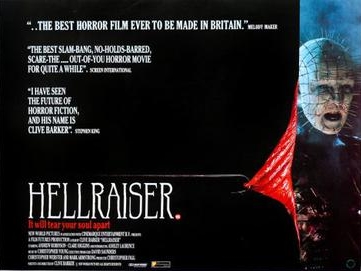
Hellraiser is a 1987 British supernatural horror film written and directed by Clive Barker in his feature debut. Adapted from Barker’s 1986 novella The Hellbound Heart, it concerns a mystical puzzle box that summons the Cenobites—extra-dimensional sadomasochists who cannot tell pain from pleasure. It stars Andrew Robinson, Clare Higgins, Ashley Laurence, and Doug Bradley as the lead Cenobite later named Pinhead. Developed before the novella’s publication, shot in London in autumn 1986 with producer Christopher Figg and New World Pictures financing, it premiered at the Prince Charles Cinema on 10 September 1987, became a commercial hit (about $30 million worldwide on a roughly $1 million budget), and evolved from divided reviews into a horror classic. Nine sequels followed; Bradley played Pinhead in the first seven. A 2022 reboot, also titled Hellraiser, was executive-produced by Barker. For kink-literate viewers, the original remains the purest statement of Hellraiser as pain-pleasure cinema: the box as last hedonist upgrade, Cenobites as “explorers” not demons, and Frank Cotton’s regeneration as the ultimate betrayal of flesh and family.
Plot: Frank, Julia, Kirsty, and the Box
In Morocco, hedonist Frank Cotton buys a puzzle box said to open a realm of otherworldly pleasure. At home in a bare attic he solves it; hooked chains tear him apart. A black-robed figure resets the puzzle and the room. Later Frank’s brother Larry moves into the house with second wife Julia, hoping to rebuild their marriage—unaware Julia had an affair with Frank before marrying Larry. Larry cuts his hand moving furniture; blood on the attic floor resurrects Frank in ghoulish form. Still obsessed, Julia agrees to restore his body so they can flee together. She picks up men in bars, mortally wounds them in the attic, and Frank drains their lives to regenerate.
Frank explains: having exhausted ordinary sensation, he sought the box for new carnal extremes. Solving it brought Cenobites who subjected him to extreme sadomasochism. Larry’s teenage daughter Kirsty (Frank’s niece) sees Julia bring a man home, finds Frank in the attic, escapes with the box, and collapses. In hospital she solves the box out of curiosity and summons Cenobites and the Engineer. Pinhead explains they have been called angels and demons but are explorers from another dimension seeking carnal experience; they no longer differentiate pain and pleasure. When they try to take Kirsty, she bargains: Frank escaped them. They will spare her if Frank confesses.
Home again, Kirsty finds Frank has killed Larry and wears his skin. Julia shows a flayed corpse she claims is Frank, then locks Kirsty in. Cenobites are not fooled. Frank reveals himself, is rejected sexually, tries to kill Kirsty to finish regenerating, accidentally stabs Julia, and drains her without remorse. Chasing Kirsty to the attic, he confesses killing her father within Cenobite hearing; hooks and chains tear him apart. When Cenobites double-cross Kirsty, she reverses the box and banishes them. She and boyfriend Steve escape the collapsing house. Kirsty throws the box on a pyre; a stalking vagrant retrieves it from the fire, becomes a winged skeletal creature, and flies away. The same merchant later offers the box to a new customer.
The erotic engine is unmistakable: Julia’s bar pickups as blood sacrifice, Frank’s skinless hunger, Pinhead’s lecture on pleasure and pain as one continuum. This is not a BDSM how-to; it is gothic SM horror about desire past the point of consent or return.
Cast
- Andrew Robinson as Larry Cotton
- Clare Higgins as Julia Cotton
- Ashley Laurence as Kirsty Cotton
- Sean Chapman as Frank Cotton
- Oliver Smith as Skinless Frank
- Doug Bradley as Lead Cenobite (Pinhead)
- Supporting Cenobites and roles including Steve, the Engineer creature, and the merchant/vagrant figures who bookend the box’s circulation
Production: First-Time Director, Sub-Million Budget
Dismayed by prior adaptations of his work, Barker—experienced as playwright and maker of two shorts—decided to direct. Figg told him a first-timer needed under a million dollars: a house, some monsters, little-known actors. The Hellbound Heart fit. New World funded about $900,000. Shooting at end of 1986 was planned for seven weeks and stretched nine to ten. Working titles included Sadomasochists from Beyond the Grave; Barker preferred Hellbound, Figg suggested Hellraiser.
Barker later recalled cast and crew kindness toward his “ineptitudes,” admitting he could not tell a 10mm lens from a 35mm. After filming, New World pushed a U.S. relocation, requiring overdubs to soften English accents. Bradley struggled to hit marks in makeup—black contacts blinded him—and feared tripping on Pinhead’s skirts. The Engineer creature was hard to maneuver. Simon Sayce built delicate wood-and-brass Lament Configuration props; he lay under Cenobites during takes in case a drop cost eight hours of rebuild. After principal photography, executives liked the footage enough to fund reshoots, including Frank’s final chain-ripping. Reverse motion built Frank’s resurrection flesh. Editors: Richard Marden and uncredited Tony Randel.
Censorship: X Rating, Thrusts, and Erotic Cuts
The MPAA originally gave an X; Barker cut hammer-murder closeups, replaced a naked victim murder with a semi-clothed version, shortened Kirsty’s hand in Frank’s guts, Frank’s dismemberment, and a head explosion. He told Samhain (July 1987) the erotic flashbacks were hotter and less violent than allowed—“they wanted to substitute one kind of undertow for another… take out the sodomy and put in the flick knife.” A spanking version of Frank and Julia’s seduction was rejected; the MPAA allegedly allowed two consecutive buttock thrusts, not three.
Soundtrack
Barker wanted Coil; New World refused. Tony Randel suggested Christopher Young (Elm Street 2, Invaders from Mars). The 1987 score mixed gothic orchestra and synthesizer; AllMusic praised it as proof Young still had horror ideas. Coil’s demo themes later appeared as The Unreleased Themes for Hellraiser.
Release, Bans, Re-Releases
Prince Charles Cinema premiere 10 September 1987; U.S./Canada release 18 September. Ontario initially banned it (3–2) for “brutal, graphic violence… degradation and torture,” then passed it after about 40 seconds of cuts (hooks, rats). Wide U.S. theatrical re-release 5–6 February 2025 with featurette Under the Skin: Doug Bradley on Hellraiser.
Home media: multiple Anchor Bay DVD editions (including THX 5.1 and tin with Hellbound); Anchor Bay Blu-ray 2009; Image “Midnight Madness” 2011; Arrow Films UK Scarlet Box (2015) with Hellbound and Hellraiser III, 2K restorations and documentaries, U.S. Scarlet Box December 2016; 30th-anniversary Composite Effects Hell Priest masks (30 units, March 2017) and SteelBook Blu-ray (30 October). Young’s score was remixed for anniversary screenings.
Box Office and Critical Response
About $14.56 million U.S./Canada, £763,412 UK, $30 million worldwide. UK critics were often ecstatic: Time Out “dazzling debut,” Daily Telegraph “fine degree of menace,” Melody Maker “best horror film ever made in Britain.” Kim Newman praised serious tone amid comic slashers, noted mid-Atlantic dub compromise and the Engineer as drive-in gross-out, still called it a return to cutting-edge horror. U.S. reaction mixed: New York Times disliked the cast; Washington Post found it dark and occasionally terrifying but weak at the climax; Roger Ebert gave half a star—“without wit, style or reason.” Variety called it well made and well acted with skillful effects.
Rotten Tomatoes later: 70% of 53 reviews positive (average 6.5/10)—“fiendishly unique… disquieting—and sadistically smart—alternative to mindless gore.” Metacritic: 56/100. Time Out’s early-2010s horror poll placed it at #80.
Sequels and Remake Path
Nine sequels followed; Bradley’s Pinhead headlined the first seven. Barker has said he signed away story and character rights to the production company before release, not realizing how critical and financially successful the film would become. Remake plans were publicized from October 2007, when Alexandre Bustillo and Julien Maury were reported to direct with Barker producing and Marcus Dunstan and Patrick Melton writing. After Maury and Bustillo left, Todd Farmer and Patrick Lussier were attached for an early 2012 target; following Hellraiser: Revelations (2011)—rushed to secure continuing rights—Farmer and Lussier were no longer involved. By 2018, after the success of Halloween, Miramax confirmed interest in new Hellraiser installments. The project was green-lit in early 2019 with David Bruckner directing a Ben Collins and Luke Piotrowski script; it released on Hulu in October 2022. An HBO Hellraiser television series has also been reported in development.
Q magazine’s contemporary note still resonates for adult viewers: the film’s moral and emotional complexity—its ambition about desire, marriage betrayal, and sensation past the known body—was always at risk of being misread by audiences trained on jokier 1980s horror. Hellraiser’s lasting kink-cinema power is simple and severe: open the box for pleasures beyond the body you know, and the beings who answer will teach you that agony and ecstasy were never separate—only that you were too timid to stop pretending they were. Related paths include The Hellbound Heart, Hellbound’s Leviathan cosmology, Hell on Earth’s unbound Pinhead, and the 2022 reboot’s contractual “gifts” from Leviathan.