
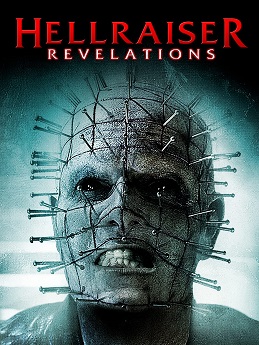
Hellraiser: Revelations came out in 2011. It is the ninth Hellraiser film, rushed out because the series rights were about to slip. Victor Garcia directed. Gary J. Tunnicliffe wrote it. Dimension Films had a practical problem: put out another Hellraiser soon, or risk losing the series. The project was announced in August 2010 and was supposed to be in the can by mid-September. The shoot was tiny and the budget was tiny. That rush is why Pinhead changed hands. Doug Bradley had played him in every previous film. Someone outside Dimension approached him privately. Dimension Films did not make the offer. Bradley stressed that he had no contact and no negotiation with anyone at Dimension. The ink on the script was barely dry. Cameras were two weeks out, wrap was set for mid-September 2010, and the budget was minuscule. He decided this was not a serious attempt to revive the series, and he walked. Stephan Smith Collins played Pinhead instead. When images leaked, director Victor Garcia said they did not show how Pinhead would look in the finished film.
Mexico, the tape, and the box
The story follows two friends, Nico Bradley and Steven Craven. They leave home for Mexico, film themselves through days of partying, and vanish. Mexican authorities return their belongings to the parents, including a tape of their last moments and an ornate puzzle box. A year later the two families sit down to dinner. Steven’s sister Emma, who is also Nico’s girlfriend, insists on seeing the tape her mother has been rewatching in private. The flashback is the first extreme. In a bar restroom Nico kills an adult woman while having sex with her, then threatens to implicate Steven in the killing so Steven will keep going on this so-called vacation. A vagrant later gives Nico the puzzle box and pitches it as a new kind of sensual extreme, past ordinary hedonism.
Back on that same year-later night, Emma finds the box among Steven’s things and starts to work it. Steven appears, covered in blood. He warns that the Cenobites are coming. When Emma plays with the box again she feels intense sexual arousal. She tries to seduce Nico’s father, then kisses and caresses this “Steven,” until she sees chains and mutilated bodies. The same vagrant kills Nico’s father. “Steven” takes a shotgun, shoots his own father, and holds the rest of the household at gunpoint.
Stolen skin
Nico solves the box and opens a door to the Cenobites. They are extra-dimensional sadomasochists who no longer separate pain from pleasure, led by Pinhead. They torture and mutilate him. From inside their realm, during rough sex with an adult prostitute, Nico reaches Steven through the box and talks him into killing so Nico can get out of Hell. Nico comes back skinless and emaciated. Steven kills several more prostitutes and feeds Nico their blood until the flesh returns. The skin does not. When Steven finally refuses to continue, Nico kills him and puts on his skin.
Dying, the real Steven uses the box to contact the Cenobites. He wants revenge, and he becomes one of them. The “Steven” holding the families is Nico wearing Steven’s skin. He taunts them, tells them Steven’s father and Nico’s mother were having an affair, and demands that Emma solve the puzzle for him so the Cenobites will take her and let him go. Emma opens the portal and summons them, including Steven as a Cenobite. They kill Nico’s mother for speaking out of turn. Nico tries to trade his life for Emma’s. Pinhead says he admires the dark sexual desire in her, refuses the bargain, and takes Nico back for further experiments. As Nico is taken, Emma’s father shoots and kills him, a last act of revenge. Short one victim, the Cenobites take Emma’s mother instead. Her father apologizes and dies in her arms. Emma is left alone, reaching for the puzzle box.
Adults, and not a how-to
The sexual beats are between adults. Murder is staged as foreplay, the box as a sensual upgrade, the stolen skin as identity theft. Pinhead appraises Emma’s darkness and still will not honor a bad trade. That is a beat for adult viewers who already know BDSM and fetish. It is not an ethical BDSM manual. It is a horror film about pain and pleasure run together. Clive Barker said on Twitter that the movie using the Hellraiser name was no child of his. The tenth film, Hellraiser: Judgment, was still written and directed by Tunnicliffe, with Paul T. Taylor as Pinhead.
One theater, then disc
On 18 March 2011 the film played a crew screening in a single California theater, nominally open to the public. DVD and Blu-ray followed on 18 October under the Dimension Extreme banner. On Rotten Tomatoes, five reviews sit at 0% positive, average 2.5/10. Dread Central wrote that this one is bad enough to make every other sequel look good, and that it could be mistaken for a Hellraiser mockbuster from The Asylum. Other reviews mocked the pseudo-Pinhead as an Austin Powers Mini-Me who mostly strokes bloodied chains and pulls sinister faces. Scott Weinberg called it contractually mandated garbage, made out of greed, dancing on the grave of a real genre classic. Richard Scheib at Moria gave it two and a half out of five: the effects and the new Pinhead leave a lot to be desired, but the story is interesting, the twist works, and it follows the original more closely than any other Hellraiser sequel. Dimension Films shot it in Los Angeles over three weeks. ARC Entertainment put out the DVD and Blu-ray on 18 October 2011 under Dimension Extreme. Barker’s tweet, in his wording, was that he wanted it on record: the flick out there using the word Hellraiser is no fuckin’ child of his.