
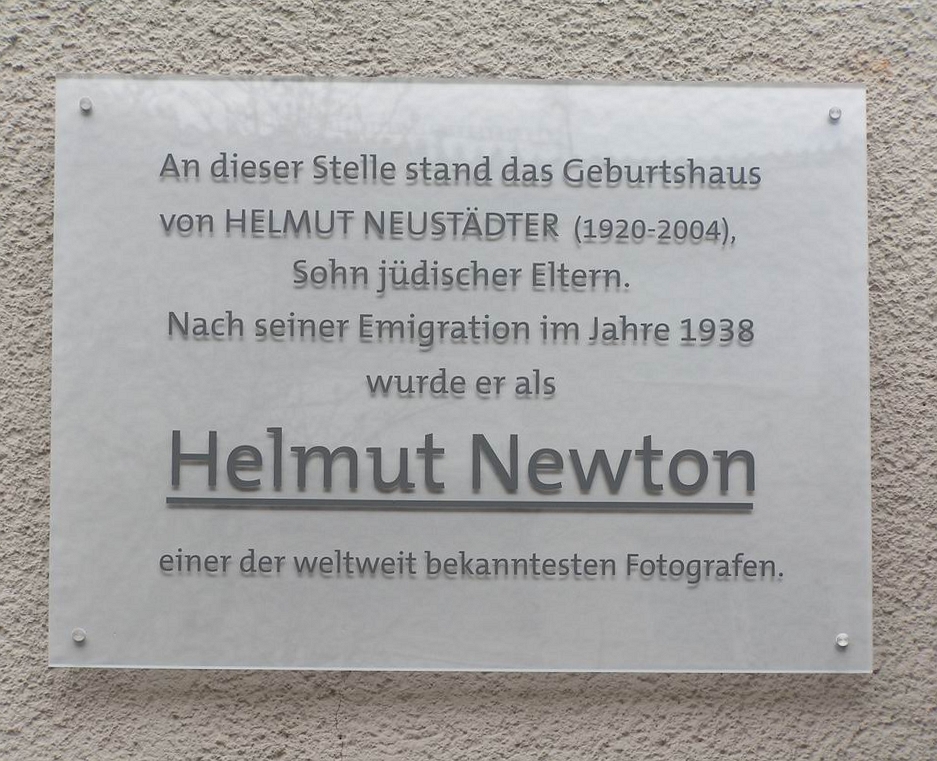
Helmut Newton, born Helmut Neustädter, was a German-Australian photographer, born 31 October 1920 and dead on 23 January 2004. His black-and-white pictures were provocative and erotic, and they held space in Vogue and other fashion magazines for years. The New York Times called him a prolific fashion photographer who was widely imitated. Across decades the work set a cold, glamorous erotic look. For people who watch BDSM and fetish, the dominant women, the sado-masochistic hints, the high heels, and the high-gloss objectification in his frames are a hard, direct bridge between couture and kink imagery. The photographs are not a rope manual. They are full of power played as a contest.
Newton was born into a Jewish family in Berlin. His father, Max Neustädter, owned a button factory. He went to the American School in Berlin, and he had his first camera at twelve. In 1936 he began working for the photographer Yva. As German policy against Jews tightened, his father lost control of the factory. After Kristallnacht in 1938, Newton was briefly held in a concentration camp, and the family got out. His parents fled to Argentina. On 5 December 1938, just after he turned eighteen, Newton left Germany, boarded the Conte Rosso at Trieste, and was bound for China. In Singapore he was able to stay because of the situation there. He photographed for the Straits Times, then worked as a portrait photographer. British authorities interned him, and he reached Sydney on the Queen Mary on 27 September 1940. He was sent to the camp at Tatura. Released in 1942, he picked fruit in Northern Victoria, and that August he joined the Australian Army as a truck driver. In 1945 he became a British subject. In 1946 he took the surname Newton. In 1948 he married the actress June Browne, later known as a photographer under the name Alice Springs. In 1946 he opened a studio in Melbourne and, in the postwar years, shot fashion, theatre, and industrial work. In 1953 he and Wolfgang Sievers, another refugee from Germany, showed New Visions in Photography. It was probably the first presentation of New Objectivity photography in Australia. He then partnered with Henry Talbot, who had also been interned at Tatura. The partnership continued even after Newton left for London in 1957.
As the name grew, Newton shot fashion for Australian Vogue in 1956. The next year he took a one-year contract with British Vogue and went to London. He left for Paris before the contract was up and worked for French and German magazines. In 1959 he was back in Melbourne under a contract with Australian Vogue. In 1961 the Newtons settled in Paris. The pictures kept appearing in French Vogue and in Harper’s Bazaar. The signature was erotic and carefully posed, often with a sado-masochistic and fetish undertone: power poses, a cold sheen, bodies shaped like weapons or furniture. A heart attack in 1970 cut his output. The profile that followed is sharper, especially the 1980 Big Nudes against an empty ground. Naked and Dressed, and Domestic Nudes in 1992, are treated as the peak of that erotic urban style. He also shot pictorials for Playboy, including Nastassja Kinski and Kristine DeBell. Original prints from DeBell’s August 1976 set, 200 Motels, or How I Spent My Summer Vacation, sold at Bonhams in 2002 for $21,075 and at Christie’s in December 2003 for $26,290.
From the 1970s he used Polaroid cameras heavily, so he could see composition and light at once, especially in fashion. By his own account, on the 1981 Naked and Dressed shoot the Polaroid film went by the crate. The prints were also his sketchbook, with scribbled notes on the model, the client, the place, and the date. Pola Woman, published in 1992, is made only of Polaroids. In 2011 the exhibition Helmut Newton Polaroids at the Museum für Fotografie in Berlin showed more than three hundred works from the original prints. In 2009 June Newton organized the tribute Three Boys from Pasadena, with work by Mark Arbeit, Just Loomis, and George Holz. The three were studying photography at the Art Center College of Design in Pasadena, California, when they met Helmut and June in 1980. They were friends, and they assisted him on shoots. The show set their pictures beside private snapshots, contact sheets, and letters, and it makes the studio June’s record as well as Newton’s stage.
In later life he lived between Monte Carlo and Los Angeles, and from 1957 he spent each winter at the Chateau Marmont. On 23 January 2004, driving from the hotel toward Sunset Boulevard, he had a severe heart attack. He died after he was taken to hospital. His ashes are at the Städtischer Friedhof III in Berlin. Schöneberg still has a memorial to him. The Helmut Newton Foundation keeps the way of looking he made: fashion treated as a power game, erotic photography that does not pretend desire is polite.
Books published while he was alive include White Women (1976), Sleepless Nights (1978), and Big Nudes (1981), among others. After his death, June Newton edited A Gun for Hire (2005), along with further volumes. Critics keep returning to two claims. Fashion photography can show sex directly, rather than stopping at softcore. Power, cruelty, and glamour can occupy the same frame. The argument has not closed. Some people say he opened a space for women’s dominance. Others say he froze women as cold objects. For a BDSM audience, the refugee years, the Melbourne studio, the Paris fashion position, and the Polaroid sketchbooks make the S&M element read as a style he chose. That visual language is still in how magazines, advertising, and fetish photography handle a high heel, a stare, and a body that looks ready to give an order or to take one.

![[Art Video] 2041 Finale Wild Dance Kana Sakaguchi](https://bdsmwild.com/wp-content/uploads/2026/08/Art-Video-2041.jpg)
![[Art Video] 2117 Pet Beast Woman 3 Chinatsu Nakano ADV-0129](https://bdsmwild.com/wp-content/uploads/2026/08/Art-Video-2117-ADV-0129.jpg)