Hannah Cullwick (26 May 1833 – 9 July 1909) was a working-class English domestic servant whose diaries, letters, and photographs document an extraordinary lifelong relationship with barrister and working-women observer Arthur Munby. Their private theater mixed Master/slave language, dirt and service fetish, cross-dressing across class and race, a leather “slave band,” and—eventually—a reluctant marriage in which she kept her birth name, refused children, and still drew a housekeeper’s wage. For BDSM and power-exchange history, Cullwick is not a modern scene label; she is a Victorian archive of service, devotion, and fetish ritual written in her own hand, with enough autonomy to refuse Munby’s terms when they violated the deal.
Early Life and Family
Cullwick was born and raised in Shifnal, Shropshire. Her father, Charles Fox Cullwick (1803–1847), was a Master Saddler of Shifnal and a Burgess of Bridgnorth in a family of saddlers dating to Richard Cullwick’s Newport business around 1670. Her mother, Martha Owen (1800–1847), had been lady’s maid to the aristocratic Mrs Eyton. There were more than a dozen aunts and uncles and over fifty first cousins—mostly literate farmers, publicans, and saddlers. Charles suffered business losses; the household became very poor. Five children: Hannah, James (1830–1915, master wheelwright, later a house owner), Dick (1836–1887, master saddler/harness maker in London), Ellen (1839–1915, married William Cook, Registrar for Poplar), and Polly (1844–1924, large haberdashery in Ipswich Buttermarket).
Schooling was rudimentary. Hannah attended Bluecoat Charity school in Shifnal and contributed money from age eight—first in the home of solicitor’s wife Mrs Andrew Phillips, then at the Red Lion Inn, then as sole nursemaid to the large family of Reverend Robert Eyton at Ryton Rectory. At fourteen both parents died suddenly: Martha of infection at 47; Charles two weeks later at 44. Eyton refused to let Hannah travel home for fear fever would reach Ryton. The younger children were dispersed to uncles and aunts. At seventeen she was under-housemaid for Lady Boughey at Aqualate Hall, Forton, Staffordshire—dismissed after eight months when her mistress saw her “playing as we was cleaning our kettles.” She then served Lady Louisa Cotes at Woodcote Hall, Sheriffhales, and during the London seasons of 1852–1854 went to the capital as kitchen maid—the city where Munby would find her.
Occupations and Invisible Victorian Labor
Cullwick’s working life spanned pot girl, nursery maid, kitchen maid, and maid-of-all-work in both rural manorial houses and urban elite dwellings—straddling old gentry service and industrial-era domestic labor. Victorian middle-class ideology demanded that “respectable” women display leisure while concealing household work; only a thin elite layer could staff homes enough to make that fiction real. Servants were expected to do the dirtiest labor early or late, out of sight, and to present clean white sleeves and aprons that erased evidence of toil. Cullwick’s diaries invert that ethic: she lists boots cleaned by the hundred, sometimes by licking them, and once told Munby she could taste where her “Massa” had been from his boots. Christian belief framed hard labor as spiritual capital toward heaven even when society refused to value domestic drudgery. Pride in dirt and service is the political and erotic hinge of her self-portrait.
Meeting Munby and the Master/Slave Frame
In London, Cullwick met Arthur Munby on one of his urban expeditions studying working women. He was struck by her size and strength—about 5 ft 7½ in (171.5 cm) and 161 lb (73 kg)—and by the nobility he projected onto working women’s labor. She saw an idealized gentleman who celebrated the intensity of maid-of-all-work toil. To stay near him she worked in middle-class London households: upholsterer, beer merchant, lodging houses (more freedom from supervision), a widow with several daughters. Before Munby, her first theater visit had been a lavish musical of Byron’s The Death of Sardanapalus—a pacifist king and his slave-girl Myrrha, whom Cullwick strongly empathized with. That story of beloved slave and sovereign became a private script.
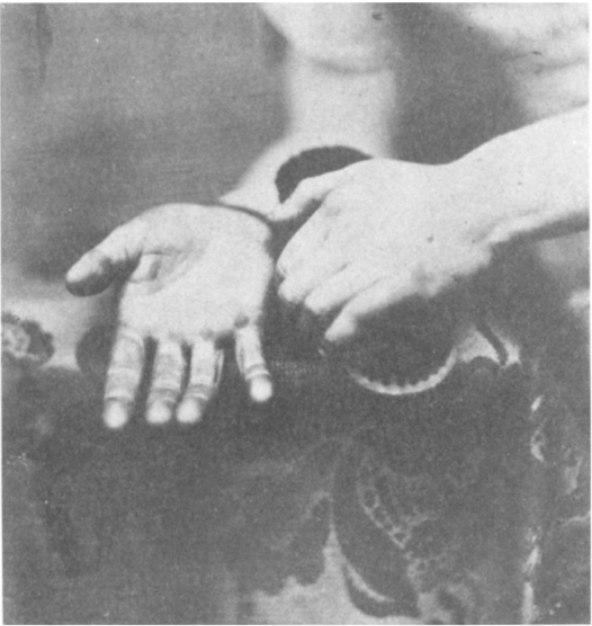
She proudly called herself Munby’s “drudge and slave” and called him “Massa” in an explicit Master/slave register. For much of her life she wore a leather strap on her right wrist and a locking chain around her neck for which Munby held a key. She wrote him almost daily letters detailing long work hours and arranged to visit “in [her] dirt,” displaying a full day’s cleaning as erotic and moral spectacle. They married reluctantly in January 1873 at Clerkenwell Parish Church by Special License from Archbishop Archibald Campbell Tait. She kept the surname Cullwick. They had no children—she never wanted any. Marriage did not erase the service contract; it complicated it.
Dirt Fetish, Slave Band, and Refusal
In Victorian visual codes, dirt marked the working class and was forbidden on “respectable” women’s hands and clothes. Cullwick wore her labor openly. After injuring a wrist at domestic work she began a leather strap; when the wrist healed she kept the band as a sign of devotion to Munby—her “slave band.” When an employer ordered it off for dinner service, she refused: it was “the sign that I’m a drudge & belong to Massa.” She was dismissed. In photographs Munby took for their mutual enjoyment, the band remains visible even in upper-class lady cross-dress—she would not fully erase work identity for his costume fantasy. Anne McClintock and other critics read the band against Britain’s shift from slave-market empire to wage market: a visible “slave” sign in a bourgeois dining room dragged imperial labor history into the parlor. For modern kink readers, the band is also recognizable hardware of belonging—worn against employer and sometimes against Munby’s own wish to complete a lady transformation.
Cross-Dressing: Class, Race, Empire, and SM Theater
Cullwick and Munby’s fetish practices staged power relations of empire: adult over baby, master over servant, White man over Black slave, urban over rural. Photographs of Cullwick in Blackface as a male slave, or costumed as a farmworker, do not merely “play dress-up”; they reenact categories the British Empire naturalized. Scholars emphasize the paradox: their SM theater both obeys power conventions and, through exaggerated costume, script, and scene, reveals those conventions as invented. Cullwick’s ability to move among identities suggested that race, class, and gender boundaries were more fluid than Victorian ideology admitted—an insight modern readers can hold without romanticizing the racial imagery itself. The photographs are historical SM documents and imperial documents at once.
Agency, Diaries, and Domestic Power Reversals
Literacy itself was power: most women of her class left no comparable archive. Cullwick’s diaries have sometimes been read by biographers as pure submission to Munby; her own pages show boundary enforcement. She stood up when she believed the relationship’s terms were broken. Marriage was accepted only hesitantly—wifehood looked like dependency and boredom. She never surrendered her birth name. She remained childless by choice and kept her time for work rather than childcare. After marriage she lived at his lodgings in Fig Tree Court, Inner Temple, as both wife and servant. Munby paid her a housekeeper’s salary for the rest of her life—including a decade of separation after a major altercation in late October 1877. For about nine years she seldom saw him, living with friends and relatives in Shifnal, Wombridge, Brewood, Wolverhampton, and Bearley near Stratford-upon-Avon (caring for her niece’s husband’s grandmother Mrs Hannah Gibbs). From 1887 they rented a cottage in Hadley, Shropshire, and spent time together regularly. In 1903 they moved to Wyke Place, Shifnal—meters from her birth house.
She also directed aspects of their ritual. Munby’s diaries under-report practices Cullwick recorded: bathing him, rocking him, nursing him like a baby—service flipped into maternal dominance and age-play. The archive is not one-way ownership; it is negotiated theater inside extreme class inequality, with Cullwick’s pen often more candid than Munby’s.
Death, Legacy, and the Closed Boxes
Cullwick worked until shortly before death on 9 July 1909, age 76 (“failure of heart action and senile decay”). She was buried at St Andrew’s, Shifnal; the stone names her “for 36 years of pure and unbroken love the wedded wife of Arthur Munby of Clifton Holme in the Wapentake of Bulmer.” Munby died the following January, age 81, estate about £26,000. He left books and two deed-boxes of correspondence, diaries, and photographs to the British Museum; when that failed, the material went to Trinity College, Cambridge, sealed until 1950. Selections of her diaries appeared as The Diaries of Hannah Cullwick, Victorian Maidservant (ed. Liz Stanley)—a controversial edition not approved by Cullwick’s family. The pages remain a primary source on sixteen-hour servant days, middle-class Victorian morality held alongside sexual “deviancy,” and female service labor written without shame. In 2003, Kim Wood’s short film On My Knees (Melora Creager of Rasputina) drew on the diaries. A full biography by distant relative John Cullwick, Our Hannah (2022), added early-life detail and context for the 1877–1887 separation and their last twenty years in Shropshire. Related reading includes Diane Atkinson’s Love and Dirt, Barry Reay’s Watching Hannah, and Anne McClintock’s Imperial Leather.
For adult power-exchange readers, Cullwick’s usable legacy is concrete: a Victorian woman who eroticized dirt and service, wore locking collar and wrist strap under the name Massa, kept diaries that assert pride and limits, married without surrendering name or wages, and left an archive that later leather and M/s cultures can study without pretending her world was modern SSC/RACK consent culture. She is biography first—and fetish history because she insisted her labor and her belonging were worth writing down.
What the Diaries Record as Fetish Practice
Beyond the headline slave band and Massa vocabulary, Cullwick’s writing treats service itself as eroticized labor. She catalogs boots cleaned—monthly and yearly totals in the hundreds—and the boot-licking detail is not a modern fanfic insert; it is her own boast to Munby about tasting where he had walked. Visits “in her dirt” staged sweat, ash, and grime as offerings rather than shame. The locking neck chain with Munby’s key is hardware modern collar protocol would recognize, even though Victorian law and employment made the power baseline radically unequal. Historians still argue over how much of the script was Munby’s projection and how much was Cullwick’s authorship; her pages of bathing him, rocking him, and nursing him like a baby show she could flip the polarity when the scene called for it. That reversibility matters: the relationship was not a simple one-way ownership fantasy, even when language said “drudge and slave.”
McClintock’s imperial reading remains useful without turning Cullwick into a pure allegory. Blackface slave photos, farmworker dress, and lady drag are documents of how empire’s race and class hierarchies became bedroom costume. They also show Cullwick as an actor who could put the costumes on and take them off—while often refusing to remove the slave band that marked work identity. When biographers such as Derek Hudson flattened her into Munby’s instrument, they ignored the diary evidence of refusal, wage insistence, name retention, and childlessness by choice. Liz Stanley’s edition made selections available to a wide audience while sparking family and scholarly dispute over framing; John Cullwick’s 2022 biography recenters kinship archives and the long Shropshire last act. Diane Atkinson’s Love and Dirt and Barry Reay’s Watching Hannah supply complementary angles on marriage, body, and Victorian horror-fascination with working flesh.
Why BDSM History Still Needs Cullwick
Modern M/s and service-oriented submission did not invent dirt play, collar keys, or domestic service as erotic theater—Victorian private life already ran those scenes under different names and without community safety culture. Cullwick’s archive is valuable precisely because it is messy: pride and exploitation, love and inequality, ritual and employment contract, agency and constraint. She cleaned boots, wore steel and leather marks of belonging, kept the name Cullwick on a marriage license, cashed housekeeper wages from her husband, and wrote it all down in a voice that still startles readers who expect only silence from nineteenth-century maids. For this site’s readers, she is a primary-source ancestor of service fetish and Master/slave role language—not a how-to, not a consent model, but a life that refuses to be reduced to either pure victim or pure proto-dominatrix. The boxes at Trinity opened in 1950; the arguments about what she meant by Massa are still open.


![【Exclusive】[隷嬢寫眞館] わずかひとときの恍惚 彩木美奈](https://bdsmwild.com/wp-content/uploads/2025/01/03006-slavebondage-bdsmwild-【Exclusive】隷嬢寫眞館-わずかひとときの恍惚-彩木美奈.webp)