
In the 1992 industrial-rock scene, Nine Inch Nails’ “Happiness in Slavery” is one of the tracks people still point at. It is on the EP Broken, released that year, and it came out as a promotional single in November 1992. The title and the refrain come from Jean Paulhan’s preface to Pauline Réage’s 1954 erotic classic Story of O. Réage’s novel fixed a picture of negotiated erotic slavery in modern literary imagination. Nine Inch Nails turned that literary claim into industrial pop with a hard edge. On the U.S. Billboard Modern Rock Tracks chart the song reached number 13, and literary SM language went into regular alternative-radio rotation.
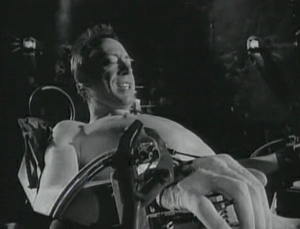
The music video has its own place in BDSM media history. Jon Reiss directed it. The text draws on The Torture Garden, the 1899 novel by the French writer Octave Mirbeau. The lead is the masochistic performance artist Bob Flanagan, an adult living with cystic fibrosis who joined that illness to extreme SM and treated real pain as art. In the video Flanagan enters a huge room, sets a flower and a candle on an altar, strips, washes, and lies on a machine that straps him in. Robotic claws tear his skin and pierce his hands. He answers with pleasure. Drills go into him. Blood drips onto a garden fertilized with human blood. Grinders step the injury up. In a scream that mixes pain and pleasure the machine disembowels him, kills him, swallows the body in a metal cask, and minces it into fertilizer. The body horror and the torture-garden fantasy, set against Flanagan’s actual illness, give the clip a documentary weight an actor faking it could not get.
The video loops back on itself. At the start Trent Reznor sings from a cell. At the end he walks into the same room, begins the same ritual, and the picture fades as he lights a candle. Reznor said it was not pure shock. It was, in his words, the most appropriate visuals for the song, tied to the artistic freedom he had after his fallout with TVT Records. Industrial noise plus Flanagan’s performance pushed masochistic ecstasy and mechanical domination to the edge of music television. On release the clip was almost universally banned. It later showed up on the Closure video album and in the Broken film, and MuchMusic played it on Too Much 4 Much, the showcase for videos that could not enter regular rotation.
The track traveled past alternative rock. In 1997 the Canadian extreme metal band Strapping Young Lad sampled “Happiness in Slavery” for “Centipede” on the live album No Sleep ’till Bedtime. That pickup kept the riff and the slavery theme moving outside a pure Nine Inch Nails audience. On the promo discs, the U.S. CD PRCD 4795 is the LP version at 5:26. PRCD 4827 adds a Flaccid edit at 4:17. A U.S. promotional 12-inch lists a Fixed version (6:09), the Sherwood Slave Mix (2:17), the PK Slavery Remix (5:41), and a Broken version (5:21).
In 1994 Nine Inch Nails played the song at Woodstock ’94. That performance helped the band win the Grammy for Best Metal Performance in 1996. For listeners who know BDSM, “Happiness in Slavery” takes Réage and Paulhan’s erotic claim — slavery as fulfillment — and sets it against industrial rage and a machine that eats the masochist. Happiness, in the song, is what complete submission is supposed to feel like in front of that machine. The clip remains one of the most extreme SM films of the 1990s that still sat next to the mainstream, and collectors still treat it as a piece you do not skip.
![[Art Video] 2117 Pet Beast Woman 3 Chinatsu Nakano ADV-0129](https://bdsmwild.com/wp-content/uploads/2026/08/Art-Video-2117-ADV-0129.jpg)