
On 12 June 1990 Madonna released “Hanky Panky” on Sire Records. The single comes from I’m Breathless, the soundtrack album for the film Dick Tracy. It is a loud mark in pop history, and it is also one of the tracks that carried BDSM — bondage and discipline, dominance and submission, sadism and masochism — into mainstream view. It was the album’s second and final single, written and produced by Madonna with her longtime collaborator Patrick Leonard. The song takes off from Breathless Mahoney’s line about not knowing whether to hit or to kiss, and it put erotic spanking into the top ten on the radio: a half-joking jazz-and-swing number offered up to “a good spanking.”
The track is built as a trick on the ear. A false intro starts as a slow piano solo and promises ballad intimacy, then breaks into fast, large-scale jazz swing. The sheet music is common time, about 170 beats per minute, in D minor, with a chorus that lifts from minor toward major, and a vocal range from B♭3 to D5. After a moment of expecting a ballad, the listener is inside 170 BPM and a lyric full of double meanings. Moving bass and big-band brass make a sound that is period and still aggressive.
Humor or violence
The argument around “Hanky Panky” starts in the lyric’s open praise of pain play. The lines are direct: “Nothing like a good spanky,” and “Ooh, my bottom hurts just thinking about it.” That plainness was rare on mainstream radio. For people who like BDSM it reads as a celebration of sadomasochism. For some conservative critics it was an “S&M lite” song.
Ireland was where the fight got sharp. The National Women’s Council of Ireland accused the song of glorifying violence against women and called it “highly dangerous.” Women’s Aid called the line “I’ll settle for the back of your hand” “extremely harmful.” That criticism hit at the same time as Madonna’s admission, on the Arsenio Hall show, that she liked spanking, and the two together produced the damage-control phase. Under the pressure she later said the person who liked spanking was the character Breathless Mahoney, not the star, and she added that her public image leaned dominant, a top, rather than submissive, a bottom. Disney, the studio behind the film, also made her soften some of the more suggestive lines for the sake of the brand.
Reviews and the charts
The fight did not stop most critics from liking it. Robert Christgau picked it among the album’s best and called it stylish S&M lite. Billboard’s Bill Coleman heard “steamy and suggestive jumpin’ jive.” People called it a “paean to kink.” Medium’s LaBeau thought it stopped at novelty, and Jude Rogers of The Guardian later ranked it as a low point for Madonna, but most of the commentary still treated it as a comic hymn. Pandora Boxx and other kink-media voices have called it underrated, a record that never got bigger because it annoyed too many conservatives.
Commercially it landed. It entered the Billboard Hot 100 at number 40 on 30 June 1990 and peaked at number 10 on 28 July 1990, Madonna’s 20th U.S. top-ten single and a record for a female artist at the time. The RIAA certified it gold, 500,000 shipments. In the UK it peaked at number 2 and took a BPI silver certification. It hit number 1 in Finland. Australia and New Zealand put it in the top ten. Austria and other countries put it in the top twenty. The sales say mainstream listeners took the swing arrangement and also heard that the BDSM in the lyric was not nonsense syllables.
On stage, and what came next
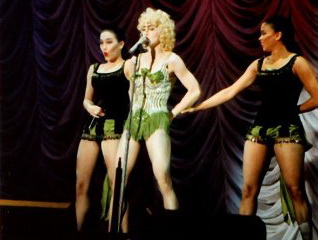
Live, the song got a harder performance frame. On the 1990 Blond Ambition World Tour Madonna wore a green-and-white striped vaudeville corset, sang it like a nightclub singer, and closed with the joke: “You all know the pleasures of a good spanking… When I hurt people, I feel better.” That staging sits closer to her brand as the dominant one. On the 2004 Re-Invention World Tour she brought it back as a circus showgirl, black hot pants and red heels. Sean Piccoli called it vampy Bette Midler humor. In March 2016 it returned as a one-off at the final Rebel Heart show in Sydney.
“Hanky Panky” sits early in the stretch where Madonna was moving eroticism and SM into the mainstream. Later the same year, “Justify My Love” pushed softcore queer and SM imagery further into public view and ran into a video ban. “Human Nature,” in 1995, is still on that line. “Hanky Panky” used vaudeville bluntness and sent sadomasochism in as humor rather than as a threat. For BDSM readers it belongs with “Human Nature” and “Justify My Love” as one of the pipes that carried SM onto the 1990s charts. Fetish can show up in pop as camp.
![[Fuji Kikaku] W-02 Bandage Bondage White Flesh Doll Asako Mochizuki Eiko Nishimiya -Chimu Nuruki- (Bandage Bondage White Flesh Doll) fuji-0017 [Exclusive]](https://bdsmwild.com/wp-content/uploads/2026/09/W-02-fuji-0017-Exclusive.jpg)