
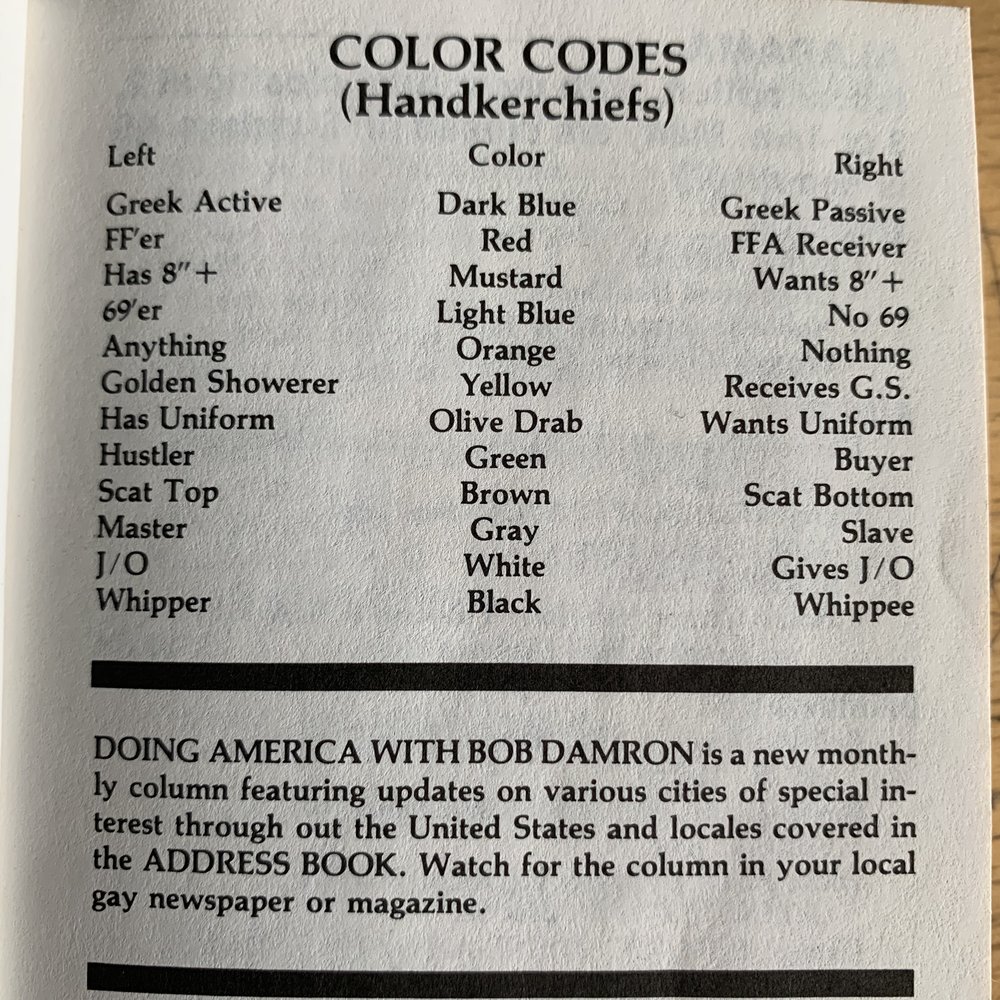
The handkerchief code, also called the hanky code, bandana code, or flagging, is a visual language that uses color to advertise sexual interests and fetishes without speaking. The color of a cloth handkerchief or bandana names the act. Where it is worn names the role. Left pocket usually means top, the active or dominant side of that act. Right pocket means bottom, the passive or submissive side. A dark blue hanky signals interest in anal sex: left pocket if you prefer to penetrate, right pocket if you prefer to receive. The system settled in the 1970s among gay men, bisexual men, and BDSM practitioners in the United States, Canada, Australia, and Europe who wanted casual sex or scene partners.
Colored bandanas were ordinary neckwear among cowboys, railroad engineers, and Western miners in the mid- and late nineteenth century. Stories about the sexual meaning do not agree. A popular one puts bandanas on men in San Francisco after the Gold Rush: with few women for square dances, blue marked the “male” dance part and red the “female,” worn on the arm, the belt, or the back pocket. By the 1970s the custom had become frank sexual advertising in the gay leather community. The “inventor” is disputed. A joke by a Village Voice journalist in New York, printed cards from San Francisco’s The Trading Post, and Alan Selby’s 1972 expansion of the colors after a supplier increased an order can all have fed the same boom.
Core colors and left/right
There is no single official standard. Larry Townsend’s The Leatherman’s Handbook II, the 1983 second edition, set down colors that a lot of people still treat as the core. The logic is left for top, right for bottom: left dominant and active, right submissive and passive. Online charts have swollen into dozens of niche shades, and many of the rare ones live as memes rather than street practice. The durable set most leather people still share is smaller. Dark blue is anal sex. Red is fisting. Black is SM. Gray is bondage. Yellow is watersports. Orange usually means anything goes, or anywhere. Townsend warned that a color is not an absolute contract. Someone may wear it only because the hanky itself turns them on. You still have to ask out loud.
From cloth to apps
A literal bandana in the back pocket is less common now. The color logic came back on harnesses, armbands, boots, and other fetish gear. The leather pride flag, created in 1989, marked a turn from secret signs toward visibility in public. Social media and dating apps digitized the signal again: people list kinks on a profile and skip the street harassment that public flagging could draw. The code did not vanish. It moved into icons, emoji, and checkboxes. Leather bars still teach new members the old left/right grammar.
On screen and on stage
The code left marks in pop culture. In the 1980 film Cruising, Al Pacino’s detective has the code explained by a hanky salesman. The same year, the Bijou Video porn film Erotic Hands uses a red handkerchief in the opening credits. In the early 1980s Judas Priest frontman Rob Halford folded hanky coding into his stage clothes; in the video for “Heading Out to the Highway” he wears red in the left pocket. Those appearances, along with further reading such as Trevor H. Jacques’s On the Safe Edge, are why the leather hanky is the best-documented body-semiotic system of its kind. For adults who have already agreed to play, flagging is an invitation and a filter, not a signed contract. Red on the left does not give anyone the right to fist a stranger. It means the interest can be negotiated.