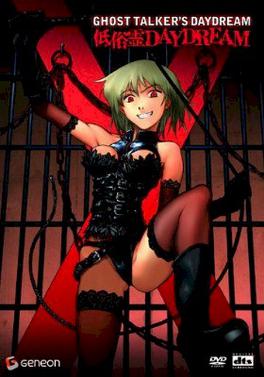
The Japanese title is 低俗霊DAYDREAM, Teizokurei Daydream. The English release title is Ghost Talker’s Daydream, which is not a literal translation. Saki Okuse wrote it and Sankichi Meguro drew it, set in present-day Japan. Ten volumes came out. In 2004 it was adapted as a four-episode OVA. For readers of adult-leaning manga, the hook is the heroine’s three jobs at once: professional dominatrix at a BDSM club, columnist for a porn magazine, and civil-servant necromancer whose government work is usually exorcism. The series treats SM labor, sexual trouble, and dealing with ghosts as equally “vulgar” daily work. The tone mixes erotic fan service, suicide culture, abuse trauma, and the idea that damage to the soul does not always stop at death.
Saiki Misaki and the rope familiar
Saiki Misaki is a virgin with albinism: pink eyes, white hair, and no pubic hair at all. That last fact embarrasses her, and it is also why she is in demand as a pro domme at the Myure Mule S&M club in Roppongi and as a contributor to the magazine Honey Chop. She can see ghosts and sometimes let them speak through her. She still considers the Livelihood Preservation Group post — exorcism as a civil-service job — tawdrier and less respectable than the sex work or the column. Her familiar, Kinue, is a demonic guardian whose body is a cord twisted from a braid of hair. She often wears him like a garment. He has to feed on humans in a way the story never really explains. For rope readers the image is hard to miss: a living bondage cord.
The people around her
Kadotake Souichirou is her partner and liaison inside the Livelihood Preservation Group. He is excitable, fascinated by her erotic work, and privately wants to be dominated. He is good at contacts and information. His judo is competent, not master-level. He is terrified of ghosts, which makes him an odd partner for a necromancer.
Fujiwara Mitsuru is a high-school student in the manga. After a relationship with a much older woman, he is wary of domination and still infatuated with Misaki, who treats him as a pest and a stalker. His father is a Shinto priest, and the two are somewhat estranged. Kunugi Ai is a middle-school student in the manga, a novice necromancer who looks up to Misaki, friendly and unusually brave. Her sister died by suicide; Misaki helped her look into that death, which also involved the unintentional death of Ai’s niece. Those two are fictional characters who are minors in the story. This is a cast note, not a sexual scene about them.
Other recurring figures include Shizue Mikuriya, openly a lesbian, editor and model at Honey Chop; Saiki Shigeyuki, Misaki’s father and chief administrator of the Livelihood Preservation Group; Detective Gada, who has a relationship with the necromancer Isa Haru; and Yujima Hijiri, Mitsuru’s middle-aged lover, who killed herself and still haunts him.
What the comic is doing, and what the OVA keeps
Nudity and sex in the manga push motive and backstory. They are not padding. The series is interested in “carnal troubles of the soul”: abuse and sexual damage that death does not automatically erase. The rope familiar, the club scenes, and Souichirou’s wish to submit make power exchange a job, a kink, and a figure for who controls whom among the living and the dead. Of the four OVA episodes, two stay fairly close to the manga and the other two diverge sharply. The anime is a short sample of the tone, not a retelling of all ten volumes. English readers should know the pun in the Japanese title: rei is “ghost,” and rei can also mean a companion. Misaki is a vulgar companion dealing with vulgar ghosts.