
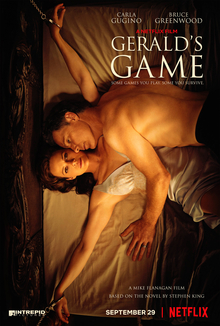
Gerald’s Game is a 2017 psychological horror film directed and edited by Mike Flanagan, adapted from Stephen King’s 1992 novel, long treated as unfilmable. Carla Gugino and Bruce Greenwood play a married couple whose lake-house trip turns into a handcuff nightmare when the husband dies of a heart attack mid-scene. For people who know BDSM, this is not an erotic lesson. It is a thriller about consent collapsing. Agreed play and a partner who will not stop are not the same thing. Once he is dead, the metal is no longer a bedroom prop. It is hardware she cannot open.
Fairhope, a rape fantasy, and a heart attack
Jessie Burlingame and Gerald Burlingame are at a remote lake house in Fairhope, Alabama. She wants to pull the marriage back together. She changes into a new slip. He has taken Viagra. He handcuffs her to the bedposts to act out a rape fantasy. She tells him to stop. They argue. He does not stop. Then he dies of a sudden heart attack. The key is out of her reach. Hours pass, and then it is night. This is not negotiated CNC, consensual non-consent. She said stop. He ignored it. After he dies, the cuffs are still on her.
The dog, the hallucination, and getting a hand free
While she waits, a hungry stray dog starts eating Gerald’s corpse. She also splits inside her own head. A hallucination of Gerald taunts her about the marriage and about his erectile dysfunction, and he calls her Mouse, her father’s nickname. That opens a memory of a solar eclipse in her childhood. Another, more self-assured version of Jessie, also in her head, says things she had never admitted. To get out, she breaks a water glass, cuts her wrist, uses her own blood to lubricate the cuff, and degloves the hand so she can pull it free. That is what the film shows. It is not something to copy. She unlocks the other cuff, bandages the wrist with sanitary pads, and passes out. In the dark she puts her wedding ring into the bag of a figure called the Moonlight Man, drives away, crashes, and is rescued.
The eclipse memory and the courtroom
The film ties the cuffs to Jessie’s childhood. During that eclipse, when she was twelve, her father sexually abused her and made her pretend it had not happened. The film treats this as trauma, not as a sex scene, and this article is not going to spell the assault out. The coercion in the marriage is that same pattern continued. It is not “hot CNC.” At the end, Raymond Andrew Joubert is caught: a necrophiliac grave robber and serial killer with acromegaly. He mutilated Gerald’s body for trophies and left Jessie alive. In court he breaks his handcuffs and mocks her — she is made only of moonlight. She answers that he is much smaller than she remembers. The bedroom captivity has become a face-off between a predator and the person who survived him.
How it was made, and how it was received
Deadline Hollywood reported the project in May 2014. Principal photography started in October 2016 in Mobile, Alabama. Netflix released the film on September 29, 2017. Reviews were strong. Rotten Tomatoes stood at 91 percent. Metacritic scored it 77 out of 100. The consensus was that Gugino carries this small-scale suspense with a career-high performance. Stephen King, after a rough cut, called it hypnotic, horrifying, and terrific. Flanagan uses a small cast and one main location. The novel’s interior argument becomes Jessie talking with the Gerald in her head. The eclipse runs from the childhood assault through the marriage and into the courtroom.
What cuff players are supposed to notice
The film’s point for anyone who uses handcuffs is practical. The gear only stays play if there is consent, a key, and someone watching the person in the cuffs. If the agreement that you can stop mid-scene is broken, the problem is survival, not a scene that went spicy. Jessie gets free by injuring herself. That is the horror plot. It is not a method.
![CN-166 Heisei Married Woman Underground Sex Path 5 Denki Akechi [Exclusive]](https://bdsmwild.com/wp-content/uploads/2026/09/CN-166-Exclusive.jpg)