
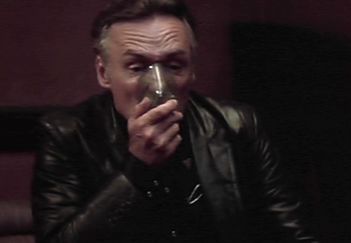
Frank Booth is the main antagonist of David Lynch’s 1986 psychological thriller Blue Velvet, played by Dennis Hopper. He is a violent drug dealer who kidnaps lounge singer Dorothy Vallens’s family and holds them hostage to force her into sexual slavery. Their encounters are ritualized abuse, not consensual BDSM: Booth huffs an unknown gas from a portable tank and flips between personas he calls “Baby” and “Daddy” while assaulting her. One associate, a detective nicknamed “The Yellow Man” for his yellow sport coat, helps Booth kill rival dealers and steal their drugs from the evidence room. Hopper’s performance became legendary; AFI ranked Frank No. 36 among the top 50 film villains of all time. For kink-aware viewers, Frank is a cinema study in sadistic pathology and gas-mask theater—not a lifestyle Dom to copy.
Character and Crimes
Frank is an over-the-top, foul-mouthed, psychopathic gangster, dealer, and pimp at the center of Lumberton, North Carolina’s criminal underworld. He is aggressively unhinged, sadistic, perverse, and animalistic, with a hair-trigger temper that flips into rage or violence without warning. The film implies extreme childhood trauma and an incestuous relationship with his mother; he seems to enjoy the monstrous traits he amplifies by inhaling the tank gas. When he is with Dorothy he splits: Daddy beats and demeans her (read as echo of paternal abuse); Baby ritualistically rapes her while begging her to gag him with a scrap of blue velvet (read as echo of maternal abuse and incest). Sexual arousal arrives as violent rage, turbocharged by the inhalant.
When Dorothy resists continuing the relationship, Booth cuts off her husband’s ear—later found by college student Jeffrey Beaumont. Jeffrey investigates, spies on Booth abusing Dorothy, and begins a sexual relationship with her. Following Booth, he learns about the Yellow Man. Booth catches Jeffrey and Dorothy together and forces them to the apartment of “Suave Ben,” who holds Dorothy’s husband and son. At Booth’s urging, Ben lip-syncs Roy Orbison’s “In Dreams,” reducing Booth to tears. Afterward Booth takes Jeffrey to a lumber yard, kisses him, and beats him. Later Booth murders Dorothy’s husband, beats her nearly to death, and leaves her naked on Jeffrey’s lawn. Jeffrey tracks Booth to Dorothy’s apartment, finds the husband’s corpse and the Yellow Man shot in the head, hides in a closet with a gun, and when Booth returns to finish the job and opens the closet, Jeffrey shoots him dead.
How to Read Frank on a BDSM Site
Frank’s scenes use props kink culture also knows—velvet cloth, gas mask, Daddy/Baby dirty talk, forced oral and physical domination—but the frame is abduction, rape, and murder. He is a film villain, not a negotiated power-exchange partner. Adult viewers who recognize the semiotic overlap (mask, fabric fetish, role names) should keep the boundary clear: Blue Velvet eroticizes horror and trauma for psychological thriller effect; it is not a how-to for sadomasochistic lifestyle. The charge of the character is precisely that he is monstrous and funny and terrifying at once—Première called him one of “the most monstrously funny creations in cinema history”—not that he models consent.
Cultural Impact and Sampling
Frank’s dialogue and his dense use of “fuck” are endlessly quoted and sampled. Pop Will Eat Itself’s “Pretty Pretty” lifts pieces of his rambling. “Don’t you fucking look at me!” made Première’s “100 Greatest Quotes in Cinema” and was sampled by Faultline on Closer, Colder. Pigface used a Booth line on the remix “Sick Asp Fuck.” Mr. Bungle’s self-titled album scatters Frank samples; “Squeeze Me Macaroni” takes “Man, where’s the fucking beer, man?” and “One thing I can’t fucking stand is warm beer, makes me fucking puke!” Ministry samples “Let’s hit the fucking road!” on “Jesus Built My Hotrod.” Acid Bath’s “Cassie Eats Cockroaches” uses several Booth samples. The cover of Pitchshifter’s Industrial shows Frank after the fatal headshot. Hosting Saturday Night Live, Hopper played Frank as host of a game show “What’s That Smell?,” opening with “Hello, neighbor.” In a 2011 Rolling Stone interview, Lynch, asked whether Frank or Marcellus Santos was more dangerous, answered he’d rather “hang with Frank Booth… chill with him, and wait for a booty call.”
Lists and Casting
Beyond AFI’s No. 36 villain rank, Première put Booth at No. 54 on its 100 Greatest Movie Characters list; Empire ranked him 67th Greatest Film Character. The part was offered to Willem Dafoe and Richard Bright, who passed; Michael Ironside has said Frank was written with him in mind. Hopper read the script, called Lynch, and said: “You have to let me play Frank! Because I am Frank!”
The Unnamed Gas
Throughout the film Frank uses a medical mask and tube to inhale a stimulant from an aerosol canister. Lynch’s script specified helium, to raise the voice and separate Daddy from Baby. Hopper, a veteran of real drug culture, argued helium was wrong for the character. Lynch later thanked him: the helium idea died so the gas would not play as comedy; in rehearsal Hopper claimed he knew what belonged in the canisters. On the 2002 special-edition DVD documentary, Hopper says the drug was amyl nitrite—an angina medicine used recreationally as a popper in disco and sex scenes. The mask-and-tank image remains one of cinema’s most iconic inhalant fetishes, often misremembered as pure helium camp even though production steered away from that gag.
For media literacy on a BDSM site, Frank Booth is a test case. Props overlap with kink (velvet, mask, Daddy/Baby talk, forced oral, physical domination). Consent does not. The film’s erotic charge is inseparable from terror; Dorothy’s captivity is the engine, not a negotiated scene with aftercare. Viewers who eroticize the aesthetic—gas mask, blue fabric, Hopper’s roar—still need the ethical firewall: fantasy cinema about a sadistic criminal is not an instruction manual for partners. That firewall is why this page frames Frank as film villain first and last.
Related topics: BDSM-coded villains in film, Blue Velvet, Dennis Hopper, cinematic sadism versus consensual SM, gas-mask and inhalant imagery in erotic horror, Roy Orbison’s “In Dreams” as Lynchian set piece, and AFI villain canons. Watch Frank as Lynchian nightmare and awards-caliber performance—not as a template for play partners. The correct takeaway for kink culture is semiotic, not practical: mainstream cinema knows our props and will use them to code evil unless we keep drawing the consent line ourselves.