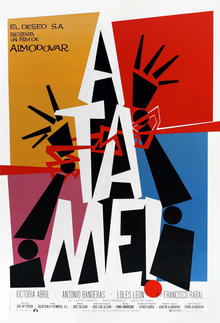
In 1989 Pedro Almodóvar released the black romantic comedy Tie Me Up! Tie Me Down! The Spanish title is ¡Átame!, “Tie Me Up!” The extra English clause, “Tie Me Down!,” points at a lasting relationship, not only a knot. In Spain it was the year’s biggest domestic hit. In the United States the release turned into a ratings fight. Viewers who like BDSM and fetish often file it as a bondage film. Almodóvar has kept denying that the ropes have any direct link to sadomasochism. He is telling a love story. The rope is still on the bed.
Ricky, played by Antonio Banderas, is twenty-three, just released from a psychiatric hospital, and alone. He has had an affair with the hospital’s female director. The future he wants is the actress Marina, played by Victoria Abril. She is a former porn actress, getting off drugs. During an escape from the asylum he spent a night with her. He does not treat that night as a fling. He treats it as a contract she has forgotten. He means to marry her and have children with her, so he kidnaps her and uses physical restraint to force the destiny.
Marina is shooting a Euro-horror picture, The Midnight Phantom, in which a masked muscleman loves her character. That lines up with the wheelchair-using director Máximo, played by Francisco Rabal, who wants her in private. Máximo is Marina’s mentor, not the other way around. He is secretly attracted to her and wants what may be his last time directing a female lead. The set is already a machine for looking at her. Ricky arrives as a second, unauthorized camera. In a wig he does a handstand to get her attention. She does not remember him and sends him away. On wrap night he forces his way into her apartment, headbutts her quiet, tapes her mouth, and ties her to the bed with rope. She wakes with a toothache that ordinary painkillers cannot touch, because she is addicted to stronger drugs. To get the pills he refuses the black-market price, attacks the dealer, and steals them. That rough care is the film’s version of Ricky doing romance.
Marina’s sister Lola, played by Loles León, follows a lead to the apartment. To keep the sister from finding them, Ricky moves Marina into the empty flat next door, using a spare key and the fact that the neighbor is away for the summer. The kidnapping runs on ordinary Madrid building logistics. When Ricky comes back cut and bloody from the dealer he attacked, Marina sees vulnerability and devotion, not only the headbutt. She cleans his wounds. That is where the love starts, in the film’s telling. The scene Spanish critics later called the heart comes when he is about to steal a car and take her to his hometown. She still thinks of herself as his prisoner, and she tells him to keep her tied so she will not run. The rope becomes something she asks for.
The director says the rope is not SM
Almodóvar has said there is no erotic charge in the knots and gags. On his account the film is about forcing love: Ricky builds a love story the way someone might study for a degree, by will and persistence. Read that way, the movie parodies heterosexual marriage as something close to inevitable Stockholm syndrome, and the rope stands for “a sweeter human bondage.” A BDSM reader does not have to take the director’s word as the last word. Marina’s request to stay tied is where the kink plot occupies the same frame as the kidnapping. The film sets the Beauty and the Beast myth, the confinement of The Collector, and the late-1950s romantic comedy in which the man will not take no, inside a grotesque comic shell. The persistence is rope.
Casting carried it. Victoria Abril replaced Almodóvar’s longtime muse Carmen Maura as the female lead. By the production’s own accounting, Maura at forty-four was too old for a role that wanted a younger woman. Abril is why Marina can be a porn-world survivor, an addict in withdrawal, a horror-film scream queen, and a woman who asks to be tied so she will not bolt, without the stack turning into a joke. Banderas plays the kidnapper with a child’s idea of a conventional marriage still inside the violence. The role pushed him toward Hollywood.
The X, the unrated release, and NC-17
In the United States the fight was the X rating. The MPAA fixed on a long sex scene, shots of urination, and especially Marina in a bathtub using a scuba-diver toy to get herself off. Distributor Miramax sued the MPAA and lost. The film went out unrated. After enough other filmmakers made the same complaint, the MPAA in September 1990 retired the X and created NC-17. Tie Me Up! Tie Me Down! later received NC-17 for strong adult sensuality and nudity. Almodóvar wanted the censors to see a parable of marriage. What the American ratings machine saw was the body: urine, masturbation, a woman tied to a bed.
In Spain the audience was more than a million. Critics were mostly kind and called it “a terrible tender love story.” Ennio Morricone wrote the score in thriller mode. Almodóvar used only about half of it. More of the storytelling is done by Dúo Dinámico’s “Resistiré” (“I will resist” / “I will prevail”) and by a bolero. At the end Marina, Lola, and Ricky drive off singing “Resistiré” together. The kidnap comedy ends as a road-movie family.
The film is now in the Criterion Collection. The director still denies the SM label. Viewers still see the restraint. The American ratings fight pushed the X into NC-17. In Spain it was the domestic hit of its year. For a BDSM audience there is no dungeon etiquette in the picture. Ricky does not use specialist bondage gear. He uses tape, handcuffs, and ordinary rope. There is no safeword. Marina later asks to be kept tied, and that ask comes after a headbutt. That is not what a dungeon means by consent.