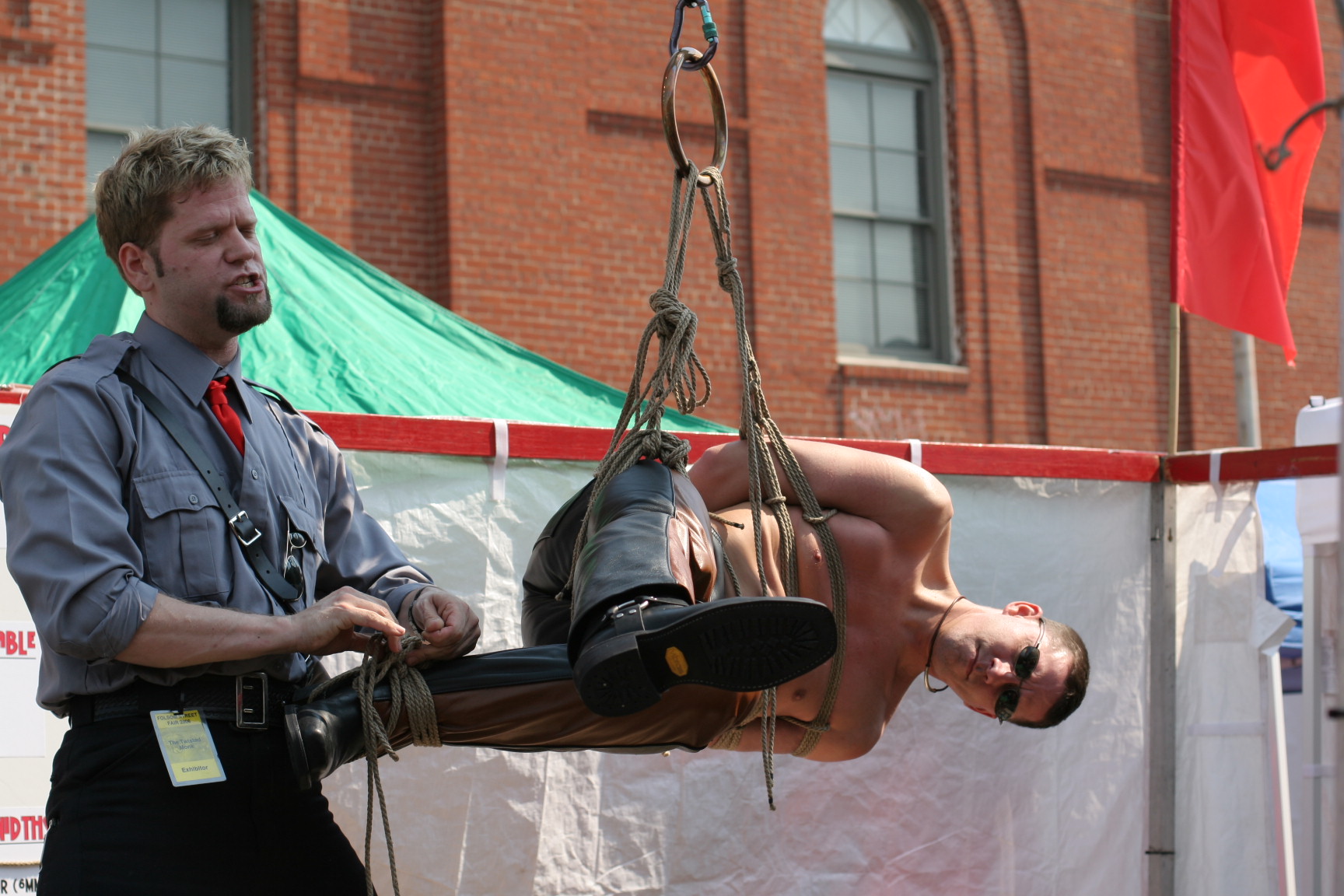
Suspension bondage is sexual bondage for consenting adults: a bound person hung from one or more overhead points. It is high-risk play, in the same seriousness bracket as heavy breath play, not a pair of cuffs on a bedpost. The point is to get the body off the floor. Once the person believes that fighting free could mean a fall and an injury, the rope has a mental lock on top of the physical one. In a large open room that hang increases vulnerability, objectification, and erotic helplessness, for the person in the air and for anyone watching. Conventions and fetish nightclubs use it as performance, private D/s turned into a public spectacle. This is a description of what the forms are and what they can do to a body. It is not a tying or hoisting tutorial.
Partial suspension means rope, cable, or chain carries some of the weight, not all of it. A classic partial has the bottom balanced on one foot, a chest harness taking part of the load, and the other leg pulled off to one side. Another partial: upper back on the ground, legs tied up to a point, lower back lifted off the floor. Full suspension means no floor contact at all. The whole body is on the hang. In full air there is no single correct orientation. Shape is limited by the bottom’s endurance and the rigger’s skill, and that uncertainty is part of the charge.
Vertical, horizontal, inverted
The three main orientations are vertical, horizontal, and inverted. Each one loads the body differently and reads differently to anyone watching.
Vertical suspension usually lifts from the wrists, with rope or purpose-made suspension cuffs. Rope alone on the soft tissue of a wrist can cause severe damage and cut circulation. A wrist-rope hang is only even discussable for a very short time, and it is still dangerous. Cuffs that spread the load around the wrist hurt less and mark less than bare rope. They are not a license to hang from the wrists for a long time. Metal cuffs or handcuffs are possible and extremely painful, and they mark deeply. The vertical approach that moves stress off those thin wrist joints is a rope harness around the upper arms, the upper thighs, and through the groin, with the hang points attached more like a parachute harness. Arms and legs can hang free. Without help, getting down is extremely difficult. The free limbs are part of the display: they can reach and they can move, and they cannot get the person to the floor.
Horizontal suspension holds the body roughly parallel to the ground. Lift can come from wrists, ankles, other load-bearing areas, or a mix. Ankles or wrists can be kept together or forced apart with a spreader bar. When the torso itself carries weight, a hogtie or a ball tie can be tied first and then lifted. A common variant locks the wrists to a spreader bar, or to a point between the ankles, so the hogtie becomes a suspension bow. Face down, the breasts may hang nearly straight down. Nipple clamps and weights add pain; clamps fixed to a point on the floor turn any struggle into immediate sensation and a limit on movement. Horizontal work is used for display, impact, genital access, and the floating-object feeling.
Inverted suspension is head-down, usually from the ankles, because ankles take load better than wrists. Boots let the rope run on an outer surface and spare the skin some burn and compression. Legs can stay together or be spread. Open legs increase genital exposure, and the erotic charge is strong. Blood rushes to the head, so the position is hard to hold for long. A head-first fall of only a few inches can kill or permanently paralyze. That is one of the most dangerous failure modes in rope bondage. Inverted work has to be negotiated for the physical risk and for the emotional intensity.
Falls, nerves, harness hang, and getting someone down
A bad hang can become a breathing emergency in the middle of a scene if the chest is compressed or the position steals air. The obvious danger, beyond ordinary bondage risks, is falling: a weak suspension point, failed equipment, or poor technique. The head-first inverted fall is the sharp case. Quieter injuries include nerve compression with long-term damage, circulation problems, fainting, and harness hang syndrome, recognized more recently and associated with hangs where the legs are below the heart and carry no standing weight, as in a standing hang.
If the person loses consciousness, or a winch or hoist jams, getting them down safely is hard. Experienced tops work with spotters who can help lower someone, plus shears and a rehearsed cutaway. Many well-known riggers suspend often and still refuse to publish full technique, because amateurs without anatomy and without progressive practice copy it and get hurt. Most of the writing is on the internet, and books exist. Neither replaces supervised training, redundant hardpoints rated for a dynamic human load, and partners who can lower a limp body before the scene ever leaves the ground. Hanging yourself can slide into autoerotic asphyxia. That path is extremely dangerous. It is not a solo hobby. Weak beams, bad cuffs, and an unsupervised first try cause real injuries. You cannot learn this from one article.
![[Art Video] 2167 Lewd Ass Climax Orgasm Prim Beautiful Woman Masochist Riri Kanai](https://bdsmwild.com/wp-content/uploads/2026/08/Art-Video-2167.jpg)
![[Fuji Kikaku] AS-03 Essence of Bondage 3 Is Suspension Hell or Paradise Shion Kasumi -Chimuo Nureki- (Essence of Bondage 3) fuji-0068 [Exclusive]](https://bdsmwild.com/wp-content/uploads/2026/08/AS-03-fuji-0068-Exclusive.jpg)