
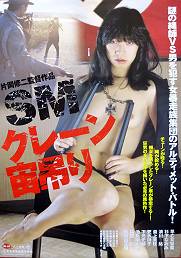
S&M Hunter is a 1986 Japanese comedy pink film directed by Shuji Kataoka for Kokuei. The Japanese title includes 地獄のローパー、緊縛・SM・18才. Jigoku no Rōpā means Hell Roper. The “18-sai” in that billing is title language. This is an adult pink film with adult performers. It is not sexual content about minors. Shintōhō Eiga released it theatrically. The plot is a genius nawashi whose specialty is tying women as a “taming” act, then taking a vigilante job against a sukeban gang. For people who watch kinbaku on screen, it is camp SM comedy, not solemn art-house rope. The charm is that bondage skill is played as an action-hero power.
The Hunter, played by Shiro Shimomoto, is billed as a super-genius rope artist who binds women in order to tame them. The all-female delinquent gang The Bombers kidnap a man and keep him as their personal sex slave. The captive’s boyfriend hires the Hunter for the rescue. Pink-film plot logic: the rope is erotic spectacle and it is also how the hero beats the gang. The tone is comic-book exaggeration. Rope is the superpower, and that inversion is what collectors remember.
The cast is period SM pink. Beside Shimomoto: Hiromi Saotome, from that generation of Japanese SM pink performance; Yutaka Ikejima as the Dungeon Master; plus Ayu Kiyokawa, Bunmei Tobayama, Naomi Sugishita, and Akira Fukuda. The U.S. release smoothed some names. Kiyokawa’s Machiko is called Machi. Fukuda’s Wataru is called Jack. Export packaging kept the rope hero and the gang, and shortened names for English-language festival and DVD audiences. Ikejima’s Dungeon Master credit is straightforward genre signaling for anyone hunting bondage-adjacent supporting roles.
The picture likes showy restraint more than quiet indoor kink. Hell Roper in the Japanese title, plus crane lifts and mid-air hangs in the marketing, points at display bondage, not a domestic scene and not a negotiation workshop. Comedy comes first. The rope comes right after it. That order is what makes the 1980s title stick.
Japan got the film in February 1986. English-speaking audiences waited. The U.S. premiere was September 2008 at Austin’s Fantastic Fest, with another U.S. showing at the San Francisco Independent Film Festival. That gap is typical of how 1980s SM pink reached rope and exploitation fans: festival curiosity first, home video after. A Region 0 DVD from the U.S. label Pinkeiga, also styled Pink Eiga, has been available since 14 January 2009. By 2012 the film was also offered as a download or stream on the Pink Eiga site. Fantastic Fest’s “Behind the Pink Curtain” frame put Kataoka’s film inside a broader Japanese pink retrospective instead of leaving it as an isolated oddity.
![[Art Video] 2124 Women Who Climb to the Peak of [Algolagnia] Algolagnia Sensuality (9) [Exclusive]](https://bdsmwild.com/wp-content/uploads/2026/08/Art-Video-2124-Exclusive.jpg)
![[Fuji Kikaku] R-01 Sailor Uniform Consecutive Bondage Immoral Crotch Rope Torment Hiromi Saotome Yuka Fujino -Chimuo Nureki- fuji-0006 [Exclusive]](https://bdsmwild.com/wp-content/uploads/2026/09/R-01-fuji-0006-Exclusive.jpg)