
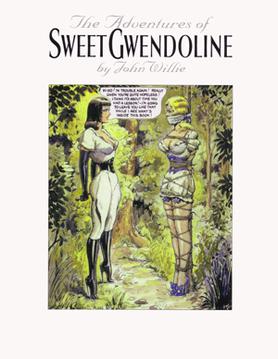
Sweet Gwendoline is the signature woman in bondage artist John Willie’s drawings: a naïve, curvy blonde who keeps getting elaborately tied, rescued, and tied again in mid-century fetish illustration and comics. The story is not about a final escape. It is a loop. Secret Agent U-89 gets her out, then restrains her again for supposedly benevolent reasons. That structure is why she became a marker in bondage art history.
The Wink serial
She first appeared as a serial, usually two pages at a time, in Robert Harrison’s mainstream girlie magazine Wink, from June 1947 to February 1950, and later turned up in other magazines. Collectors treat the Wink run as foundational. A mainstream-adjacent magazine was already mixing explicit rope fantasy into a mass-market girlie book, decades before glossy specialty fetish titles made that look ordinary. Two pages trained the reader to expect the next predicament, not a rescue that stuck.
Willie’s cast
In the drawings she is called a girl in the comic sense: an adult woman’s body and an adult pin-up type, not a child. The villain is moustachioed Sir Dystic D’Arcy, based on Willie himself. The artist drew himself as a sadistic aristocrat, tying the heroine and laughing at his own persona. U-89 is the protector, and the protector is also the one who ties her, over and over, “for her own good.” The strip has been compared to The Perils of Pauline. Willie said he had not seen that film, and had not even heard of it, until much later in his career. His formula is not a Hollywood cliffhanger homage. It is rope after rope, issue after issue. The bondage is the story shape.
Punk, goth, and a 1984 film
The character left the portfolios. In Germany the punk band Die Ärzte recorded “Sweet, Sweet Gwendoline” and put a mid-century rope heroine in front of listeners who otherwise had little contact with BDSM. Gothic rock band Umbra et Imago, known in the fetish goth scene, recorded a song titled “Sweet Gwendoline.” Those tracks carried her out of collectors’ folders and into punk and goth playlists.
In 1984 Just Jaeckin loosely adapted the stories as The Perils of Gwendoline in the Land of the Yik-Yak, with Tawny Kitaen as Gwendoline. Jaeckin already had Emmanuelle and Story of O behind him. The film is not a page-faithful comic transfer. It is a pulp-adventure costume piece riding Willie’s name and the damsel-in-bonds brand. For adult viewers it is the best-known live-action pointer back to the serial: useful as a pop entry, incomplete as art history.
Sweet Gwendoline is not a modern consent manual. She is a mid-century bondage icon, and the “rescue” is often just better rope from a friendlier agent. Villain and protector are both binders. That ambiguity is what kept Willie readable for kink adults who already know fantasy is not a protocol. From the Wink serial to the Die Ärzte and Umbra et Imago songs to Jaeckin’s 1984 film, the same blonde-in-bonds figure is one of the clearer bridges between underground SM illustration and a wider pop sense that bondage can be the shape of a story, as well as something people do in a bedroom.

![[Art Video] 2124 Women Who Climb to the Peak of [Algolagnia] Algolagnia Sensuality (9) [Exclusive]](https://bdsmwild.com/wp-content/uploads/2026/08/Art-Video-2124-Exclusive.jpg)