
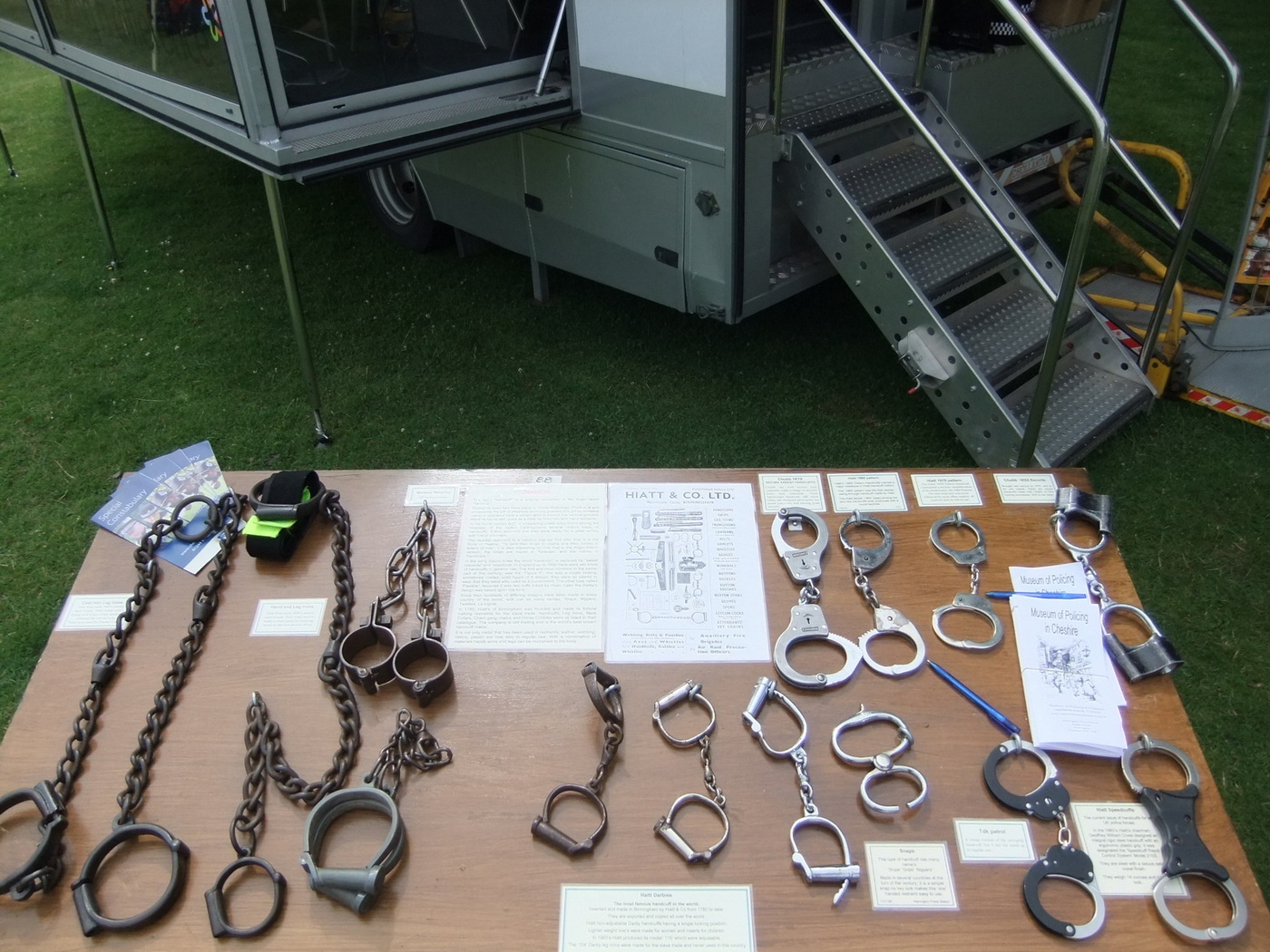
Handcuffs are paired restraints that lock the wrists close together, joined by a chain, a hinge, or a rigid bar. Each cuff has a rotating arm. Once the ratchet shuts, it will not open without a key or specialist skill. On the wrists, the hands usually cannot separate more than a few centimeters or inches, and a lot of ordinary tasks become impossible. Police around the world use them to cut the chance of escape in custody. In BDSM bondage, metal police cuffs are iconic fantasy hardware and a real injury risk at the same time. Purpose-built bondage cuffs exist because law-enforcement gear was never designed for long erotic wear. This is not a guide to picking a lock, shimming a pawl, hiding a key, or stepping the body through cuffs from back to front. Handcuffs are a temporary restraint, not a vault.
Three metal types dominate now. Chain cuffs use a short chain and allow the most movement. Hinged cuffs allow less and are generally treated as more secure. Rigid solid-bar cuffs, including the Hiatt Speedcuffs common in UK policing, are bulkier to carry, easier to apply with one hand, and support pain-compliance and control techniques that chain cuffs do not. A lockable box can fit over a chain or hinge and add rigidity and security. In 1933 the RCMP experimented with Mitten Handcuffs, meant to stop a prisoner grabbing an officer’s gun. They never caught on. Materials include carbon steel, stainless steel, aluminium, and synthetic polymers. Oversized cuffs exist for large wrists. When the hands cannot meet, two pairs are sometimes daisy-chained. Collections hold late-nineteenth- and early-twentieth-century T-type “Come Along” cuffs, D-type cuffs, and figure-8 designs.
Disposable plastic restraints — wrist ties, riot cuffs, plasticuffs, flexicuffs, tri-fold, zapstraps, zipcuffs, zip-strips — look like heavy cable ties. Soldiers and police carry them in bulk for protests and riots. Airlines stock them for disruptive passengers. They cannot be loosened for fingerprinting or a bathroom without being cut, so one person may wear several sets in a few hours. Keyed disposable versions exist, but they are weaker and only partly reusable. Many officers and medics think plastic restraints raise the risk of nerve and soft-tissue injury compared with metal.
Legcuffs, or leg irons, have a larger perimeter and close on the ankles. Some use an elliptical shape to ease pressure on the Achilles tendon. A standard model uses a longer connecting chain so a person can walk but not run. A shortened chain forces a shuffle, or a wheelchair. Looped together with handcuffs, the connector can make a full hog-tie. That practice is controversial. People hog-tied face down have died of positional asphyxia, and many jurisdictions ban it or restrict it hard. Permanent shackling in a cell marks the ankles and is widely treated as cruel and unusual. Transport often adds a belly chain in metal, leather, or canvas, holding the hands at waist level. Handcuff covers over the keyholes plus a belly chain make a harsher, more painful package. A longer connector can link leg irons to handcuffs or to the belly chain for court and medical trips. Wrists and ankles locked together on a face-down body carry the same positional-asphyxia warning into floor bondage. A belly chain that pins the hands at the waist for a long time has a fetish cousin in armbinder and waist-cinch combinations. They look hot. They still need a plan for blood flow. These are risks, not steps.
A double lock engages a detent so the ratchet cannot tighten further. That stops intentional or struggle-driven over-tightening, which can damage nerves or cut off circulation, and it blocks the trick of tightening until an officer loosens the cuff and then slipping it. A double lock also makes picking harder. This article does not explain how to pick one. Smith & Wesson-style mechanisms include a lever lock, which needs no tool, a push-pin lock, and a slot lock. Release is usually a reverse turn of the key. Most modern cuffs in the United States, the United Kingdom, and Latin America share one universal handcuff key for transport. High-security cuffs and many thumbcuffs do not. A handcuff cover hides the keyhole from the person wearing it. Behind the back, hinged or rigid cuffs are harder to open on your own than chain cuffs. Since about the mid-1960s, behind-the-back cuffing has been the U.S. police standard. Earlier practice often cuffed in front. Most academies teach palms out. Some agencies, including the Jacksonville PD and the LA County Sheriff, prefer palms together, to reduce radial neuropathy on a long hold. Keyholes face away from the hands. A cuffed person cannot break a fall with their hands. The moment the steel closes, the officer carries the liability. Front cuffing raises the chance that the hands become a weapon. Rear cuffing raises the chance of a trip and a fall. On any long hold, the double lock should be standard so struggling does not nerve-damage a wrist. Keyhole direction, rigid or hinged geometry behind the back, and palm position all change both how hard escape is and how likely neuropathy is. In bondage, check the color, temperature, and sensation of a cuffed hand.
Handcuffs are temporary. They are not a high-security vault. Before the ratchet, slipping out was easier. A modern ratchet makes slip-off hard, and not always impossible. Houdini stacked multiple pairs for stage escapes. Brute force can break or loosen some cuffs at a high injury cost: bruised wrists, torn muscle. People with cleidocranial dysostosis, born without collarbones, can sometimes bring the arms up from behind and over the head more easily. That is physiology and stage history, not a lesson. In a scene, someone fighting steel can injure themselves. Purpose-built bondage cuffs, with a known lock, emergency shears, and a negotiated time limit, beat novelty police props bought online with no double lock and no attention to size.
Depiction rules differ. Japan often requires pixelation of cuffed hands, after Kazuyoshi Miura successfully argued that the image of cuffs implied guilt. France bans airing images of restrained people before conviction. Italy’s criminal procedure code forbids publishing images of people deprived of liberty in handcuffs or other coercion, even pixelated, as the data-protection authority has read it. Hong Kong police often offer a black cloth bag over the head. Sri Lanka generally does not handcuff women. In mid-July 2020 the High Court in Windhoek, Namibia, prohibited handcuff use under any circumstances as unconstitutional.
Police handcuffs show up constantly in sexual bondage fantasy and in real scenes. They are a poor tool for that. They were not made for long erotic wear, and they can cause handcuff neuropathy and other tissue damage. Bondage cuffs borrow the soft-restraint idea from psychiatric restraints: a wider contact surface, longer wear, often closed with a padlock. The rule of thumb is blunt. Metal law-enforcement cuffs are a hot image and a high medical risk. Cuffs built for bondage are the default for adult play. The surrounding hardware culture includes handcuff covers, thumbcuffs, Hiatt Speedcuffs, belly chains, and collectors’ restraint museums.
Everyday language kept the picture. “Golden handcuffs” are retention pay that traps an employee. A policy bottleneck leaves someone “handcuffed.” Fantasy football talks about a “handcuff” backup. Spanish esposas literally means wives or spouses. The crossed-wrists gesture can mean “submit to cuffing,” solidarity with someone under arrest, or a coach’s signal. For restraint fetish and police-play readers, the device sits on the border of state violence and negotiated power exchange. It is the same steel. The ethics depend on consent, keys, time limits, and circulation checks.
Collecting restraints is its own subculture. Old figure-8 and come-along designs, national-museum holdings, and online catalogs such as Handcuffs.org and private collections trace custody gear from simple irons to high-security models with non-standard keys. Thumbcuffs, handcuff covers, Hiatt Speedcuffs, PlastiCuffs, and leg irons are one family. They show up in police play, prison play, and predicaments. BDSM retail answered the medical problem with leather, hybrid, and medical-style soft cuffs: lockable, wearable longer, less edge pressure. The chrome chain cuff is still the visual shorthand in porn and in fashion editorials, even when educators tell students not to sleep in them. Legal rules on images — Japanese pixelation, the French pre-conviction ban, the Italian ban on coercion images, the Namibian constitutional bar — show how heavily a cuffed body is politicized as a mark of guilt and of state power. Fetish photography that eroticizes the same image is working with that politics and against it. For readers here: know the types, respect the injury mechanisms, prefer bondage-specific gear for play, and treat real police cuffs as high-risk props with a long custody history, not as harmless costume jewelry.