
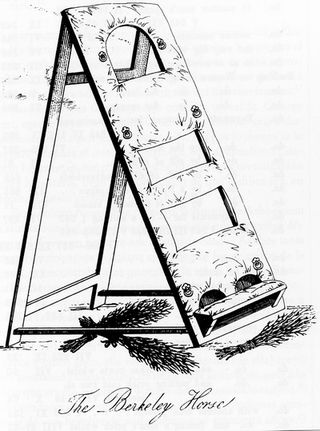
In nineteenth-century London, 28 Charlotte Street in Marylebone — today’s 84–94 Hallam Street — was not an ordinary brothel. Theresa Berkley, also spelled Berkeley, ran a house for paid flagellation there. She died in September 1836. In the language of the time she was a “governess,” not a schoolteacher: a woman whose trade was chastisement, whipping, and discipline. Wealthy men and women paid to be flogged, or to watch other people flogged under her direction. No reliable portrait survives. Contemporary descriptions that do exist tend to call her attractive and strong-willed. Among aristocrats she was treated as an expert in pain taken for pleasure, and she kept strict secrecy around her client list.
The Berkley Horse and the limits of the job
A large part of her fortune is credited to the Berkley Horse, a frame built for efficient, controlled flagellation — whipping furniture from long before modern dungeon catalogs. Bibliographer Henry Spencer Ashbee, quoting an unnamed source, recorded a wide kit: a cat-o’-nine-tails, leather straps, holly brushes, green nettles, and a hook-and-pulley rig for restraint and elevation. Natural stingers, leather, and a mechanical assist sat in the same inventory. Berkley would take a measure of pain if the client paid her price. If a client wanted to inflict more than she chose to take herself, she hired other women to receive it. That is professional risk management dressed as Victorian vice. A contemporary-style sketch put the same point in sexual terms: a successful performer needed real erotic fire, not a woman moving only for pounds, shillings, and pence.
The estate that went to ash
After Berkley died, her brother came back from Australia. When he learned the fortune came from a flagellation brothel, he renounced the inheritance and returned there. The property then moved toward her medical attendant and executor, Dr Vance, who refused to administer it. The estate, valued at about £100,000 — on the order of £11.9 million in 2023 purchasing power — was escheated to the Crown. Vance did take her correspondence, including letters from the highest-ranking men and women of the aristocracy. Those letters were destroyed. For BDSM history that is an archival loss: a client book of Regency and early Victorian power was burned, and what remains is secondhand description of the Berkley Horse, the tools, and the Charlotte Street house.
Where dominatrix history still starts
Berkley is a landmark on maps of BDSM people and equipment because she makes professional female dominance visible in English city life decades before modern SM slang. The Berkley Horse is equipment history. The Hallam Street house is venue history. The destroyed letters show that paid flagellation sat inside elite life while polite society pretended otherwise. The line runs through English dominatrices, the Berkley Horse (also called the chevalet), Ashbee’s bibliographies of forbidden books, and Steven Marcus’s The Other Victorians, from the Victorian “governess” to contemporary pro-domme work. She is remembered as the inventor of the chevalet. The pornographic novel Exhibition of Female Flagellants was sometimes attributed to her and almost certainly was not. Her actual trade was live professional dominance, and the furniture still turns up in histories of restraint equipment.