
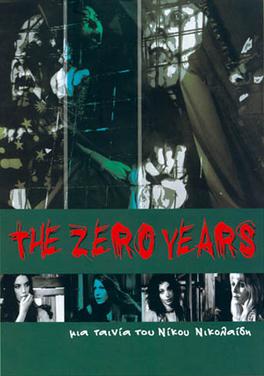
The Zero Years, released in 2005, is the last feature by Greek director Nikos Nikolaidis. It is a dystopian art film that mixes drama, experiment, independent production, and underground style. Viewers who know his 1990 cult film Singapore Sling will recognize the late work: more closed rooms, more degraded luxury, women used as erotic instruments of a totalitarian order. It sits closer to the aftershock of the art-house film Salò than to a lifestyle BDSM manual. There is no negotiated practice and no aftercare. Dominance is the air the characters breathe.
Set and plot: masochistic labor in spoiled luxury
Four sterilized women who work as prostitutes are locked into sadomasochistic labor under a despotic Power. The décor sits between a baroque stage set and a junk warehouse: lavish furniture next to degraded objects. The world stays shut. It never opens onto a freer outdoors. During one especially intense session a client nearly dies. The women hide him in a kind of cage. Power arrives, demands an explanation for the disappearance, and puts the women through severe interrogations.
From youth to sorrowful maturity, the four figures stage four stances a slave can take toward authority, whether that authority is political, familial, or a group. The feeling of the film is an obsession with freedom and rebellion married to a near-conspiratorial acceptance of submission. Escape looks impossible. The one woman who does get outside comes back of her own will, convinced the outer world is worse than the prison. There is no future outside the role she was assigned. That fatalism is the film’s SM politics: dominance is the whole environment, not a scene people agreed to play.
The four women as a timeline of submission
The age spread turns the brothel into a timeline of submission: youth, leadership, suffering in the middle, and supervisory complicity. The film reads as a catalog of slave positions under total power, not as one heroine’s arc. Vicky Harris plays Prostitute Vicky. Jenny Kitselli plays the Leader. Arhontisa Mavrakaki plays Maro. Eftyhia Yakoumi plays Christina. Michele Valley plays the Supervisor. Supporting players include Alkis Panagiotidis, Yiorgos Mihalakis, Maria Margeti, Nikos Moustakas, Angeliki Aristomenopoulou, Dorothea Iatrou, Anastasia Iatrou, Nefeli Efstathiadi, Christos Houliaras, Themis Katz, and Natasa Kapsabeli.
Reviews and awards: a style that had hardened
Production designer Marie-Louise Bartholomew won Best Production Designer at the Greek State Film Awards of the Thessaloniki International Film Festival in November 2005. The film was officially selected for the Chicago International Film Festival in October 2005 and again in October 2006, and it was nominated for the Gold Hugo both times. Vrasidas Karalis, professor and author of A History of Greek Cinema, called it “highly personal” and “hermetic,” but also “derivative” of Nikolaidis’s earlier work. He described the visual style as fossilized into self-conscious mannerist extravagance, and he compared the film to Luis Buñuel’s Belle de Jour (1967) and Pier Paolo Pasolini’s Salò, or the 120 Days of Sodom (1975). The Salò comparison is the loud one for viewers who track cinema of institutionalized sadism. Derek Elley, in Variety, argued that despite the excess a strain of irony stays constant, and that the film keeps an off-center, ironic flavor.
What one Italian critic pulled out of the style
An Italian critic summarized the director’s stylistic thread as a closed universe where degraded objects sit beside lavish, or pretend-lavish, furniture. The characters are usually humiliated, stripped women. The sex, in any conventional romantic sense, is “anything but erotic.” Along with the cage, the interrogation, and the knowledge that outside is worse, the critic noted decadent-intellectual dialogue, a director reluctant to cut, and — despite the flaws — an original proposal for cinema that is not content to copy other people’s experiences.
Who it is for
If you want Greek underground extremes rather than softcore titillation, watch it beside Singapore Sling, Salò, and other art films that map institutionalized cruelty. The award-winning production design mixes luxury and junk until the closed set feels like a fetish stage built from scavenged symbols of authority. Adult viewers should expect talky decadence and political masochism, not negotiation or aftercare. After the film was finished, and after it failed to match the earlier success of Singapore Sling, Nikolaidis said he would stop making movies and turn to music. That sharpens its status as a last statement: hermetic, mannerist, and uninterested in pleasing a wider market.