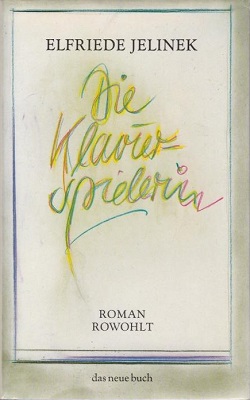
The Piano Teacher, Die Klavierspielerin in German, uses a feminine ending on purpose. The title points at the person playing, not at the job title “teacher.” Elfriede Jelinek, the Austrian Nobel laureate in literature, published it with Rowohlt Verlag in 1983. Joachim Neugroschel’s translation was the first of her novels to appear in English. The English title stayed The Piano Teacher even though the German weighs the player more than the post. Erika Kohut is a piano teacher whose sex and emotions are both pressed down. She enters a sadomasochistic relationship with her young student Walter Klemmer, and it ends in disaster. In 2001 Michael Haneke adapted the novel, with Isabelle Huppert. The film carried Jelinek’s cold control and masochistic psychology onto the international arthouse circuit.
The story is set at the Vienna Conservatory. Erika is in her late thirties and still lives with her harsh, elderly mother. She has a room of her own and still shares her parents’ marriage bed with her mother. The mother resents the money Erika spends on a new dress that is only hers, and tries to take it. Erika rips out some of her mother’s hair. The mother is saving for a future apartment for the two of them. Erika does not wear the dress. She strokes it and looks at it late at night. That deferred pleasure, and the aggression pushed outward, sets the temperature of the book. Erika carries a buried violence and a need for control. On trains she takes large instruments so she can hit people and call it an accident. She kicks or steps on other passengers’ feet and watches them blame each other. She is a voyeur and goes to peep shows. Once she comes across a couple having sex in a park and is so affected that she urinates.
The chronology is not a straight line. It tangles with images of the past and with what the characters think. Childhood keeps returning and pressing on the present. A cousin visits, an attractive athletic young man. The mother praises him and at the same time forces Erika to practice. The result of that scene is Erika’s self-mutilation. Walter Klemmer, an engineering student, appears early. He comes to class ahead of time, watches her play, then becomes her student and wants her. Erika treats love as rebellion, or as a way out from under her mother, so she wants absolute control in the relationship. She is a sexual masochist, and she still carefully tells Klemmer what he must do to her, writing the terms of her own degradation as a script. The contradiction is the point. Putting her own degradation on paper is how she stays in charge.
As it goes on, Klemmer grows uncomfortable with that strict control. He beats and rapes her in her apartment while her mother is in the next room. After the rape she goes to him and finds him laughing, pleased. She stabs herself in the shoulder and goes home. Once the written and spoken contract of desire has been answered with force, self-harm is the last expression she has left.
Larson Powell and Brenda Bethman argue that musicality is the key to the book. Jelinek herself had been a student at the Vienna Conservatory. She uses that musical tradition to set off the heroine’s perversion. The training was meant to make women attractive as wives, and Erika’s failure as a pianist marks her perverse position. The artist can turn pleasure into sublimity and become a desiring subject. The pervert stays stuck as an object. Erika remains the object of her mother’s desire. She never gets the subjectivity that the principles of her musical education had refused her from the start. The conservatory is a workplace, and it is also a factory of gendered aesthetic discipline. The novel turns that factory inside out.
Another line of criticism is the absent father. The mother is suffocatingly present. The father has been sent to a psychiatric asylum and exiled in space. That absence gives the mother sole psychological discretion. The exclusive bond between mother and daughter is never broken, and the mother’s domination has nothing in its way. His removal is read as a structural cause of Erika’s failure to separate, and of a masochistic drive that is too heavy. The masochism here is not offered as a freely chosen adult kink identity. It comes from a household in which one parent’s body and will fill every room.
Beatrice Hanssen calls the novel an anti-Bildungsroman and an anti-Künstlerroman. She reads it as a satire of the 1970s and 1980s literature that idealized the pre-oedipal mother-daughter bond. Erika does not grow into healthy artistry or a reconciled womanhood. Her path is voyeurism, petty public violence, a carefully written masochism, rape, and a stab to her own shoulder. The book refuses a redemptive mother-daughter romance and refuses the artist’s triumphant subjectivity. Readers who come only for “SM content” still have to sit inside Jelinek’s larger attack on Austrian cultural respectability and on sentimental feminism. It is not a consent manual and not a romance of negotiated power exchange. It is a cold Austrian novel: a masochistic script, mother-daughter captivity, a student-teacher hierarchy, voyeuristic hunger, and then violence that is not consensual. Adult readers can take it as a book about pathological control and desire. Around it sit Jelinek’s wider work, the 2001 film, sadomasochism in fiction, Vienna Conservatory culture, the anti-idyllic mother-daughter writing of the 1970s and 1980s, and the argument over whether a woman’s masochistic fantasy on the page frees her or traps her again.
![[Art Video] 2019 Slave Correspondence No.13 Chinari Aizawa [Exclusive]](https://bdsmwild.com/wp-content/uploads/2026/08/Art-Video-2019-Exclusive.jpg)