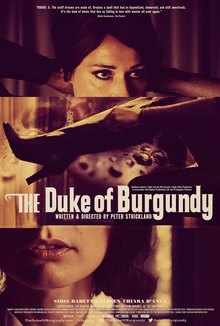
Peter Strickland’s 2014 film The Duke of Burgundy takes lesbian BDSM out of a private night game and sets it in the middle of the day. Sidse Babett Knudsen plays Cynthia. Chiara D’Anna plays Evelyn. For viewers who already know fetish culture, the lepidopterology décor is not the subject. The subject is a D/s relationship run as a repeated shift. What desire wants here is the loop, not a new trick.
Evelyn studies lepidoptera under the older Cynthia, keeps the house, and lives under strict rules about cleanliness and conduct. When she falls short of what Cynthia expects, she is punished. The hierarchy has a structure under it, and the film lets that structure show: Evelyn writes the instructions. She sets the script the two of them reenact every day. The scenes are sexually exciting for Evelyn. For Cynthia, playing the dominant is labor she does to please her lover. “Punishment” is on the schedule. It is not a storm that arrives by itself.
The strain shows up in a birthday gift. Cynthia means to hire a carpenter, played by Fatma Mohamed, to build a bed with a drawer underneath, so Evelyn can sleep in it as “punishment.” Evelyn refuses because the work will take too long. She then asks Cynthia to lock her in a trunk at night. Cynthia agrees. Moving the trunk, she injures her back, and she starts to feel her body aging and tiring. The new physical separation feels like being sent away. Evelyn’s expectations outrun Cynthia’s body and her willingness, and the relationship cracks. Cynthia also takes it as betrayal when Evelyn polishes another lecturer’s boots.
On Evelyn’s birthday the unhappiness hardens. Cynthia forces her to bake the cake, eats it while reclining, and puts her feet on Evelyn’s face. Evelyn is not enjoying it. She calls the safeword, pinastri. Cynthia ignores it. They start the familiar scene again, and only then does Cynthia break character and cry. Evelyn comforts her and says she loves her. The pages of instructions are burned. The punishment trunk is carried out of the house. At the end Evelyn is back at the door, ringing the bell, and the loop starts again. The ritual is still there after the confession.
Strickland has cited the Spanish exploitation director Jesús Franco as an influence, and he casts Franco’s regular Monica Swinn as Lorna. Swinn left film in 1982. This was her first role in more than thirty years. The casting puts the picture in a European erotic line that is soft, dreamlike, and close to fetish, and it looks at power exchange without the heat of pure exploitation. The lecturers and craftspeople around the couple fill out a closed world of women. D/s here is household infrastructure, not nightclub theater.
The title names a butterfly, Hamearis lucina, the Duke of Burgundy. How the species got that aristocratic name is lost in what entomologists themselves call the mists of entomological antiquity. The blur fits the film: a handsome name, an unclear origin, a creature pinned under a scholar’s gaze.
The reviews were overwhelmingly good. Rotten Tomatoes sat near 94 percent. Metacritic scored it 87 out of 100. The film won the Grand Jury Prize at the 23rd Philadelphia Film Festival. At the Hamptons International Film Festival, Strickland received the Wouter Barendrecht Pioneering Vision Award.
This is not a manual for adult players. A ritual people have agreed to can still hurt. The film has a safeword that gets ignored, a dominant who is performing the role, a submissive who writes the punishment calendar, and a gift that misses. Burning the instructions does not walk them out of the loop. There is the night Cynthia’s back gives out, the point where the trunk feels like exile rather than heat, and the moment a foot on a face stops being play and becomes coercion. That is the film’s account of a D/s relationship running out of fuel.