 English
 日本語
日本語 简体中文
简体中文 繁體中文
繁體中文
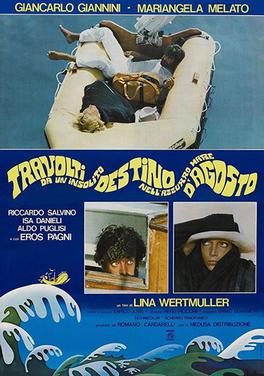
Swept Away… by an Unusual Destiny in the Blue Sea of August (Italian: Travolti da un insolito destino nell’azzurro mare d’agosto), usually shortened to Swept Away, is a 1974 Italian romantic adventure comedy-drama written and directed by Lina Wertmüller and starring Giancarlo Giannini and Mariangela Melato. A wealthy woman on a Mediterranean yacht ends up stranded with a communist deckhand; survival flips their class roles into a raw, erotic power struggle that still reads to kink-aware viewers as non-negotiated dominance, service, slap, and sexual submission on a desert island. Released to divided but largely positive reviews, it won the 1975 National Board of Review of Motion Pictures Award for Top Foreign Film. A critically and commercially failed English-language remake starring Madonna and directed by her then-husband Guy Ritchie arrived in 2002—proof that the original’s charge is harder to copy than its plot outline.
Plot: Yacht Insults, Dinghy Failure, Island Reversal
Arrogant heiress Raffaella Pavone Lanzetti vacations on a yacht in the Mediterranean Sea with friends—swimming, sunbathing, and monologuing without stop about the virtues of her class and the worthlessness of the political left. Her nonstop politics enrage deckhand Gennarino, a dedicated communist who swallows his opinions to keep a good job. Despite her humiliating insults, he agrees to take her out late in a dinghy so she can rejoin friends who left without her. The outboard motor dies; they spend a night at sea with no land in sight. Gennarino eventually restarts the motor but has no bearings. They finally spot an island and head for it, destroying the dinghy in the landing. Ashore, they discover they are alone.
Used to being served, Raffaella keeps ordering Gennarino around. He snaps and refuses to assist her any longer. Insults fly both ways; they split up to explore the island on their own. He is soon catching and cooking lobsters. Roles reverse step by step: she depends on him for food; he wants her as his slave, convinced women are born to serve men. He forces the indignity of washing his underwear. When she answers with angry defiance, he slaps her around. He begins to force sex, then stops—deciding it would be more satisfying if she came to him willingly. Later that evening she approaches him; both willingly engage in passionate sex. He wants her to fall in love with him; she becomes subservient. The island becomes a private hierarchy of service, violence, and desire—erotic power exchange without a contract, safeword, or aftercare, which is precisely why political critics and kink readers still fight over how to watch it.
They eventually spot a ship. Though both are reluctant to disrupt their newfound “paradise,” they signal and are rescued. Back in the world, old roles return almost immediately: she re-embraces the upper-class lifestyle of her friends; he returns to lower-class work and marriage. Gennarino contacts her in secret and asks her to return to the island with him, promising to abandon wife and children if she will leave her husband. She chooses the helicopter with her husband instead; Gennarino screams insults at the departing craft while left alone on the dock. His wife Anna discovers the affair and spitefully tells him their marriage is over. The film closes on a defeated, saddened Gennarino carrying her luggage along the dock, trailing behind her—power and class restored, erotic island law erased, the worker again burdened with bags.
Production: Eastern Sardinia and Shamrock V
Wertmüller shot along the eastern Sardinian coast in the province of Nuoro. The sailing yacht visible at the beginning of the film is the J-class yacht Shamrock V, which at the time of production was named Quadrifoglio. The beach of the shipwreck landing is Cala Fuili, in the municipality of Dorgali. The beach of Cala Luna, straddling the municipalities of Dorgali and Baunei, was another location used for filming. The Carunchio refuge and the most sensual scenes were shot in the dunes of Capo Comino, a town in the municipality of Siniscola. On screen the beaches read as a single continuous shoreline; in reality they sit several kilometers apart. The final scene of the helicopter departure is set in Tortolì, in Ogliastra, also in Nuoro province. The same locations were later chosen for Guy Ritchie’s remake—geography recycled for a very different critical fate.
Release, Box Office, and the Critical War Over Misogyny
Medusa Films released Swept Away on 19 December 1974. It was the fifth highest-grossing film released in Italy during the 1974–1975 season. Roger Ebert gave it four stars—his highest rating—in the Chicago Sun-Times, arguing the film “resists the director’s most determined attempts to make it a fable about the bourgeoisie and the proletariat, and persists in being about a man and a woman. On that level, it’s a great success.” Other defenders said critics fixated on misogyny simply missed the class-warfare message. James Berardinelli wrote that casual viewers might easily mistake the film for a male fantasy, but that Wertmüller had “the courage to show things that other filmmakers shy away from.” John P. Lovell argued that the sexual violence can be analyzed as political violence within patriarchal politics and the film’s concern with a symbolic presentation of social revolt.
In Jump Cut, Tania Modleski rejected those justifications, contending that critics would not have been so kind to films that reinforced stereotypes culminating in violent subjugation of oppressed ethnic groups—so there was no justification for praising a rape-fantasy film. On the class message she wrote that even if Wertmüller wanted only to convey a political message, she had “clouded rather than clarified the issues” and “should have made both parties male.” On the review aggregator Rotten Tomatoes, 60% of 25 critics’ reviews are positive, with an average rating of 7.6/10. Metacritic, using a weighted average, assigns a score of 68 out of 100 based on 7 critics, indicating “generally favorable” reviews. For BDSM-media readers, the film is not SSC fantasy and does not pretend to be; it is cinematic power exchange without negotiation—slaps, forced service, a near-rape that becomes willing submission, then the cold restoration of class after rescue. That is why it keeps showing up in discussions of erotic hierarchy on film even when political critics disagree about what the hierarchy means or whether the film earns its cruelty.
Remake, Related Titles, and Why the 1974 Original Endures
The film was remade in 2002 as Swept Away, starring Madonna and directed by then-husband Guy Ritchie. The remake was a critical and commercial failure. The male lead was played by Adriano Giannini, the son of Giancarlo Giannini, because the elder Giannini was considered too old to reprise the role—a casting echo that only underlined how much the original couple’s chemistry had carried the earlier film. Related literary and film cousins often cited include The Admirable Crichton and other desert-island role-reversal stories such as Overboard. Awards recognition for the original centered on the National Board of Review’s Top Foreign Film honor in 1975; nominations lists and foreign-press attention of the period placed Wertmüller’s sex-and-class comedy-drama among the most discussed Italian exports of its year.
For bdsmwild’s power-exchange film shelf, the 1974 original remains the essential text: Wertmüller, Giannini, Melato, Sardinian light, J-class yacht glamour collapsing into lobster-catching hierarchy, and a romance that is also a class slap, a service protocol, and a break-up that puts the luggage back in the worker’s hands. Watch it as political allegory, as erotic role reversal, or as a document of how mainstream European cinema staged dominance long before “BDSM romance” was a bookstore category—the island still decides who kneels, and the dock still decides who carries the bags. The 2002 remake’s failure only sharpens the original’s status: the chemistry, the cruelty, and the class punchline are harder to franchise than the plot synopsis suggests.