Samuel Steward (1909–1993) moved through several centers of mid-twentieth-century American underground life. As a professor, a tattooist, and a writer of gay erotica, he kept a hidden chronology of leather sex, rough trade, and sadomasochistic play. For readers who know BDSM and fetish culture, he is not a later scholar looking in. He was there, and he wrote it down. Before “leather subculture” had an institutional label, he was already turning power, pain, and street masculinity into erotic text. The life runs from Ohio to Chicago and then to the San Francisco Bay Area, and it left a large private archive of diaries, journals, and statistical cards.
Steward was born in Woodsfield, Ohio. The early academic years went smoothly enough. He taught at Ohio State University and lectured at colleges in Montana and Washington. In 1936 the State College of Washington fired him over Angels on the Bough, a novel with a sympathetic portrait of a prostitute. He settled in Chicago and taught at Loyola University until 1946, then left to help rewrite the World Book Encyclopedia, and later taught at DePaul University. Raised Methodist, he converted to Catholicism at university and later left the church. From the mid-1930s through 1949 he was deep in alcoholism. By day he was a properly dressed college teacher. By night he was a secret sexual ethnographer.
Literary modernism shaped his taste and his company. In 1932 an academic adviser introduced him to Gertrude Stein. The correspondence became a long friendship. In the summers of 1937 and 1939 he visited her in France and, at her country place, met Thornton Wilder, Lord Alfred Douglas (Oscar Wilde’s lover), Thomas Mann, and André Gide. Those high-modernist meetings were never fully split off from the leather underworld he entered later. They sat in the same life.
In late 1949 Steward met the sex researcher Alfred Kinsey and became an unofficial collaborator with Kinsey’s Institute for Sex Research. He donated sexually themed material, opened his lifelong sexual records, and introduced Kinsey to large numbers of sexually active men in Chicago. He let Kinsey photograph the all-male sex parties in his apartment and supplied early Polaroids. In spring 1950, at Kinsey’s invitation, Steward and the New York erotic artist Mike Miksche—also known as Steve Masters—were filmed in a BDSM sex scene. A scientific institution, not a police raid, was what put gay sadomasochistic practice on record. Steward called Kinsey a mentor “as approachable as a park bench,” and “Doctor Prometheus,” a bringer of sexual enlightenment.
Outside the university, Steward became a professional tattooist in the 1950s, mentored by the Milwaukee master Amund Dietzel. For most of his adult years he worked a South State Street shop in Chicago, tattooing Navy trainees from Great Lakes Naval Training Station, along with gang members and people off the street. He mentored Cliff Ingram (Cliff Raven) and Don “Ed” Hardy and pushed both toward the Japanese-style work he admired most. Chuck Arnett was one of his clients. After he retired from tattooing in 1970 he published Bad Boys and Tough Tattoos, a social history. In the late 1960s he moved to the San Francisco Bay Area and served as the official tattoo artist of the Hells Angels Motorcycle Club. In his last Chicago years he befriended Chuck Renslow, co-owner of Kris Studio, whose partner was the homoerotic illustrator Dom Orejudos, known as Stephen and as Etienne. The two later opened the Gold Coast, Chicago’s first leather bar, and founded International Mr. Leather.
The erotica starts in the 1960s under the name Phil Andros. Early pieces ran in the Danish magazine Eos/Amigo and fixed on rough trade, sadomasochistic sex, and the power in interracial encounters between men. After U.S. publishing law loosened, Guild Press issued the story collection $TUD in 1966. He then wrote a run of pulp porn novels narrated by the hustler Phil Andros, tracking desire, class, and control. Collectors of classic gay SM and hustler fiction still treat those books as period documents. He also published novels, poems, and mysteries as Samuel M. Steward and as Phil Sparrow.
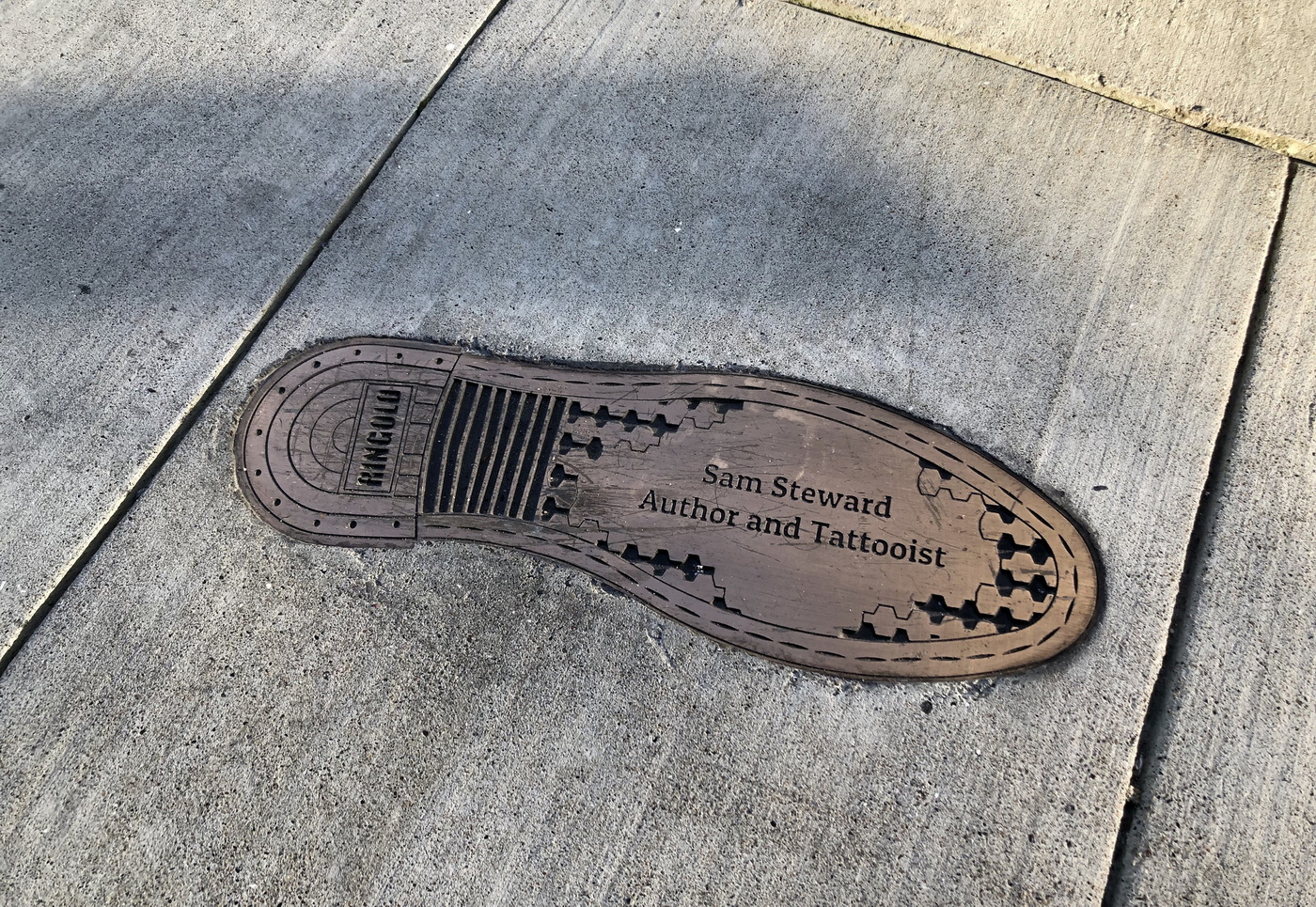
For Kinsey he kept daily logs of sexual activity from the 1950s and filed them in a secret card index he called the Stud File. From 1957 he turned those encounters into short stories for the Zurich gay magazine Der Kreis. Chronic obstructive pulmonary disease and barbiturate addiction later damaged his writing, but the archive stayed large. In 1972 Jack Fritscher became the first openly gay writer to seek him out and interview him. Those tapes underpin Justin Spring’s biography. The full title is Secret Historian: The Life and Times of Samuel Steward, Professor, Tattoo Artist, and Sexual Renegade (Farrar, Straus and Giroux, 2010). It was a National Book Award finalist and won the National Leather Association’s Geoff Mains Non-fiction Book Award for 2011. Steward died at 84 in Berkeley, California. He entered the Leather Hall of Fame in 2012. In 2017 his name was set into a bronze bootprint in San Francisco’s South of Market Leather History Alley.
![[Art Video] 2002 Beautiful Big Tits Maso Club Akane Aoi Yu Shiraishi](https://bdsmwild.com/wp-content/uploads/2026/08/Art-Video-2002.jpg)