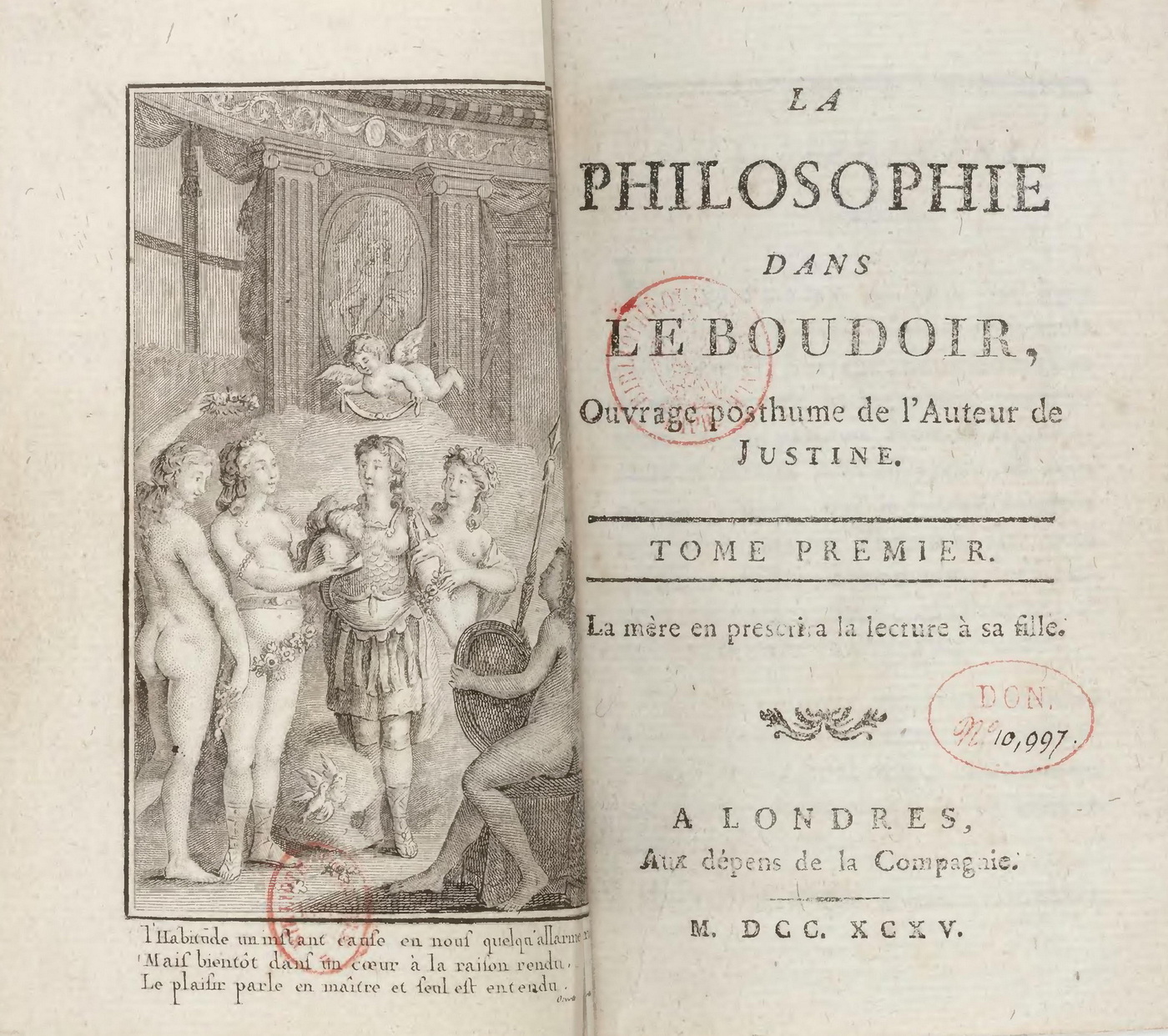
In 1795 the Marquis de Sade finished a book written as dialogue. The French title is La philosophie dans le boudoir. English often mistranslates it as Philosophy in the Bedroom. A boudoir is a woman’s private room, and that is where the argument sits. Sade’s libertines claim that the only moral system fit for the French political revolution is libertinism. If France will not adopt it, they say, the monarchy will return. The book reads as a recruiting pamphlet wrapped in explicit argument, pushing the reader to indulge desire.
Who is in the room
The house and the bedroom belong to Madame de Saint-Ange, twenty-six, a libertine. She takes in Eugénie for two days. The book writes Eugénie as fifteen. She starts out modest, decent, and obedient, the way her mother raised her. The voice that runs the talk is Dolmancé, thirty-six, an atheist, bisexual, with a strong preference for men. He is the dominant speaker opposite Eugénie. Saint-Ange’s brother, Le Chevalier de Mirval, is twenty. The gardener Augustin is about eighteen to twenty. They are in the house for the same display. The book treats its characters as bisexual. Sodomy is the preferred act, and Dolmancé especially: he prefers male partners, and with women he will have only anal sex. This is not a modern consent manual. Eugénie is written as a minor.
What the dialogue claims about pain and pleasure
Dolmancé tells Eugénie that morality, compassion, religion, and modesty are absurd barriers, and that the only aim of a human life is pleasure. The book says there is no “true pleasure” without pain. The lesson, as they frame it, starts with biological facts, then claims that physical pleasure outranks reproduction as a motive. The dialogue is full of sex, of torture, and of speeches defending incest, sodomy, adultery, and other taboos. The speeches come down to “if it feels good, do it.” Unlike many of Sade’s other books, this one stages no actual murder. Dolmancé still claims that even murder committed for the sake of pleasure should not be punished. That is a claim inside a 1795 text. It is not a set of instructions.
The republican pamphlet
In the fifth dialogue the Chevalier reads a long pamphlet. In English it is “Frenchmen, Some More Effort If You Wish to Become Republicans.” It carries Sade’s views on religion and morality, and the program he wants the new republic to write into law. He pushes atheism, rejects ordinary teaching about pleasure and pain, and says crimes committed in pursuit of pleasure should not be condemned. Royal tyranny and religious superstition, he writes, are shackles locked together. After the monarchy is abolished, religion has to go too, or liberty will not hold. Rome fell as Christianity rose. France is finished if she keeps revering it. Europe, the pamphlet says, is waiting to be rid of “specter and censer alike.” For Sade, political liberation and erotic liberation are one project. A republican’s only gods must be courage and liberty.
The plot spine, and what came after
The book is seven dialogues. The pace is an initiation: theory, demonstration, more partners, incest spoken out loud, the republican pamphlet, more practice, and a last scene in which the mother is punished. Eugénie’s father sends her to Saint-Ange to strip away the virtue her mother taught. In the final dialogue the mother arrives, finds her husband complicit, and finds that her daughter will not leave with her. The book treats that punishment as the lesson: virtue destroyed, the family turned upside down, law and compassion mocked. Later erotic work kept the shape — a classroom, a curriculum, practicals, cruelty at the end of the course — even after the ethics moved to negotiation and safewords.
The book is remembered because it treats pain as the door to pleasure and puts a charismatic educator, Dolmancé, at the center. It has been filmed more than once. Spanish director Jesús Franco adapted it in 1970 and again in 1980. Italian director Aurelio Grimaldi filmed L’educazione sentimentale di Eugenie in 2005. In 2003 a stage piece called “XXX,” drawn from the dialogue, toured European cities with simulated sex and audience interaction, and the show drew controversy. Those versions do not follow the book line by line. They use the Sadean brand: charismatic libertines rewrite a novice until family morality is what looks obscene. For readers who track BDSM and fetish, it is a revolutionary-era text that puts atheism, fury at the mother, a celebration of incest, and an explicit argument about power exchange into dialogue.

![[Art Video] 2214 Bewitched Slut Illustrated Guide Pleasure of Enema 8 Akane Aoi, Yoko Takase, Miku Aso [Exclusive]](https://bdsmwild.com/wp-content/uploads/2026/08/Art-Video-2214-Exclusive.jpg)