
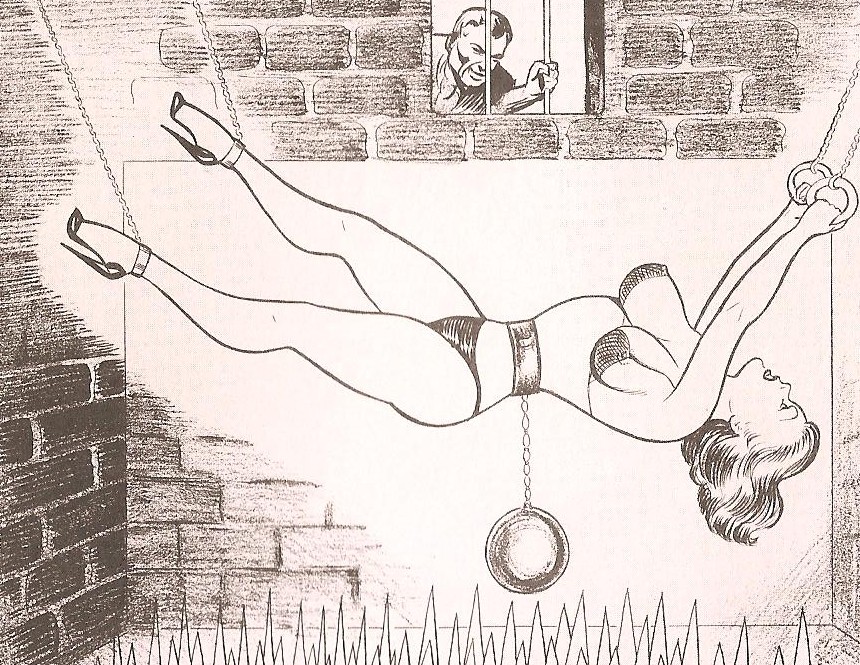
Nights of Horror is a 1954 American fetish comic series from the tiny New York publisher Malcla, drawn by Joe Shuster, the same artist who had co-created Superman with Jerry Siegel. The scripts came from a writer working as “Clancy,” who used other pen names as the issues piled up. The stories are BDSM, bondage, torture, and sexual slavery: men and women as tormentors, men and women as victims. There is almost no full nudity. What there is—whips, foot worship, bloodletting, flagellation, lingerie fetish, interracial sex, lesbian scenes, humiliation—was more than enough for 1950s New York to treat the booklets as poison.
The series mattered because a psychiatrist waved it in a murder trial, because New York City and then the State of New York seized and banned it, and because the United States Supreme Court let the ban stand. Shuster’s name stayed off the art until Gerard Jones named him in 2004. For a BDSM reader the point is not nostalgia for a dead pamphlet. The point is that one of the foundational superhero draftsmen, broke and going blind after losing Superman, spent a stretch of the 1950s drawing the exact kink tableaux that American law then burned.
From Science Fiction Fanzine to Action Comics
Shuster and Siegel started making comics together in the early 1930s, after they became friends in high school. The first Superman story appeared in a hand-typed school fanzine called Science Fiction. Clark Kent’s other self was their idea of the American man: foreign-born, muscular, bulletproof, assigned to save the country and then the world. Both artists came from Jewish immigrant families. Both described themselves as quiet and meek. Drawing a hero who was strong, confident, and wanted by women was a way to put an ideal self on paper.
Breaking into the business was hard. They finally found a buyer at National Allied Publications, later DC Comics, which wanted a new book called Action Comics. Editor Harry Donenfeld paid them $130 for the first story and bought the rights to Superman. The first issue landed in June 1938 and launched an industry. Shuster and Siegel were paid a fraction of what Donenfeld and DC made from the character—somewhere between 50 and 90 percent of each strip, depending on the deal and the year. Shuster’s eyesight was already failing, which made drawing multiple features a physical grind. After nearly a decade on Superman, wanting more control, and watching senators, clergy, and the children’s psychiatrist Dr. Fredric Wertham start a moral war on comics, the two men sued DC for Superman and for the less famous Superboy.
The 1948 trial gave them Superboy and left Superman with DC. The court treated the original $130 as a work-for-hire sale. Siegel and Shuster walked out jobless and nearly broke. A second try at an iconic hero, Funnyman, died after three issues. That is the career wreck from which Nights of Horror comes. It is not a side hustle by a man still drawing the Daily Planet. It is what a co-creator of Superman did when the company that owned his muscleman no longer needed him.
Malcla, a Queens Basement, and Sixteen Unsigned Issues
Broke and slowly going blind, Shuster took a job from a neighbor who wrote for a publisher called Malcla. The “Cla” was Clancy. The “Mal” was Eugene Maletta, who ran a print shop out of a Queens basement. The assignment was art for a new booklet series of BDSM, kidnapping, and torture stories. The drawings put men and women into humiliation, foot worship, bloodletting, bondage, flagellation, lesbian scenes, lingerie fetish, and interracial sex. Nudity is scarce. Exposed women’s breasts are about as far as the anatomy goes. Power is not scarce. Both sexes hold the whip. Both sexes take it.
The run lasted sixteen issues. Clancy wrote all of them under changing names. Shuster never signed a page. Attribution is still universal once you put the panels next to his Superman work. Some faces in Nights of Horror look like Lois Lane, Lex Luthor, Jimmy Olsen, even Clark Kent. Whether that was revenge, habit, or just the only handsome anatomy he knew how to draw is a guess. Craig Yoe, in Secret Identity: The Fetish Art of Superman’s Co-Creator Joe Shuster, argues the simplest explanation: Shuster needed money, and the character resemblances are his hand repeating itself. Shuster told no one. He got no credit and no notoriety until a rare surviving copy turned up decades later.
That silence is part of the object. Mid-century American fetish publishing often lived in basements, under fake bylines, sold from Times Square racks that also moved detective pulps and “art studies.” Nights of Horror is that economy with a famous ghost at the board. The bondage, the begging, the interracial taboo, the lesbian set pieces—this is the same visual grammar later Tijuana bibles, Irving Klaw stills, and 1960s bondage digests would keep using. Shuster just happened to have already taught America how a strong jaw and a helpless pose should look.
What the Booklets Actually Show
Call them comics if you want the format. Call them fetish booklets if you want the market. The stories are situational more than novelistic: abduction, restraint, whipping, forced worship, torture as spectacle. Men torment women. Women torment men. Women torment women. The sadism is the point, not a plot twist on the way to a kiss. That matters for anyone who wants to file this under “campy 1950s naughtiness.” It is not a tease. It is SM staging with the breasts out and the genitals still inked over, which is exactly how a lot of American commercial kink got past printers who would not risk a penis.
The Superman lookalikes are the detail that later collectors cannot leave alone. A Clark-faced man on his knees, a Lois-faced woman in lingerie and rope, a Luthor-looking sadist with a whip—those are not Easter eggs planted for comics historians. They are what happens when the only professional figure-drawing vocabulary you have left is the one DC now owns. If you read the booklets as BDSM art rather than as a lawsuit exhibit, the recycling is almost honest. Superhero bodies were already fetish bodies: rubber, cape, boots, invulnerability, a secret identity, a woman tied to a railroad. Nights of Horror just drops the alibi.
Sixteen issues is a real run for an underground fetish title in 1954. Someone was buying them. Times Square shops were stocking them. That commercial fact is what made the later injunction possible. A pamphlet nobody sold cannot be a public menace. A pamphlet that moved through five midtown bookstores could be treated as a citywide contaminant.
The Brooklyn Thrill Killers
In the summer of 1954, Jack Koslow (18), Melvin “Mel” Mittman (17), Robert “Bobby” Trachtenberg (15), and Jerome “Jerry” Lieberman (17) tore through Brooklyn. They terrorized girls with mail-order whips, beat vagrants, and set people on fire. They beat an old man to death. They were caught after forcing a man off a pier into the East River to drown. They did not rob their victims. The press, needing a phrase for violence without a wallet motive, named them the Brooklyn Thrill Killers.
The jury trial opened in November 1954. Trachtenberg became the state’s witness and walked. Lieberman’s murder case was dismissed for lack of evidence that he had taken part in the killing. Koslow and Mittman drew life without parole. The legal file would have been ugly enough as a teenage murder case. It became a comics case when Dr. Fredric Wertham examined Koslow to see if he was fit for trial and found a young man steeped in violent booklets.
The boys’ whips had come from ads in the back of either Uncanny Tales or Journey into Mystery; Koslow could not remember which. He had also found Nights of Horror. Wertham brought a copy to the cell. Koslow confirmed it. He said the booklets gave him sexual pleasure, and that the gang had acted out scenes—making vagrants beg and kiss their feet while being beaten. That admission went into the case against him. A psychiatrist had drawn a straight line from a fetish comic to a corpse. For the city’s lawyers, that line was a gift.
Wertham Already Hated Superman
Wertham had just published Seduction of the Innocent (1954), his brief against comic books. He had already attacked Shuster’s Superman work. “We have established the basic ingredients of the most numerous and widely read comic books: violence, sadism, and cruelty.” He did not know the same artist had drawn the booklet he was about to wave at a murder defendant. In court he said Koslow had “fancied himself a Superman” and become “steeped in horror comics, his mind becoming filled with all the thrill of violence, murder, and cruelty described in them.” He put up a chart matching Thrill Killer acts to Nights of Horror panels. He asked the law to ban literature of that type for the safety of children.
The irony is almost too neat to trust, except that it is documented. The man who had blamed Superman for juvenile sadism used unsigned Superman-house fetish art as exhibit A in a real sadism case, and never named the draftsman. Shuster, already stripped of the hero, now had his kink pages used to justify a citywide seizure. He was not indicted. He was not even identified. The art still did the damage.
New York Moves to Ban the Booklets
On 10 September 1954 the Corporation Counsel of New York, working out of the mayor’s office, asked a court to enjoin the sale of Nights of Horror. The police commissioner told the city there was “a definite relationship between the types of crime portrayed in Nights of Horror and similar works, and the crimes of sex and violence which beset the City of New York today.” The booklets, first published that June, were blamed for a summer of juvenile violence. Correlation was treated as causation because the summer felt like causation.
Corporation Counsel Adrian P. Burke got his order on 11 September 1954. Five Times Square shops were restrained from distributing or selling the series: Kingsley Books Inc., Metropolitan Books, Time Square Bookshop, Pelley Bookshop, and Publishers Outlet. They had to surrender stock for disposal. Kingsley Books and Time Square Bookshop appealed to the New York State court in 1955. Their argument was the First Amendment. Judge Matthew M. Levy’s answer was that the booklets offered “naught but glorified concepts of lustful and vicious concupiscence,” that they “deride love and virtue, invite crime and voluptuousness, and excite lecherous desires,” and that they were simply pornography: “dirt for dirt’s sake.” He said it was not the court’s job to become a censor or “book burner,” then upheld the ban, the seizure, and the destruction anyway, as a duty of public safety.
That is the municipal version of a move kink publishers have lived with ever since: we are not censors, we are sanitarians. The object is not a book. The object is dirt. Once a judge has called your bondage panels dirt, the Constitution is a housekeeping problem.
Kingsley Books, Inc. v. Brown
Kingsley Books took the case to the United States Supreme Court. Argument was 22 April 1957. Judgment came 24 June 1957. In a 5–4 decision the Court upheld the ban on sale and distribution. The holding was procedural as much as moral: “nothing in the Due Process Clause of the Fourteenth Amendment restricts a state to the criminal process in seeking to protect its people from the dissemination of pornography.” A state could enjoin a book as if it were contraband. It did not have to wait for a criminal jury to convict a bookseller after the fact.
Justice Felix Frankfurter wrote the opinion. A state court may ban distribution or sale of a publication it finds obscene, for the protection of the people, and may also punish distributors who ignore the order. “It is not for this Court thus to limit the State in resorting to various weapons in the armory of the law.” If New York wanted to prosecute people who spread obscene “literature” and also treat the books as deodands of old—property forfeited because it had done harm—or both, that choice of remedies was not the Supreme Court’s to second-guess, so long as there was a chance to try the underlying issue.
The word deodand is medieval. It means an object that caused a death and is therefore given to God, or in practice to the crown. Frankfurter was willing to talk about a fetish comic as if it were a runaway cart that had killed a child. That is the legal atmosphere in which American BDSM print tried to exist in the 1950s: the pamphlet itself was the weapon.
The Dissents: Prior Restraint and Book Burning
The four dissenters did not recast Nights of Horror as art. They recast the remedy as unconstitutional. Chief Justice Earl Warren wrote that manner of use should determine obscenity: judge the conduct of the individual, not the quality of the art or literature. To do otherwise is prior restraint. “Certainly, in the absence of a prior judicial determination of illegal use, books, pictures and other objects of expression should not be destroyed. It savors too much of book burning.” Justice William Douglas added that the Court was on First Amendment ground, and that nothing devastates those rights like the power to restrain publication before a hearing. “This is prior restraint, and censorship at its worst.”
They lost. Every copy under the order was to be surrendered for destruction. That is why surviving issues are rare-book objects now, and why a collector’s dusty box could still change the attribution history in the 2000s. The state did not merely fine a shop. It tried to delete a print run.
Read next to later American obscenity fights—Roth the same year, then Memoirs, then Miller—Kingsley Books is the injunction case. It is about whether the government may stop a booklet at the shop door instead of prosecuting after a sale. For fetish publishers the difference is existential. A criminal trial at least implies a specific seller and a specific sale. An injunction treats the title as a public nuisance, the way a city treats an open sewer.
After the Ban: Other Titles, Other Racks
When Nights of Horror became legally radioactive, leftover stories and drawings moved under other names: Hollywood Detective, Rod Rule. Some remaining books resurfaced as Pink Chemise and Black Chemise. Shuster, never charged and never named in the trials, kept drawing, including for other pornographic periodicals such as Continental. A few copies of the original series hid in private collections. The art did not stop because a court called it dirt. It changed costumes and kept selling to the same hunger.
That is a pattern BDSM publishing knows by heart. Ban the title, and the plates migrate. The Times Square injunction did not abolish American fetish drawing in 1954. It taught the trade to use new mastheads. Anyone hunting Shuster’s unsigned SM pages has to follow that paper trail through detective drag and chemise titles, not just the sixteen numbered horrors.
Yoe, Jones, and the Late Outing of the Artist
In 2009 Craig Yoe published Secret Identity: The Fetish Art of Superman’s Co-Creator Joe Shuster. He describes finding a copy in “a dusty old cardboard box in a used bookseller’s stall” and recognizing the hand at once. The book reproduces art and stories from all sixteen issues, plus work from Hollywood Detective, Rod Rule, and Continental. It also tells the industrial story: Shuster’s beginnings, the booklets, the trials. Gerard Jones had already named Shuster as the illustrator in 2004. Yoe’s volume added a foreword by Stan Lee, a friend of Siegel’s who never met Shuster but admired the work.
The outing is a comics-history event and a kink-history event at the same time. Superhero scholarship got a scandal. Fetish scholarship got a documented run of 1954 bondage and torture comics with a first-rank American draftsman attached. Neither field should flatten the other. These are not “lost Superman pages.” They are SM booklets that happen to share a line and a face with the most famous American cartoon body. Treating them only as a copyright footnote insults the people who originally bought them to get off.
The Comic Book Legal Defense Fund has since told the story as a censorship case, which it is. It is also a case about what American law does when sexual violence on the page is consensual fantasy and a teenager then copies the choreography in a street. Wertham’s chart assumed the booklet caused the crime. A BDSM reading can hold two facts without merging them: the booklets are fetish art, and Koslow was a murderer who liked them. Plenty of people liked them and did not drown strangers. The Supreme Court did not pause on that distinction. It let New York destroy the stock.
The Comics Code and the Scapegoat Decade
Nights of Horror sits inside the wider 1950s panic in which comics became the official explanation for juvenile delinquency. In September 1954, while the Thrill Killers were in court and the injunction was landing, the Comics Magazine Association of America folded under public and press pressure. It asked Charles Murphy to run a self-censorship regime. That became the Comics Code Authority, which lasted until around 2011. Stores refused comics without the seal. Mainstream publishers castrated their own crime, horror, and sex content to keep rack space.
The Code was not written solely because of Shuster’s unsigned SM booklets. Wertham, Senate hearings, church campaigns, and a thousand crime titles all fed it. But the coincidence of dates is not decorative. The same month New York tried to burn Nights of Horror, the industry built a seal so that newsstands would not have to think. Fetish work of this kind was never going to get a Code stamp. It lived in the same city as Superman and sold from a different counter, until the city decided the counters were connected.
For this site the usable history is blunt. One of the men who designed the American superhero body also designed 1950s bondage and torture pages. A murder case and a psychiatrist made those pages a civic emergency. New York seized them. The Supreme Court, 5–4, said an injunction against “dirt” does not violate due process. Warren and Douglas called it book burning and lost. Shuster kept his mouth shut. Collectors kept a few copies. Fifty years later the secret identity came off, and the fetish art of Superman’s co-creator became a book you can put next to a Klaw catalog and a Wertham paperback and see the whole circuit: desire, panic, seizure, and the long afterlife of a pamphlet that was supposed to be destroyed.