
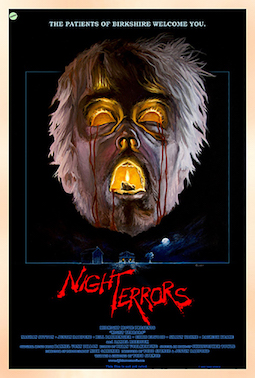
Night Terrors is a 1993 horror film directed by Tobe Hooper, a Canada–Israel co-production. The selling point is Robert Englund in two roles. He plays the modern character Paul Chevalier, written as a descendant of the Marquis de Sade and the man leading a sadomasochistic cult, and he plays the historical Marquis de Sade in flashbacks. A young woman goes to Cairo to see her father and is pulled into Chevalier’s strange, charismatic cult. Ritual, sexual domination, and thriller plotting tangle together until she is no longer an ordinary tourist. With Englund, the cast includes Zoe Trilling, Alona Kimhi, and Juliano Mer-Khamis. The power games are built around the Sade name.
The production path was a mess, and the finished film shows it. In 1993 producer Globus and Harry Alan Towers made three Israeli films. Only Night Terrors also got a theatrical release. Daniel Matmor wrote the script. Rom Globus shares a credit, his only film credit. Englund signed when he heard the shoot would be in Alexandria, Egypt. The project then changed. It stopped being a straight de Sade period piece and became a film built from a collection of de Sade’s erotic short stories. The original director quit. The location moved to Tel Aviv. The timeline became contemporary. To keep Englund, the producers hired Tobe Hooper, one of Englund’s favourite directors. Hooper was already in the stretch after Poltergeist, the years critics often treat as a decline. Post-production moved to Canada.
Reviews, and what the SM cult actually is
In BDSM and fetish talk the film is usually a bad example, or a hybrid that does not hold. It wears an “erotic thriller” label. It shows SM-coded group dynamics and a de Sade descendant. It does not go into negotiated kink or any careful power exchange. Reviews were largely negative. Entertainment Weekly called it a hybrid of Zalman King and Stephen King, and questioned whether the stars and director of Eaten Alive should have tried it. John Kenneth Muir wrote that it lacks intellectual, stylish gamesmanship, and called it a heavy-handed, turgid muddle. It is not much of a thrill, it does not show Hooper’s usual humor or energy, and the write-ups treat it as Hooper hitting a new low.
For anyone watching how BDSM shows up on screen, Night Terrors is a 1990s genre picture packaging sadomasochism as exotic, dangerous cult menace rather than as play adults arrange. The Sade material works like set dressing. Without a coherent erotic style, or any real thematic bite, the cult is a costume. The reviews are poor. Englund’s double role, away from Freddy, and the Marquis de Sade as a literary trademark, still keep the film on home video and streaming lists. People tracing how mainstream horror flattens SM can use the failure itself: this is what literary sadism looks like after a commercial thriller has simplified it.