
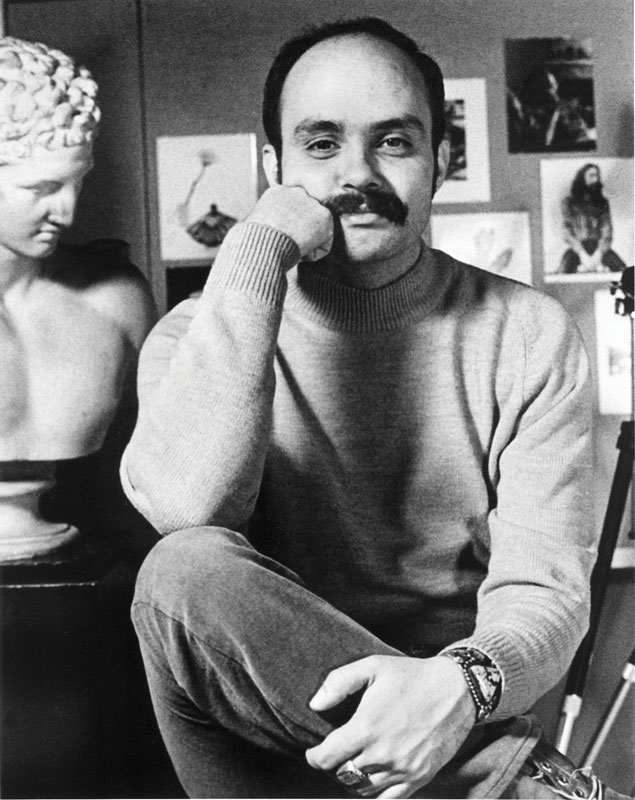
John Joseph “Jack” Fritscher (born 20 June 1939) is the American writer, editor, historian, and dirty-movie maker who turned post-Stonewall leather into sentences you can still quote. He is known internationally for fiction, erotica, and nonfiction about pop culture and gay male life. He was an activist before the Stonewall riots and an out founding member of the Journal of Popular Culture. The job that made him unavoidable was Drummer: San Francisco editor-in-chief from March 1977 to December 1979, the magazine’s most frequent contributor across three publishers, and later the man who wrote the institutional memory down so the 1970s would not vanish into bar myth.
If you care about gay SM as a culture rather than as a porn category, Fritscher is infrastructure. He put Mapplethorpe and Old Reliable into gay media, coined homomasculinity, redefined S&M as “Sensuality and Mutuality,” put older men and the first magazine-cover “Bear” into the press, shot more than 150 fetish videos with Mark Hemry, and then spent decades telling the story of how Drummer invented a language. Leather archives do not run on vibes. They run on people who were in the room and kept the tapes.
Peoria, the Josephinum, Tennessee Williams
Fritscher was born 20 June 1939 in Jacksonville and raised in Peoria, Illinois, in a Catholic family. He was a Depression baby who grew up in rental housing during World War II, then hit his teens in the 1950s among the gay men who used pop culture and the Beats to get out from under conformity. From a young age the family script said he should be a priest. In 1953, at fourteen, he entered the Pontifical College Josephinum for high school and college, studying Latin and Greek. He took a philosophy degree in 1961, then did graduate work in theology and the Scholasticism of Thomas Aquinas (1961–1963). Jesuits also put him through the humanism of Marsilio Ficino, Erasmus, and Jacques Maritain. The first publication came in 1958; the first play was produced in 1959. He has said that he was celibate at the seminary and that “I probably became gay because of the Josephinum, although nothing happened (to me) there.”
In 1962 and 1963, inspired by French Worker-Priests and tutored by Saul Alinsky, he worked as a social activist on Chicago’s South Side. He was ordained by the Apostolic Delegate to the minor orders of porter, lector, exorcist, and acolyte. The priest track then bent. In 1964 he entered Loyola University Chicago for a master’s and doctorate. The dissertation, finished in 1968, was Love and Death in Tennessee Williams. An earlier doctoral textual qualification, When Malory Met Arthur: Love and Death in Camelot (1967), shows the same obsession already running: desire, death, and male myth, filed as scholarship before it was filed as leather journalism.
The Professor Who Also Wrote Leather Blues
He reached San Francisco in 1961 and kept a base there. From 1965 he taught at Loyola University Chicago, earned tenure at Western Michigan University, and lectured regularly at Kalamazoo College. From 1968 to 1975 he sat on the board of the Kalamazoo Institute of Arts and founded and directed the museum film program. In 1969 he created and taught the first film-as-literature courses in Western Michigan’s English department. Between academic posts in San Francisco he used the Catholic-press résumé to work as an editorial writer for KGO-ABC TV, a technical writer for the San Francisco Muni Metro, and manager of marketing at Kaiser Engineers, Inc. (1976–1982). The double life is the point. The man who later edited fist-fucking classifieds had already been paid to write like an institution.
The books start early and do not stay in one genre. First novel: What They Did to the Kid: Confessions of an Altar Boy (1965), later reissued as a tale of priest abuse. First gay novel: I Am Curious (Leather), also known as Leather Blues (1969; Gay Sunshine Press edition 1984), the adventures of Denny Sargent. In 1972 he published Popular Witchcraft: Straight from the Witch’s Mouth, the first book to look hard at gay Wicca and witchcraft; the University of Wisconsin Press / Popular Press brought out a second edition in 2004. Corporal in Charge of Taking Care of Captain O’Malley (Gay Sunshine Press, 1984) was the first collection of leather fiction and the first collection of fiction from Drummer. The title play was the only drama Winston Leyland put into the Lambda Literary Award–winning anthology Gay Roots: Twenty Years of Gay Sunshine (1991).
Academic essays appeared in Bucknell Review, Modern Drama, the Journal of Popular Culture, Censorship: A World Encyclopedia, and Playbill. Photographs went out through Taschen, Rizzoli, Weidenfeld & Nicolson, St. Martin’s Press, Gay Men’s Press London, and a stack of magazines and book covers, including James Purdy’s Narrow Rooms (1996). Video and stills sit in the permanent collections of the Maison européenne de la photographie in Paris, the Kinsey Institute, and the Leather Archives and Museum. He turned up on The Oprah Winfrey Show and on BBC Channel 4 with Camille Paglia. That is not a bar-zine résumé. It is a writer who kept one foot in the university and one in the sling and refused to treat either as a hobby.
Drummer: Two Years in the Chair, Decades in the File
Fritscher entered post-Stonewall gay publishing as founding San Francisco editor-in-chief of Drummer from March 1977 through December 1979. The magazine itself ran 1975–1999, the city’s longest-lived leather title. He was one of only two editors-in-chief in its history, and its most frequent contributor—editor, writer, photographer—under all three publishers. That continuity is why he became the historian of the magazine’s institutional memory. Other men passed through. He kept the minutes.
The masthead years are also a talent scout’s log. He introduced Robert Mapplethorpe and David Hurles (Old Reliable) into gay media and put pages under Robert Opel, Arthur Tress, Samuel Steward (Phil Andros), Larry Townsend, John Preston, Wakefield Poole, Rex, and A. Jay. If you know those names as the visual and literary canon of 1970s–80s gay fetish, you are looking at a list Drummer helped make inevitable. Fritscher’s claim is not that he invented them. It is that he put them in a monthly that leather men actually bought.
He also treated language as a job. In the first post-Stonewall decade, gay journalists were inventing words for a culture that had just become speakable. Fritscher coined homomasculinity as a gay-identity term and, in 1974, redefined S&M as “Sensuality and Mutuality.” He called himself a homomasculinist, inside the larger set of masculinist men. On the page and on video he documented the start of the “Daddy” and “Bear” currents. He was the first writer and editor to feature “older men” in the gay press, in Drummer 24 (September 1978). That issue is easy to file as a kink footnote. It is actually a demographic revolt: the gay market’s youth cult getting a monthly argument that masculinity, age, and leather belonged in the same frame.
The memory books came later, when the bars were already ghosts. Gay Pioneers: How Drummer Magazine Shaped Gay Popular Culture 1965–1999 (2007) is the eyewitness history and interview file. A selection of his Drummer writing appeared in 2008 as Gay San Francisco: Eyewitness Drummer, then in a fuller 2010 Palm Drive edition subtitled as a memoir of sex, art, salon, pop-culture war, and the magazine’s history from the Titanic 1970s to 1999, edited by Mark Hemry. Those volumes are why researchers can still reconstruct a monthly that most libraries never catalogued as literature.
Man2Man, Bears on a Cover, Other People’s Start-Ups
After Drummer he published eight quarterly issues of the raunchy gay zine Man2Man (1980–1981). It was built mainly on a typewriter, under the slogans “What You’re Looking For Is Looking for You” and “The Mag You Can Stick Your Nose In.” Issues ran 44 to 60 pages: uncensored and sometimes bizarre personal ads, readers’ letters, art by Old Reliable and Rex, interviews, Fritscher’s own pornographic fiction, ads for erotic merchandise, and articles on locker-room “clothes harvesting,” jockstraps, cigars, and other extreme fetishes. Mark Hemry is credited as publisher and graphic designer. The zine is the opposite of a respectable journal. That is why it matters. It is the place the classified id went when a slicker magazine could not print the whole smell.
With California Action Guide, in November 1982, Fritscher became the first editor to put the gay “Bear” subculture on a magazine cover. He also helped launch dozens of other emerging gay magazines and booked anthologies for new houses such as Gay Sunshine Press and Bowling Green University Press. The pattern is consistent: he does not only write inside a scene. He builds the cheap paper the scene needs in order to find itself.
Palm Drive Video and the Homomasculine Camera
In 1984 Fritscher and producer Mark Hemry co-founded Palm Drive Video, aimed at homomasculine entertainment rather than the pretty-boy default of much gay porn. Fritscher wrote, cast, and directed more than 150 fetish features. The studio also shot documentary footage of street festivals and contests, including the first “Bear” contest at the Pilsner Inn in February 1987. The 2021 documentary Raw! Uncut! Video! is the later film about what that catalog did and how far the influence ran. For leather history the videos are not side hustle. They are the moving-image twin of Drummer: older men, gear, ritual, and a refusal to treat masculinity as a problem the camera should apologize for.
Palm Drive Publishing, Hemry’s imprint, later carried the novels and the history books. The couple’s working life and their erotic catalog are the same company. That is unusual even in gay publishing, where writers often sell the manuscript and let someone else own the dirty pictures. Fritscher kept both.
Historian, Bear Cover Boy, Mapplethorpe’s Ex
As a participant-witness he wrote “Artist Chuck Arnett: His Life/Our Times” for Mark Thompson’s Leatherfolk: Radical Sex, People, Politics, and Practice. He filed regular historical journalism for the Bay Area Reporter and Leather Times. In 1972 he was the first gay writer to find and interview Samuel Steward (Phil Andros); Justin Spring used those audiotapes in the 2010 Steward biography Secret Historian. Fritscher had been building a gay-history archive since 1965. The date is early enough to matter. He started clipping the culture before Stonewall made clipping fashionable.
Chris Nelson photographed him for Richard Bulger’s original Bear magazine and for the book The Bear Cult, selected and introduced by Edward Lucie-Smith. As writer and photographer he supplied fiction and pictures for covers and interiors at Bear and other Brush Creek Media titles. He wrote the introduction to Les Wright’s Bear Book II and appeared in Ron Suresha’s Bears on Bears: Interviews & Discussions and in Hemry’s fiction anthology Tales of the Bear Cult. Other people who photographed him include Mapplethorpe, Daniel Nicoletta, Arthur Tress, David Hurles, David Sparrow, Robert Opel and his nephew Robert Oppel, and Jim Tushinski. The byline and the body occupy the same archive. He did not only describe the look. He was in the look.
He is married to Mark Hemry, founding owner of Palm Drive Publishing. They met on 22 May 1979, the night after the White Night riots, under the marquee of the Castro Theatre. They took a civil union in Vermont on 12 July 2000, a Canadian marriage on 19 August 2003, and a California marriage on 20 June 2008—Fritscher’s birthday. Earlier significant partners were David Sparrow and Robert Mapplethorpe. Anthony Michael Lopez played Fritscher in the 2018 biopic Mapplethorpe. The film cameo is pop residue. The living record is the marriage that also ran the video company and the press.
The Shelf: Novels, Memoir, Awards
The novels people still cite besides the early altar-boy and leather books include Some Dance to Remember: A Memoir-Novel of San Francisco, 1970–1982 (Harrington Park Press, 2005), the big fictionalized Castro-and-plague canvas; The Geography of Women: A Romantic Comedy (Palm Drive, 1998); and Titanic: The Untold Tale of Gay Passengers and Crew (Palm Drive, 2012). The nonfiction spine is Mapplethorpe: Assault with a Deadly Camera (Hastings House, 1994), a pop-culture memoir and “outlaw reminiscence” of the photographer; the Drummer histories; Popular Witchcraft; the 1971 Claretian Press title Television Today (with Mark J. Brummel, R.J. Liskowski, and Tom Hogan); and the Loyola dissertation. He also placed short work in Richard Labonte’s Muscle Men: Rock Hard Gay Erotica (Cleis, 2010).
The leather award circuit eventually caught up with the man who had been taking notes since the 1960s. National Leather Association International gave him the Geoff Mains Non-Fiction Best Book Award in 2009 for Gay San Francisco: Eyewitness Drummer Vol. 1, and the Cynthia Slater Non-Fiction Feature Article Award the same year for the Larry Townsend obituary “Spill a Drop for Lost Brothers.” More Slater awards followed: 2016, shared with Jaco Lourens, for “Conversations With Leather”; 2020 for “Thom Gunn (1929–2004).” NLA International added the Geoff Mains Nonfiction Book Award in 2018 for Gay Pioneers, a Samois Anthology Award in 2020 for Mapplethorpe Movie, and a Lifetime Achievement Award in 2020. The Pantheon of Leather Awards gave him the Northern California Regional Award in 2010 and the Mr. Marcus Hernandez Lifetime Achievement Award (Man) in 2014. Those plaques are not the work. They are the scene admitting that the archivist was also one of the makers.
Why Fritscher Still Sits in the Leather Stack
Gay male BDSM did not arrive as a website. It arrived as bars, a magazine that lasted from 1975 to 1999, a set of new words, a camera pointed at men who were not twenty-two, and a handful of editors willing to put Mapplethorpe, Rex, Steward, and a cigar-fetish letter in the same month. Fritscher is the person who did an unusual amount of that labor and then wrote down how it felt from the chair. Homomasculinity, Sensuality and Mutuality, the first older-men feature, the first Bear cover, Palm Drive’s 150-plus fetish films, the Steward tapes Spring later needed—those are not branding claims. They are dated events.
Read him if you want Drummer as a workplace, not as nostalgia merch. Read Some Dance to Remember if you want the Castro years as a novel that still smells like poppers and funerals. Read the Mapplethorpe memoir if you want the photographer as a lover and a media bomb rather than as a museum poster. Watch Raw! Uncut! Video! if you want to see what “homomasculine entertainment” looked like when it was still a small California company and not a niche tag. And keep the Josephinum in the frame. The Latin-and-Aquinas boy who said the seminary made him gay, and the editor who told S&M it could mean mutuality, are the same intelligence. Leather culture is luckier than it knows that he stayed long enough to index it.
A compact shelf for someone who will not read everything: Leather Blues for the early gay novel; Corporal in Charge for the first leather-fiction collection and the Drummer stories; Some Dance to Remember for the 1970–82 San Francisco memoir-novel; Gay San Francisco: Eyewitness Drummer and Gay Pioneers for the magazine as history; Mapplethorpe: Assault with a Deadly Camera for the photographer as lover, subject, and media weapon; Popular Witchcraft if you want the 1972 gay-Wicca book that still surprises people who only know the sling essays. The site JackFritscher.com and the IMDb page catch the video credits the print bibliographies undersell. The Mineshaft, the New York club that sits on every “see also” list next to his name, is the East Coast room that matches the San Francisco monthly: leather as public architecture, not as a private drawer.
Two dates to keep on the same card. 22 May 1979: the night after the White Night riots, Hemry under the Castro marquee—the personal life starting at the exact hour San Francisco gay politics went through a window. March 1977–December 1979: the Drummer chair, only two years, after which he still wrote and shot for the title under later publishers until the magazine died in 1999. The short official tenure is why casual histories undersell him. The long contributor file, the eight Man2Man quarters, the November 1982 Bear cover, the 1984 Palm Drive launch, the 1987 Pilsner Inn Bear contest, and the 2000s–2020 NLA and Pantheon plaques are the rest of the job. He did not pass through leather. He indexed it, fucked on camera inside it, married the man who published it, and left a paper-and-tape trail thick enough that the next historian does not have to invent the 1970s from a harness catalog.
)