
Irving Klaw (November 9, 1910 – September 3, 1966), who branded himself the “Pin-up King,” was a decisive American merchant of sexploitation, fetish, and Hollywood glamour photographs and films. Like his predecessor Charles Guyette, Klaw was primarily a merchandiser rather than a camera artist: he commissioned models, sponsored illustrators, packaged catalogs, and ran the mail-order and storefront machinery that put bondage and fetish imagery into mid-century American hands. Models associated with his productions include Bettie Page, June King, Joan Rydell, Jackie Miller, and others; illustrators he sponsored include Eric Stanton, Gene Bilbrew, and many more. Indirectly he also kept alive the commercial legacy of Guyette and John Willie. Fetish art historian Richard Pérez Seves places Klaw at the center of the pre-1970 “Bizarre Underground.”
Brooklyn Beginnings and Movie Star News
Klaw was born November 9, 1910, in Brooklyn, New York; his father, a BMT subway conductor, died while Irving was in high school. A blended family after divorce included three boys and three girls; Paula Klaw was a step-sister who became his crucial business partner. In 1938 Irving and Paula opened a struggling basement used bookstore at 209 East 14th Street in Manhattan. When teenagers kept tearing photos out of movie magazines, Klaw switched to selling star stills and lobby cards. The stills sold so well he abandoned books and moved from basement to street-level storefront. Business thrived; the self-styled Pin-Up King relocated to 212 East 14th Street as Irving Klaw’s Pin-Up Photo and eventually as Movie Star News. An international mail-order trade in cheesecake and Hollywood glamour pin-ups ran alongside the counter trade.
Entry into Fetish Art
In 1948 a collector known as Little John “inspired/sponsored Klaw’s full-blown entry into the fetish art business.” Magazine publisher Robert Harrison also influenced the turn. Early fetish models included Harrison-world names Barbara Leslie, Vicky Hayes, Joan “Eve” Rydell, Lili Dawn, Shirley “Cici” Maitland, Kevin Daley, Roz Greenwood, and Bettie Page. Inspired by John Willie, Klaw commissioned and distributed illustrated adventure/bondage chapter serials by Stanton, Bilbrew, Adolfo Ruiz, and others—paper serials that trained a generation’s eye for heels, restraint, and villainous plot.
Burlesque Features and Bondage Film Loops
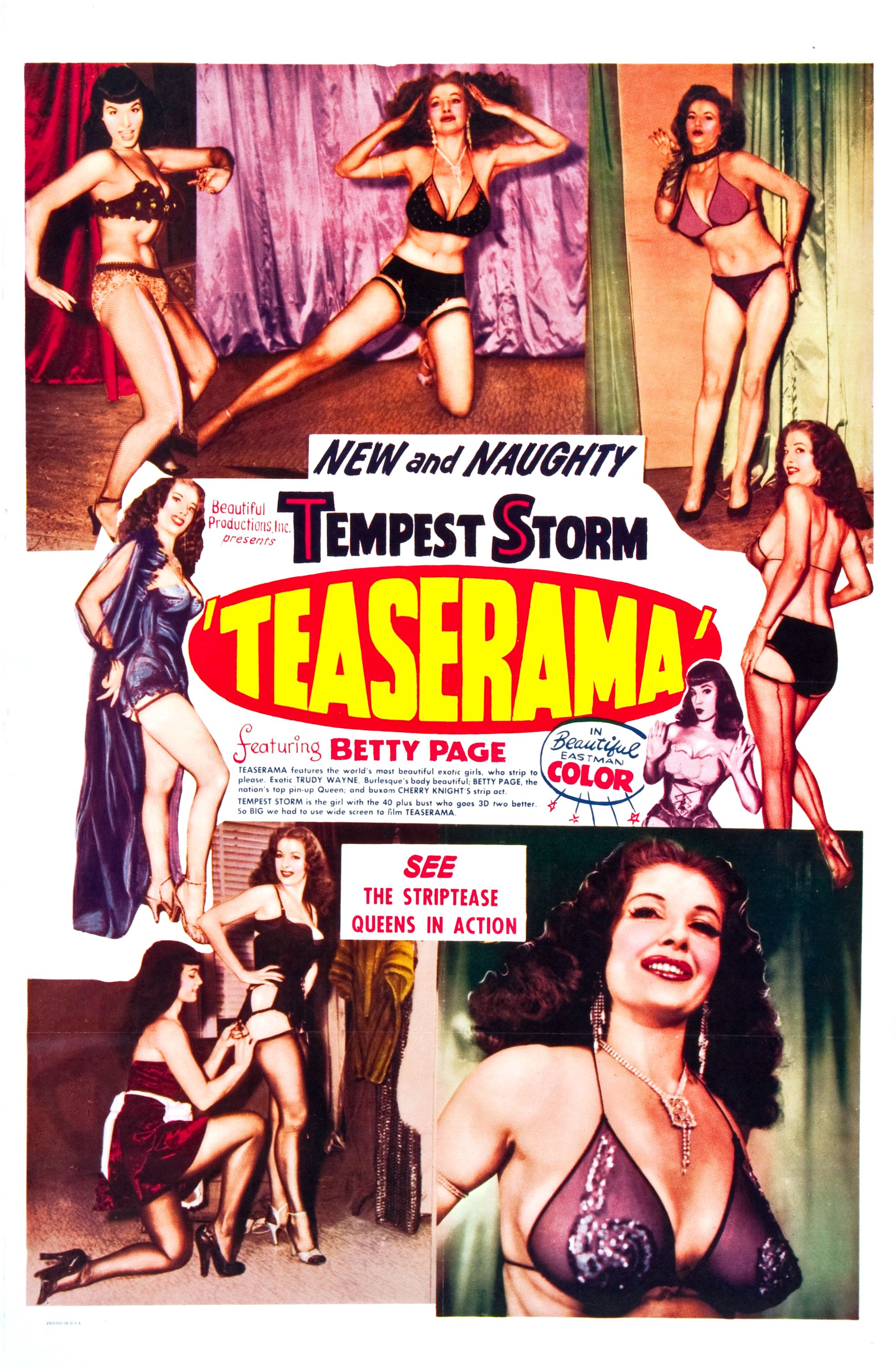
Burlesque star Lili St. Cyr later described Klaw’s production method: he shot separate segments with different women—including Bettie Page—then spliced enough reels together to make roughly fifty-minute “full pictures” that could be recombined across titles. After the surprise success of the 1953 B-movie burlesque revue Striporama (with famous strippers and Page), Klaw directed his own color burlesque features with professional crews and saturated Eastman color stock: Varietease (1954) and Teaserama (1955), starring Lili St. Cyr, Tempest Storm, and Bettie Page (later released on U.S. DVD in 2000). A third feature, Buxom Beautease (1956), proceeded without Page.
On weekends he also produced scores of silent 8 mm and 16 mm black-and-white film loops—striptease and special-request fetish scenarios. Titles such as Riding the Human Pony Girl, Bondage in Leather Harness, and Booted Amazon Fights Again show women in lingerie and heels in elaborate bondage, cat-fights, spanking, and slave-training tableaux. Most were shot on a single sparse set above Movie Star News or in a nearby loft. At least two Page films—Rumble Seat Bondage and Jungle Girl Tied to Trees—were shot outdoors. Still photos from the same sessions sold in the store and through the bi-annual mail-order catalog Cartoon and Model Parade.
Censorship, Kefauver, and the Burning of Negatives
In 1956 Abe McGregor Goff, general counsel of the Post Office Department, denied Klaw use of the U.S. mails, calling him one of the nation’s largest dealers in pornographic material. That same year his sister Mrs. Fanny Cronin was arrested over a New Jersey operation the press described as a multi-million-dollar “pornographic films and photos mill.” The 1957 Kefauver Senate Subcommittee hearings on juvenile delinquency marked the beginning of the end for Klaw’s New York mail-order fetish business. McCarthy-style proceedings branded him a degenerate pornographer and helped usher in a new censorship wave. Bettie Page was summoned but never testified (later dramatized in The Notorious Bettie Page); she soon retired from modeling.
Under political, social, and legal pressure, Klaw closed the storefront and burned many negatives—estimates claim more than 80% were destroyed. Paula secretly saved a selection of the better images, which survive for modern viewers. After Senate and state pressure barred the New York business, he moved Nutrix Publishing and associated Satellite Publications (Stanley Malkin & Pat Martini) to Jersey City. Both sold fetish-oriented photos and magazines; Nutrix became mail-order-only. Small illustrated bondage photo-booklets followed: titles such as Girl Psycho Handled with Restraint (1960, including older Page photos), Girls Punishment at School of Discipline (1962), Tortured Models in the Wax Exhibit (1962), and Paddled Severely During Sorority Initiation (1963). Eventually he sold the line to Ed Mishkin, who rebranded Nutrix as Mutrix using the first letter of his surname.
Florida Nudie Cuties and Final Legal Trouble
Relocated to Florida, Klaw briefly returned to film in 1963 as producer of Larry Wolk’s Intimate Diary of an Artist’s Model and co-director/producer of Nature’s Sweethearts. Photographer Bunny Yeager worked closely on casting and dialogue; unlike the earlier burlesque features, these were exploitation “nudie cuties” with topless women. He also continued bondage photography in Miami with models such as Maria Stinger. In 1963 Robert F. Kennedy’s campaign helped convict Klaw and brother-in-law Jack Kramer of conspiracy to send pornographic materials through the mail. Irving Klaw died September 3, 1966, from complications of untreated appendicitis. He was survived by sons Arthur and Jeffrey. Nephew Ira Kramer (son of Paula and Jack Kramer) later ran Movie Star News—on 18th Street until 2012, then in Las Vegas.
Screen Portraits and Home-Video Afterlife
Klaw has been portrayed by Dukey Flyswatter in Bettie Page: Dark Angel (2004) and by Chris Bauer in The Notorious Bettie Page (2005). The 1980s Bettie Page revival drove video compilations of his loops: London Enterprises added music and narration for Irving Klaw Bondage Classics (1984, two volumes); Cult Epics issued Bettie Page: Bondage Queen (2005) and Bettie Page: Pin Up Queen (2005), the latter drawing burlesque numbers from Striporama, Varietease, and Teaserama plus dance and cat-fight loops. Something Weird Video’s Bizarro Sex Loops volumes 4 and 20 (2007–2008) include further Klaw bondage reels, some with Page. In 2012 he was inducted into the Leather Hall of Fame.
Filmography Snapshot
- Striporama (1953)
- Varietease (1954); Teaserama (1955); Buxom Beautease (1956)
- Intimate Diary of an Artist’s Model (1963, producer); Nature’s Sweethearts (1963, producer)
- Later compilations: Irving Klaw Bondage Classics I & II (1984); Bettie Page: Bondage Queen / Pin Up Queen (2005); Bizarro Sex Loops 4 & 20 (2007–2008)
Legacy for Fetish and BDSM Media
Klaw did not invent bondage photography, but he industrialized its mid-century American distribution: storefront plus catalog plus film loops plus commissioned illustration. Without Movie Star News and Nutrix, the Bettie Page bondage archive that later flooded goth and fetish fashion would be thinner; without his sponsorship, Stanton and Bilbrew serials would have reached fewer hands. Censorship nearly erased the negatives; Paula’s hidden stock and the home-video era undid part of that erasure. For bdsmwild readers, Irving Klaw is the Pin-up King who proved fetish demand could sustain a business—and who paid for that proof in Senate hearings, burned film, mail bans, and a shortened life. Further reading includes Pérez Seves’s Eric Stanton & the History of the Bizarre Underground (Schiffer, 2018) and his expanded Charles Guyette study (FetHistory, 2018), which map the network Klaw merchandised into mass memory.
How the Business Actually Worked
Klaw’s genius was logistics. Movie Star News trained customers to buy stills; the same counters and catalogs could sell fetish commissions once demand showed itself. Weekend loop sessions maximized sparse sets: one loft, rotating models, endless recombined titles. Mail-order catalogs such as Cartoon and Model Parade carried both glamour and bondage to buyers who would never walk into a 14th Street shop. Sponsoring Stanton and Bilbrew serials extended the brand into drawn fantasy where photography could not yet go—extreme costumes, narrative captivity, chapter-cliffhanger sadism—while still feeding the same collector psychology.
Legal pressure reveals how fragile that ecosystem was. Postal bans, sister-company raids, Senate juvenile-delinquency theater, and later federal conspiracy charges treated pin-up bondage as a public menace. Burning negatives was both panic and compliance theater; Paula’s secret cache is why modern Bettie Page bondage iconography is not entirely a rumor. Nutrix booklets in Jersey City and Mutrix after the Mishkin sale show the business adapting by shrinking footprint, renaming imprints, and staying mail-only—classic mid-century erotic survival tactics.
Florida’s nudie-cutie phase with Bunny Yeager marks a late pivot toward more conventional exploitation topless product even as Miami bondage stills continued. The career thus spans Hollywood glamour retail, underground fetish illustration, burlesque features, silent bondage loops, photo-booklets, and softcore features—always as packager and director-merchant more than as art-for-art’s-sake photographer. Leather Hall of Fame induction in 2012 and endless Page compilations on Cult Epics and Something Weird complete the irony: the man driven out of Manhattan retail is now a named ancestor of fetish media studies.
For bondage and BDSM audiences, Klaw’s archive is primary evidence of pre-internet kink commerce—what people ordered, what censors feared, and which images survived the fire. Pair his loops with Guyette’s earlier merchant role and Willie’s illustration influence, and the American “bizarre underground” stops looking like a sudden 1970s invention and starts looking like a multi-decade supply chain with Irving Klaw at the cash register.