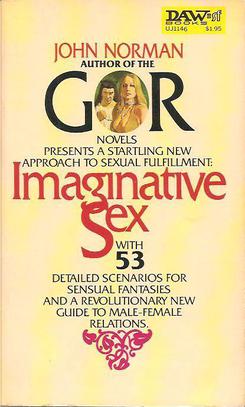
John Norman’s Imaginative Sex is not a scholarly study. It is a practical book that tries to join science-fantasy male-dom scenarios to what a couple actually does in bed. DAW Books brought out the paperback in 1974, through the same science-fiction and fantasy channels as Norman’s Gor series. In 1997 Rhinoceros Books, the adult imprint of Masquerade Books, reissued it with a new foreword by BDSM writer Patrick Califia.
Califia called the 1974 edition one of the first above-ground nonfiction books to give dominant/submissive role-play a rationale and some instructions for doing it. The jargon and conventions people now take for granted did not exist when Norman wrote, which is why the book never uses them. Historians of kink writing treat it as a bridge: Gor-style male-dominant fantasy packaged as couple advice, before SSC language, munch culture, or scene education on the internet.
Who the scripts are for
Norman’s text is written for male-dominant, female-submissive heterosexual couples. Califia’s foreword says readers of other orientations and genders can still use it. Norman is good at naming stock situations that pile up tension and polarization, the part that makes a scene work. The scripts are gendered on the page. The frames travel: capture, ownership language, ritual service, mock punishment, rescue and possession. Pull those out of the heterosexual male-dom setup and they can sit in another negotiated D/s relationship between adults.
One of Norman’s stated aims is to let imagination loosen around sex. He pushes married couples to use fantasy and role-play so the mental side of sex is in the picture along with the genital part. He still defends the male-dominant, female-submissive theory that holds up the Gor novels. He also tells readers not to import Gorean customs and institutions into real life as a literal kit. Next to the novels, this book leans harder on pair-bonding and a stable heterosexual relationship.
Clap, don’t strike, as the default
When a fantasy scenario calls for a whipping, Norman’s default is theater, not an untrained blow. The man claps his hands hard. The person playing the “slave” reacts as if struck. Adults who have not trained impact can get into the role with sound, movement, and language instead of real hitting. He wants married couples to use the fantasies to wake sex up, including the psychological layer that ordinary intercourse skips.
The scripts are built on a heterosexual male-dom pattern. Ownership lines and ritual service are doing the work of making one person dominant and the other compliant. Someone who dislikes Norman’s gender politics can still lift the scenario structure. Someone who came in through Gor will recognize the line. The book has outlasted the paperback racks it started on, from DAW in 1974 to the Rhinoceros reissue in 1997.
![[Fuji Kikaku] W-02 Bandage Bondage White Flesh Doll Asako Mochizuki Eiko Nishimiya -Chimu Nuruki- (Bandage Bondage White Flesh Doll) fuji-0017 [Exclusive]](https://bdsmwild.com/wp-content/uploads/2026/09/W-02-fuji-0017-Exclusive.jpg)