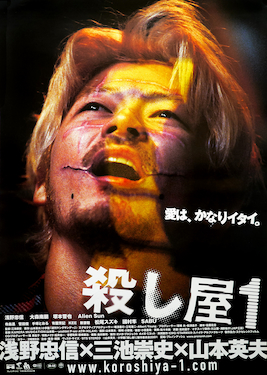
Ichi the Killer (Japanese: 殺し屋1, Koroshiya Ichi, lit. “Hitman One”) is a 2001 Japanese horror-yakuza film directed by Takashi Miike, written by Sakichi Sato, and starring Tadanobu Asano and Nao Omori. Adapted from Hideo Yamamoto’s manga, it follows a psychologically damaged man manipulated into assaulting and killing members of rival yakuza factions while a sadomasochistic enforcer hunts the truth. Graphic cruelty made the film notorious and triggered censorship in multiple countries. Kink-media viewers often file it under extreme SM-adjacent cinema: not negotiated BDSM, but a hyperviolent study of sadism, masochism, and media-consuming audiences.
Plot: Ichi, Kakihara, and Manufactured War
A man called Ichi masturbates on a balcony while watching a pimp rape and assault a prostitute; when discovered, he flees. Sadistic yakuza boss Anjo is murdered. A cleaning crew run by Jijii erases the scene and credits Ichi. Kakihara—Anjo’s sadomasochistic high-ranking enforcer—finds the spotless apartment and concludes Anjo fled with a prostitute and three million yen. At an underworld club he tells Anjo’s girlfriend Karen, an English-speaking Chinese prostitute, that Anjo may still be alive, perhaps kidnapped by rivals.
Jijii feeds Kakihara the rumor that Suzuki of the Funaki clan took Anjo. Kakihara tortures Suzuki; when Suzuki proves innocent, Kakihara slices off the tip of his own tongue as penance to Suzuki’s boss. Kakihara’s people later capture Kano, a drug-addled cleaner, who admits Ichi killed Anjo and that Kakihara is next. Ichi returns to the pimp’s balcony, watches him brutalize Sailor (a prostitute Ichi regularly sees), then intervenes, kills the pimp, and claims he will be the one to assault her—then reflexively kills Sailor when she fights back.
At Suzuki’s push, Kakihara is banished, but the Anjo clan defects with him. Suzuki offers Jijii a million yen to kill Kakihara. Jijii is secretly orchestrating inter-clan war and using Ichi as a weapon. Normally timid, Ichi becomes homicidal and sexually aroused when enraged; Jijii implants false memories—especially a high-school rape narrative—to steer him. After Ichi saves a boy, Takeshi, from bullies, Jijii goads him into slaughtering Anjo-clan remnants in an apartment. Takeshi thanks him; Takeshi’s father Kaneko (one of Kakihara’s men) later rescues Ichi from a brothel-keeper assault, remembering his own past rescue by Anjo men.
Kakihara uses corrupt twin detectives Jirō and Saburō to hunt Myu-Myu, a prostitute linked to Ryu Long of Jijii’s gang. Torture trails lead to Long; Kakihara captures him for more leads. Jijii has Karen seduce Ichi as the woman from his false memory; confused by her claim that she wanted rape and assault, Ichi kills her. Jijii warns Kakihara that Ichi is coming, then is spotted by Takayama; after a chase, surprisingly muscular Jijii kills Takayama. Ichi storms Kakihara’s base, kills the twins, and a rooftop chase with Kaneko and Kakihara ends in catastrophe: manipulated into seeing Kaneko as his brother, Ichi is shot in the leg, slits Kaneko’s throat before Takeshi, breaks down as Takeshi attacks him, and Kakihara—rattled—skewers his own ears. Kakihara hallucinates Ichi decapitating Takeshi and a bladed-boot strike to his forehead, then falls to his death; Jijii finds no head wound. Years later Jijii’s corpse hangs in a park; a young man resembling grown Takeshi leaves with schoolchildren.
Production Notes
The soundtrack was written and produced by Karera Musication, a Boredoms side project, under ex-guitarist Seiichi Yamamoto and percussionist/bandleader Yoshimi P-We. The film’s sound design and music are part of its assaultive aesthetic—noise and rhythm as partners to gore.
Themes: Violence, Media, Audience
Film journalist Tom Mes reads the movie as a sophisticated critique of violence, media, and spectatorship that never simple-mindedly moralizes. Paradoxically, a film that pushes bloodshed to new extremes can still force viewers to examine their own appetite for violent images. Mes argues Miike steers without preaching, leaving conclusions to the audience. He is especially harsh on censorship cuts: the film’s “playful” and “painful” violence work as a symbiotic whole; removing “painful” scenes makes the remainder more exploitative and guts the critical design. For BDSM-literate viewers that argument lands twice—once as film theory, once as a warning that context is everything when representing SM aesthetics on screen.
Release, Barf Bags, and Censors
World premiere: Midnight Madness, Toronto International Film Festival, 14 September 2001. Japanese release: 22 December 2001. TIFF (and later Stockholm) publicity handed out barf bags; reports claimed one viewer vomited and another fainted. The BBFC refused an uncut UK release over “scenes of mutilated, raped or savagely beaten women or of sexual pleasure from violence,” demanding 3 minutes 15 seconds of cuts for an 18 certificate. Hong Kong lost 16 minutes 59 seconds. Norway and Malaysia banned it outright; Germany banned distribution. A 2018 digital restoration by L’Immagine Ritrovata premiered publicly at HKIFF42.
Reception and Prequel
Rotten Tomatoes later sat near 65% from 40 reviews (about 6.20/10), consensus calling it a shocking gorefest for strong stomachs. Metacritic averaged 55/100 from 10 critics—“mixed or average.” Tanner Tafelski (Village Voice) praised a blood-stained commentary on toxic masculine protection that dooms men inside spasmodic hypermasculine violence. Dennis Harvey (Variety) found the hectic pace overstimulating into “numbed-out tedium.” A prequel, 1-Ichi, features Nao Omori as a younger Ichi. Cult-film lists and discussions of prostitution and underworld gender violence in Japanese cinema keep the title in circulation.
Cast and Character Axes
Tadanobu Asano’s Kakihara—scarred smile, needles, masochistic swagger—became the film’s iconic face in international marketing: the enforcer who tortures others and offers pieces of his own body when he is wrong. Nao Omori’s Ichi is the opposite energy: cowed, manipulated, sexually fused to rage, lethal when the false-memory trigger fires. Around them orbit Karen the bilingual prostitute-girlfriend, the twin detectives as corrupt procedure, Jijii as puppet-master cleaner, Kaneko as the almost-paternal gangster, and Takeshi as the child witness who collapses any remaining romance of “protector violence.” The ensemble is built so every protection racket turns into doom, which is exactly the toxic masculine sphere Tafelski described.
Cult Status, Prequel, and How Kink Viewers Should Watch
Prequel 1-Ichi lets Omori play a younger Ichi, extending the character for fans who want origin trauma rather than only the 2001 blood opera. Cult-film lists file Miike’s movie beside other extreme Asian exports of the early 2000s; discussions of prostitution in Japan, yakuza genre codes, and manga-to-screen adaptation violence keep academic and fan commentary alive. The 2018 restoration renewed festival life for audiences who first knew the film as a bootleg or heavily cut DVD.
Watch it as Miike extremism and as a grotesque carnival of sadomasochistic yakuza myth—not as a map for consensual kink. There is no negotiation, no safeword, no aftercare; sexual arousal is glued to murder, torture, and hallucination. The film’s lasting provocation is double: how far representation of sexualized cruelty can go, and whether an audience that buys a ticket (or a barf bag) is part of the machine the movie is diagnosing. Mes’s warning about cuts still applies for anyone teaching the film: if you remove the “painful” reels and keep only stylish gore, you may accidentally produce the pure exploitation text Miike’s full structure works against. For BDSM media readers, that is the useful frame—study the sadomasochistic imagery, study the audience, and do not confuse Kakihara’s needles with a negotiated scene.
From Toronto Midnight Madness in September 2001 to Japanese winter release, from BBFC scissors to Norwegian and Malaysian bans, from barf-bag gimmicks to L’Immagine Ritrovata’s clean digital pass, Ichi the Killer remains a stress test for how much sadomasochistic yakuza horror a national censor will allow and how much a genre audience will cheer. It belongs on a kink-aware film shelf as a negative star: brilliant craft about cruelty, useless as ethics, unforgettable as image. Pair it with Yamamoto’s manga source and with Miike’s wider extreme catalog if you want the full lineage; keep it nowhere near a consent workshop syllabus except as the example of everything negotiation exists to prevent.


![【Exclusive】[隷嬢寫眞館] わずかひとときの恍惚 彩木美奈](https://bdsmwild.com/wp-content/uploads/2025/01/03006-slavebondage-bdsmwild-【Exclusive】隷嬢寫眞館-わずかひとときの恍惚-彩木美奈.webp)