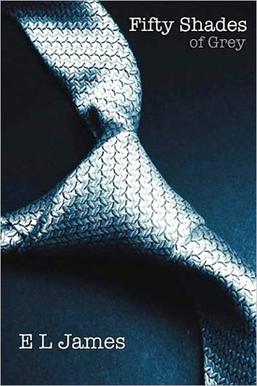
Fifty Shades of Grey is the erotic romance by the British writer E. L. James. It started as a self-published book in 2011. The series later sold more than 150 million copies worldwide. Critics fought about the prose. One line that stuck called it a Brontë without talent. What the book did, whatever the sentences are like, was push hard limits, soft limits, safewords, and a dominance-and-submission contract into mainstream reading. This page stays with the novel.
Anastasia “Ana” Steele is twenty-one. Christian Grey is twenty-seven. Both are adults in the story as it happens. A passage about Christian at fifteen is backstory in the novel, not a scene to treat as present-tense instruction. They meet because Ana covers an interview for a sick friend and stumbles through it. He is interested anyway. A hardware store, a photo session at his hotel, then a drunk pickup, and the relationship speeds up. He offers her a non-romantic sexual contract. No romance, only sex, and rules that say she may not touch him or meet his eyes. When he finds out she is a virgin, he drops a full BDSM scene for that first time, has conventional sex with her, and sleeps in her bed.
The playroom and the belt
His penthouse has a playroom full of BDSM gear. There he shows her a second contract, the dominance-and-submission one, and he wants a non-disclosure agreement. She never finishes signing the D/s contract in the first book. The belt is not their first sex. The conventional sex comes earlier, after he learns she is a virgin. The belt comes later. She asks him to show her the worst punishment he would use for breaking a rule. He beats her with a belt. She ends it.
The book says he lost his virginity at fifteen to his mother’s friend, Elena Lincoln, and that in an earlier BDSM relationship he was the submissive. He sends Ana a copy of Tess of the d’Urbervilles. After her graduation he sends a laptop so she can research BDSM. The non-romantic arrangement presses on her and she pulls back until graduation, where he is the keynote speaker and they reconnect. They talk hard limits and soft limits. He spanks her for the first time. The contract still has no signature. Readers in the community later argued over that missing signature.
Mommy porn, and the reviews
The material began as Twilight fan fiction titled Master of the Universe, with Edward Cullen and Bella Swan. Rewritten as original fiction, the leads became Christian and Ana. The Australian virtual publisher The Writers’ Coffee Shop released the first book in May 2011 as an ebook and print-on-demand paperback. Vintage Books took a revised edition in 2012. The marketing budget was small. Early sales rode book blogs and word of mouth. Newsrooms tagged it “Mommy Porn” and pointed at a large readership of married women over thirty, plus teenagers and college students. In early 2012 U.S. television treated it as a viral-marketing case, and erotic backlists moved with it, including reissues of Anne Rice.
Salman Rushdie said it was badly written. Jesse Kornbluth called reading it a sad joke. The Guardian called it readable and safe. The Daily Telegraph called it a page-turner. The New Zealand Herald and the Columbus Dispatch said the prose was awful and that people still could not stop turning pages. The book is after a guilty thrill, not literary depth. Some readers treated female submission as a theme without treating it as automatic guilt. Other research read emotional abuse through the text, including stalking, intimidation, and isolation, plus sexual-violence patterns, and saw classic abuse responses in Ana. A 2014 study linked young women who had read at least the first book with higher markers of disordered eating, emotionally abusive partners, and binge drinking. It did not show that the book caused those things.
What kink readers objected to
The fight inside BDSM is that the novel mixes negotiated kink with abuse. The demonstration is incomplete. There is paperwork and no peer education. The NDA walls Ana off. The worst punishment, the belt, is used as a relationship test rather than as a rule already agreed. Dominance is written as an illness true love is supposed to cure. Research on the text includes alcohol used to undermine consent. That is not a technique Ana is shown applying to herself. Timothy Laurie and Jessica Kean argued that staging an unequal negotiation makes consent a real problem in the scene, not a checkbox.
He flies her to Seattle by helicopter. The penthouse comes with the NDA. She still has not signed the D/s contract when the first book ends. She decides they do not fit, leaves, and goes back to the apartment she shares with her friend Kate.
Bans, the film, the sequels
From 2010 to 2019 the novel was among the books most often challenged in the United States. In 2012 and 2013 it sat on the American Library Association’s top ten challenged list, for sexual explicitness, age suitability, nudity, language, and religious objections. Libraries in Brevard County, Florida, pulled copies and later restored them because people asked. A court in Macaé, Brazil, ordered sealed sales, away from minors. Malaysia banned the books in February 2015, soon after the film ban.
The film opened in February 2015, with Focus Features among the producers and Universal distributing. Dakota Johnson plays Ana. Jamie Dornan plays Christian. The soundtrack includes The Weeknd’s “Earned It,” among other songs, and a classical compilation charted on Billboard’s classical list. Reviews were poor and the box office was huge, which pushed the series further. The sequels are Fifty Shades Darker and Fifty Shades Freed, both published in 2012. The later Christian-point-of-view books are Grey (2015), Darker (2017), and Freed (2021). Universal sued Smash Pictures over a porn adaptation. The case settled.
Fifty Shades of Grey is not a manual. It does not hand over a finished BDSM ethic. The story forced a decade of argument about contracts, Red Rooms, mommy porn, and library bans. Millions of mainstream readers met the words safeword and limit list here. Technique and ethics were left to educators and to the people actually playing.