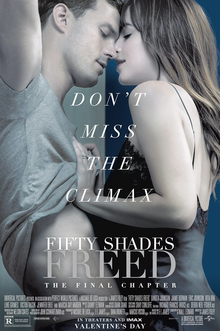
Fifty Shades Freed is a 2018 American erotic romantic drama directed by James Foley and written by Niall Leonard, adapted from E. L. James’s 2012 novel of the same name. Produced by Perfect World Pictures, Michael De Luca Productions, and Trigger Street Productions, and distributed by Universal Pictures, it is the third and final film in the Fifty Shades series after Fifty Shades of Grey (2015) and Fifty Shades Darker (2017). Dakota Johnson and Jamie Dornan return as Anastasia Steele and Christian Grey; the story follows the newly married couple as they face Ana’s former boss Jack Hyde (Eric Johnson), who stalks and attacks them. For mainstream kink-media history, Freed is the trilogy’s closing argument: marriage, pregnancy, luxury lifestyle branding, residual BDSM play, and a thriller plot that critics mostly found thin.
Development and Back-to-Back Shoot
After the first film’s February 2015 premiere, sequel development moved quickly. By November 2015, Foley and Leonard were hired to direct and write both sequels, planned as a back-to-back 2016 shoot. Principal photography on Fifty Shades Freed ran simultaneously with Darker beginning in February 2016 in Paris and Vancouver, ending in July 2016. Composer Danny Elfman, who scored the earlier films, returned for the finale. The dual production locked cast, crew, and visual language across the last two chapters and explains why the sequels feel more like one extended Foley project than a continuation of Sam Taylor-Johnson’s first film.
Universal and Focus Features had secured trilogy rights in March 2012; Michael De Luca Productions produced. At a New York fan screening of the first film on 6 February 2015, Taylor-Johnson confirmed adaptations of Darker and Freed, with the first sequel then aimed at 2016. She later told Digital Spy that returning was not her decision and that she was not in the discussions. On 12 November 2015, TheWrap reported Foley would direct both sequels with Leonard writing and De Luca and Dana Brunetti producing alongside E. L. James and Marcus Viscidi. Johnson and Dornan were locked to return.
Plot: Marriage, Break-In, and Control Fights
Newlyweds Christian and Anastasia cut their honeymoon short after a break-in at Christian’s corporate headquarters. Jack Hyde—fired for sexual assault—has stolen computer files. Christian surprises Ana with a new house and hires architect Gia Matteo to rebuild it. Ana is annoyed when Gia flirts openly with Christian and later threatens to fire her if it continues, forcing Gia to stop. While Christian is away on business, Ana ignores his demand that she stay home and meets friend Kate Kavanagh for a drink. Kate is dating Christian’s older brother Elliot and fears he may be having an affair with Gia, his business associate.
Hyde attempts to kidnap Ana when she returns home. Her new security team subdues him; he is arrested. After arguing about her night out, Ana berates Christian for being controlling and possessive and demands more freedom. He later surprises her with a trip to Aspen, bringing Kate, Elliot, Mia, and José. Elliot proposes to Kate; she accepts. It turns out Gia was only helping him choose the ring—not sleeping with him. The couple continues sexual experimentation, including the playroom dynamic that still defines their private language even inside marriage.
Pregnancy, Elena, and the Ransom
Things complicate when Ana announces she is pregnant. Christian is disturbed; he had other plans for their early years. He leaves on a night-long drunken bender. When he returns, Ana learns he texted and met his ex-lover and former BDSM dominant Elena Lincoln, who groomed him as a minor. Furious, Ana locks herself in the playroom for the night. In the morning they keep arguing; she tells him how important the baby is to her.
Hyde is released on a $500,000 bond and phones Ana demanding a $5 million ransom in cash within two hours. He has abducted Mia, Christian’s sister, and will kill her if Ana fails—or if she tells anyone. Ana must bring the money alone. She takes a checkbook and revolver from Christian’s desk and goes to the bank. The suspicious bank manager calls Christian. Christian first thinks Ana is leaving him, then realizes Mia’s disappearance and the large cash withdrawal coincide with Hyde’s release.
Hyde orders Ana into a nearby car and tells her to hand over her phone. She tricks him by taking the bank manager’s phone and slipping her own into the money bag. At the back exit she discovers the driver—Hyde’s accomplice—is her co-worker Liz. At the drop-off, a psychotic Hyde attacks Ana and kicks her abdomen. Liz tries to stop him as Ana pulls the revolver and shoots him in the leg. Christian and his security team, tracking Ana’s phone, arrive with police who arrest Hyde and Liz. Ana blacks out hearing Christian’s voice.
Hospital, Foster History, and Closing Images
Ana wakes three days later in hospital with Christian beside her. Angry at her recklessness and still anxious about fatherhood, he finally grasps how much the baby matters to her; they reconcile. Adoptive mother Grace assures him Ana will not leave. At home, private investigator Welch’s report shows Christian and Hyde shared the same foster family—Christian has no memory of it. Hyde envied Christian’s adoption into the wealthy Grey family. Hyde also blackmailed Liz with a sex tape to force her cooperation.
Christian and Ana find where his birth mother is buried, visit the grave, and leave flowers. Ana reflects on their whole journey and how they fell in love. She goes to the red room and invites him; Christian delivers the line, “You’re topping from the bottom, Mrs. Grey. But I can live with that.” Years later, they live at their lake house with son Teddy; Ana is pregnant with their second child. The trilogy ends on domestic wealth and residual D/s banter rather than a pure lifestyle SM treatise.
Cast
Dakota Johnson plays Anastasia “Ana” Grey, Christian’s wife and later Teddy’s mother. Jamie Dornan is Christian Grey, Ana’s husband and Teddy’s father. Eric Johnson is Jack Hyde, Ana’s former boss and stalker—the primary external threat. Eloise Mumford returns as Katherine “Kate” Kavanagh, Ana’s best friend and Elliot’s fiancée. Rita Ora is Mia Grey, adoptive daughter of Carrick and Dr. Grace Trevelyan Grey and younger sister to Christian and Elliot; Mia’s abduction drives the ransom act. Luke Grimes is Elliot Grey; Victor Rasuk is José Rodriguez; Max Martini is Jason Taylor, Christian’s bodyguard.
Jennifer Ehle appears as Carla May Wilks, Ana’s mother. Kim Basinger returns as Elena Lincoln, Christian’s former dominant, in the unrated version. Marcia Gay Harden is Grace Trevelyan-Grey. Bruce Altman is Jerry Roach. Arielle Kebbel is Gia Matteo, the architect recommended by Elliot to design the couple’s future home—and a flirtation flashpoint for Ana. Callum Keith Rennie is Ray, Ana’s former stepfather. Robinne Lee is Ros Bailey, Christian’s second-in-command. Brant Daugherty is Luke Sawyer, Ana’s bodyguard. Amy Price-Francis is Liz Morgan, Jack’s accomplice. Tyler Hoechlin is Boyce Fox, a popular author published by SIP. Ashleigh LaThrop is Hannah; Fay Masterson is Gail Jones, Christian’s housekeeper; Hiro Kanagawa is Detective Clark; Kirsten Alter is Prescott, Ana’s second bodyguard. The expanded security and SIP world is how the finale stages corporate theft, kidnapping logistics, and marital surveillance as plot engines.
Additional Casting Notes and Production
On 8 February 2016, Arielle Kebbel was cast as Gia Matteo; on 12 February, Eric Johnson as Jack Hyde; on 20 February, Brant Daugherty as Sawyer. Filming in Paris and Vancouver ran 9 February–12 July 2016 under the working title “Further Adventures of Max and Banks 2 & 3.” That codename covered both sequels; Foley’s unit treated them as one long production with shared crew language, which is why Darker and Freed feel more continuous with each other than either does with Taylor-Johnson’s first film. Locations split European luxury texture (Paris) with the Vancouver infrastructure already established as Seattle stand-in in the first chapter.
Universal’s rights deal (with Focus Features) dated to March 2012; Michael De Luca Productions remained central. Producers on the sequels included De Luca, Dana Brunetti, E. L. James, and Marcus Viscidi. Leonard’s scripts, as husband to the novelist, kept the films aligned with the books’ emotional beats even when critics wanted sharper cinema. Elfman’s return stitched musical identity across the trilogy while the pop soundtrack albums chased chart singles independent of the score.
Music and Soundtrack
Lead single “For You,” performed by Rita Ora and Liam Payne, dropped 5 January 2018. The track list, released 8 January 2018, featured Julia Michaels, Sia, Jessie J, Black Atlass, Ellie Goulding, Hailee Steinfeld, Dua Lipa, Rita Ora, Liam Payne, Miike Snow, and others across a 22-song album. The soundtrack debuted at No. 5 on the Billboard 200 with 58,000 equivalent album units—continuing the franchise habit of pairing soft-focus erotica with chart-seeking pop singles.
Release and Box Office
Fifty Shades Freed reached theaters 9 February 2018, with digital on 24 April and Blu-ray/DVD/4K on 8 May. It grossed about $100.4 million in the U.S. and Canada and $270.2 million internationally for roughly $371–372 million worldwide against a $55 million budget—successful, but the trilogy’s lowest grosser. Opening weekend projections sat around $37–40 million from 3,768 theaters; Thursday previews made $5.6 million (down slightly from Darker’s $5.7 million). Weekend take was $38.6 million—first place, lowest trilogy open. Valentine’s Day added $10.8 million (third-highest weekday Valentine total behind The Vow and Darker), for a five-day $56.1 million. Second weekend fell 55.1% to $17.3 million. Overseas opening was about $98.1 million for a global debut near $136.9 million.
Critical Response and Accolades Context
Reviews were largely unfavorable. Rotten Tomatoes listed about 11% approval from 194 reviews, average 3.3/10; consensus called the conclusion clumsy and the franchise a “dissatisfying ménage à trois.” Metacritic scored 31/100 from 43 critics (“generally unfavorable”). CinemaScore audiences gave B+ (same as Darker); PostTrak reported 56% of women (81% of opening weekend) gave a “definite recommend.”
Variety’s Guy Lodge noted a sex-free PG-13 cut could keep narrative coherence; Rolling Stone’s Peter Travers gave zero stars, calling whips and nipple clips mild next to the torture of watching the movie; The Telegraph’s Robbie Collin awarded one star and joked that a product-placement Audi gave one of the more detailed performances; The New York Times’ Jeannette Catsoulis found it inferior to Kim Basinger’s 9½ Weeks, dismissing the thriller subplot and one-percent lifestyle ads. IndieWire’s Manuela Lazic was a rare defender, giving three stars and calling it a disarming comedy that finally made the material fun.
BDSM Lens: What the Finale Actually Sells
As kink media, Freed keeps the Red Room as marital spice and the “topping from the bottom” joke as the series’ last word on power exchange—playful, not educational. The darker historical note remains Elena’s grooming of underage Christian, still treated as backstory rather than a full reckoning with how abuse differs from consensual BDSM. Hyde’s violence is crime-thriller antagonism, not negotiated CNC. For readers of this site, the film is useful as the commercial endpoint of 2010s mass-market SM romance: billions in trilogy revenue, terrible reviews, pop soundtracks, and a married couple who still know where the cuffs live.
How the Finale Handles Power Exchange
By the third film, the written contract of book one is largely historical memory. What remains is marital negotiation under stress: Christian’s surveillance instincts, Ana’s demand for freedom, pregnancy as a plot that reorders sexual and life plans, and the playroom as a place they still choose. The Aspen trip and group dynamics with Kate, Elliot, Mia, and José widen the frame beyond the couple, while Gia’s flirtation tests whether Christian’s world of beautiful employees and architects will respect Ana’s status as wife rather than temporary submissive.
The ransom sequence is pure thriller mechanics—cash, revolver, tracking phone, accomplice reveal—but it also stages Ana as active rather than purely acted-upon: she plans a deception, carries a weapon, and shoots Hyde. That agency sits next to the film’s softer domestic ending (Teddy, second pregnancy, lake house) in a way typical of franchise romance finales: danger resolved, dynasty begun, kink reduced to a knowing line about topping from the bottom. Fans who wanted a deeper SM education will not find it here; fans who wanted the Grey marriage myth completed with residual D/s flavor will.
Place in the Trilogy’s Commercial Arc
Freed underperformed its siblings and still made roughly six to seven times its production budget worldwide. That math explains why Universal could absorb Razzie-level critical hostility: the audience that bought the books and the first two films showed up for the ending. Home video and digital extended the life of the unrated material (including more Elena) after the theatrical run. Soundtrack strategy—Rita Ora’s return as both cast and single artist—kept the franchise in pop charts while theaters sold Valentine’s weekend seats.
Related topics: the Fifty Shades film series, BDSM in films, erotic thriller marketing, and the gap between Hollywood “Dom/sub” fantasy and real-world consent culture. If you are mapping how mainstream cinema packaged bondage and power exchange for the 2010s multiplex, start with the first film’s contract anxiety and end here—with Mrs. Grey in the red room, a baby on the way, and a franchise that proved R-rated erotic melodrama could still print money even when critics called it torture.