Escapology is the performance of getting out of restraints or other traps. Escape artists work their way out of handcuffs, straitjackets, cages, coffins, steel boxes, barrels, bags, burning buildings, fish tanks, and stacks of those hazards at once. For BDSM readers the craft sits beside erotic bondage like a stage twin. The hardware language is the same: cuffs, rope, locked boxes. The contract is the opposite. The magician is supposed to get free on a schedule. In a kink scene the point is often to stay tied on purpose. Knowing how escape acts work makes the public fantasy of restraint, displayed risk, and “could you get out?” easier to read, and it explains why a straitjacket or a water tank can still look sexual when the poster says magic.
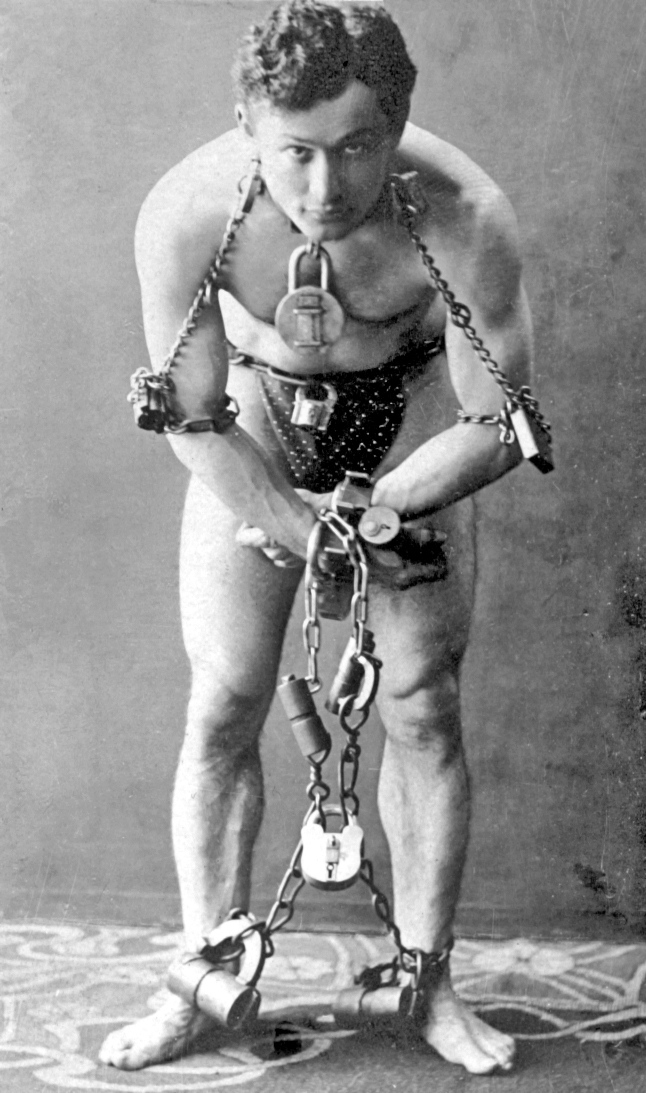
Getting out of restraints is an old skill that used to hide inside larger illusions, disappearances and transformations, rather than being sold on its own. In the 1860s the Davenport Brothers were good at slipping rope ties and used that skill to fake spirit phenomena while looking still bound. The illusionist John Nevil Maskelyne and others took the effects apart, reproduced them, and used the reproductions to attack fake mediums. They showed that the method was secret skill, not ghosts, but they had not yet sold the struggle itself as the ticket. About thirty years later Harry Houdini made escapology a recognized form of entertainment. He built a career on escaping every restraint he could put on a stage, advertised his knowledge of locks and confinement, and hid the exact methods so the mystery would hold. Many feats depended on lock knowledge and contortion. Others, including Metamorphosis and the Chinese Water Torture Cell, depended on specially built props. This is not a how-to. Houdini set the basic list still copied today: handcuffs, padlocks, straitjackets, mailbags, beer barrels, prison cells. He claimed copyright in his main escape acts and sued the rival John Clempert, who settled in 1906. The craft also picked up a religious metaphor. Catholic tradition sometimes names St. Nicholas Owen, who escaped the Tower of London and helped two Jesuit prisoners get away, as a patron of Catholic escapologists. St. John Bosco is counted among the patrons of Catholic Gospel Magicians.
Hidden struggle, full view, and escape or die
How the struggle is shown changes what the audience thinks it is seeing. Houdini popularized hidden performance, putting much of the work behind a screen or inside a cabinet so the method stayed secret. That style dominated into the late twentieth century and is still common. Because the real struggle is out of sight, people often assume a hidden assistant did the release. In the 1970s Norman Bigelow Sr. pushed Full View: nothing concealed from start to finish, escape played as skill and endurance. His signature piece, Doors of Death, pulled other performers toward struggle the audience could actually see. Jonathon Bryce first did Buried Alive in full view at Buffalo’s Music is Art Festival, with help from Goo Goo Dolls bassist Robby Takac. Mark Nelson, billed as The Great Markini, performed a full-view electrified mummy-lid torture-board escape, restraint plus a countdown, all of it in the open.
Escape or Die is the high-stakes model Houdini set, and it is still the prestige standard for top-line escapologists. Failure has three classic ways of killing: drowning, in the water escapes Houdini pioneered; suffocation, in airtight dry boxes such as coffins with no water; and a fatal fall, in straitjacket escapes hung high in the air. Houdini hung upside down from cranes and buildings. The British performer Alan Alan pushed the height further, hanging from a burning rope hundreds of feet up. Names tied to that risk include Dorothy Dietrich, Antony Britton, Bryce, and Markini. Markini added electrocution to the torture-board escape: he had to be free in under 60 seconds, or a fatal charge would run through the chains holding him to the board. The suspension and the lack of air are real physical risks, not a sexy slogan.
The stage skill has also been turned into a timed record. In 2012 the Canadian illusionist Lucas Wilson set a recorded mark for the fastest upside-down straitjacket escape: 8.4 seconds. A number like that takes a circus skill and makes it a measurable contest, a bridge between stage craft and the look of bodily control.
Escapes in fiction, and what bondage borrows
Escapology keeps showing up as a plot engine. Houdini starred in The Grim Game (1919), rediscovered by Dietrich in 2015, and in Haldane of the Secret Service (1924), which he directed and starred in. The 1953 biopic Houdini stars Tony Curtis, and Curtis also opens The Great Race with a suspended straitjacket bit. Michael Chabon’s Pulitzer-winning The Amazing Adventures of Kavalier & Clay uses escapology as a main engine. E.L. Doctorow’s Ragtime treats Houdini’s escapes as a metaphor for immigrant struggle in America. Superhero comics train Batman-type heroes in escapology for deathtrap plots. Professional escapologist heroes include Mister Miracle, Ms. Liberty, and The Escapist. Mister Miracle and The Escapist both echo the escapologist-turned-comics artist Jim Steranko. On screen and on the page there is also Cameron Steele in the 1971 pilot Escape, Danny Masters in The Escape Artist (1982), the real escape artist Bill Shirk playing himself in The Escapist (1983), Yorick in Y: The Last Man, and Rosanna Arquette’s aspiring escapologist in The Linguini Incident. Adam Phillips’s essay “Houdini’s Box” uses escape as a psychological theme. Even The Real Ghostbusters gave Houdini’s ghost a bit where traps could not hold him for more than a minute.
Erotic bondage shares the straitjacket, the cuffs, the tank, and public suspension, and then reverses the goal. Stage escape sells competence and death-risk theater. BDSM bondage sells negotiated helplessness, display, and sometimes the question of whether the bottom could get out if the scene allowed it. Self-bondage communities borrow escape-artist safety thinking, keys, cutters, time limits, and backup plans, because real restraint with nobody else in the room is closer to Houdini’s problem than to a dungeon with a top watching. A leather-bar escape challenge, or a suspension that quotes an outdoor jacket stunt, is citing a century of popular magic and blurring the line between a magic risk act and consensual SM confinement.