
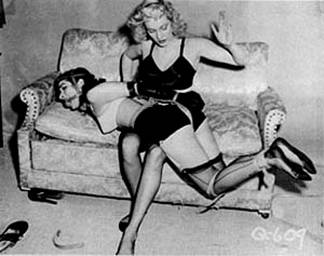
Erotic spanking is hitting someone so that one or both partners get sexually aroused or satisfied. The range is wide. It can be one bare-handed smack in the middle of sex, or a formal scene with a script, role-play, and purpose-built tools. The person being hit is usually called the spankee. The practice sits inside BDSM and impact play, but plenty of people who do it do not call themselves fetishists and do not hang around leather communities. Bedroom improvisation and a full protocol scene are on the same line. The target is always an adult who has agreed. School uniforms, teachers, and domestic rules, when they show up, are adults acting, not the beating of a child.
The interest is older than the modern scene. In the fifth century BC the Etruscan Tomb of the Whipping already shows striking staged as an erotic scene, separate from judicial punishment. Later classical and medieval sex manuals list blows as a way to raise arousal: India’s Kama Sutra (about 400 BC), the Koka Shastra (about 1150), and the Arabic Perfumed Garden (about 1400). Those books do not use the modern idea of a negotiated scene. The through-line is still there. Buttocks, the palm, and tools have been sexual implements for a long time.
In the nineteenth century, spanking literature and photography boomed in France and Britain. Victorian and fin-de-siècle print mixed “corrective” school and domestic fantasy with openly pornographic whipping books, and it fixed images that fetish media still sells: bent over, skirt raised, birch and cane. The early twentieth century is often called the golden age of spanking literature. Cheap editions, huge print runs, heavy illustration, and a production peak from the 1920s into the 1930s define it. French publishers and artists dominated. Jules Malteste worked as a writer, painter, and engraver. Studios such as Biederer Studio pushed staged fetish photographs. The German occupation of France in the Second World War, and the censorship laws that followed, ended that golden age. In English, John Willie’s magazine Bizarre kept restraint and discipline in print from 1946 to 1959. From the mid-1960s, as censorship loosened, French works came back into English, and older British works were reprinted.
From the late twentieth century into the twenty-first, legal fetish magazines devoted to the subject became easy to find as the law shifted. Spanking recordings existed in the 1920s, but it took the videocassette recorder before makers could produce films people actually watched in private. The internet then blew the door open. Commercial studios offered scenarios, blogs talked technique, and non-profit sites published fiction, so someone who did not already know a local club could still find the material.
Tools, sting, thud, and safety
A spanking can be a bare hand, but the tools often echo older corporal-punishment gear. Purpose-made pieces include the cane, the spanking paddle, the strap, the tawse, and the martinet. Improvised classics include the slipper, wooden spoon, hairbrush, bath brush, carpet beater, riding crop, switch, and birch. Less common choices include a feather-duster handle, a fly swatter, a ruler, and stinging nettles. The tool is half sensation and half role signal. A school cane and a bedroom slipper do not read the same way. Sensation splits roughly into sting and thud. A stingy tool, such as a cane, gives a sharp burn on the skin. A thuddy tool, such as a heavy paddle, drives deeper into the buttock. Heavier implements tend to thud more. Many people know which they want. An experienced top often mixes sting and thud in one scene instead of hammering one note.
Safety is the point that keeps it play. Hit the fleshy part of the buttocks. Stay off the tailbone and the hip bones, especially with a hard implement. A strike on bone is a real injury, not erotic pain. Warm the skin up and raise the intensity in steps. Agree beforehand whether bruising is wanted. If the hits get hard, watch for broken skin and bleeding. Tools that touch more than one partner need ordinary hygiene. Pain and endorphins scramble normal conversation, so a safeword or a non-verbal signal matters. Aftercare is part of competent impact, not an extra: water, warmth, a check-in, and optionally arnica or a cold pack.
Furniture, clothes, and why people want it
Scenes borrow school and domestic furniture. A gymnastic vaulting buck is a classic in teacher-and-student role-play because that is how non-erotic school punishments used to be staged. That staging is still adults acting. A purpose-built spanking bench or horse can be used with restraints or without. A common design is a padded sawhorse with restraint rings. The nineteenth-century British dominatrix Mrs. Theresa Berkley is remembered for the Berkley Horse, an early BDSM frame that fetish history still names. Costume is common: school uniform, formal domestic dress, leather. A spank skirt is open at the back so the buttocks can be bared without taking the garment off. It is often leather, PVC, or latex, and it is usually read as femme even when a man wears it. A male-coded cousin is assless chaps. The clothes turn a private beating into a scene: teacher and student, domestic discipline, a judicial fantasy, or simply presenting the target.
People also spank themselves, to experiment, because they have no partner, as masturbation, or because a dominant told them to. Solo impact still has to avoid bone, and endorphins can push the force past what you meant. It can be practice, or it can be the whole erotic act.
The motives are not one thing. A survey of 152 people who practiced sadomasochism found that 22 percent traced the interest to something outside themselves, such as memories of parental discipline or an adult introduction by a partner, and 78 percent called it intrinsic: it had “always been there,” often noticed in childhood or adolescence before it was sexual, and most of those people could not say why. About a third stressed that they enjoyed a certain kind of pain, and they separated “bad” pain from “good” pain. Exchanging control with a trusted partner was another main motive. The journalist Jillian Keenan has argued that a spanking fetish can work like a sexual orientation and should not be pathologized. Mainstream talk is easier than it was, but shame and secrecy are still common, especially when telling a partner or a friend. As a picture, erotic spanking is one of the most direct doors into BDSM. The image is simple, the intensity scales, and the art, manuals, and underground print were already centuries deep before video.