
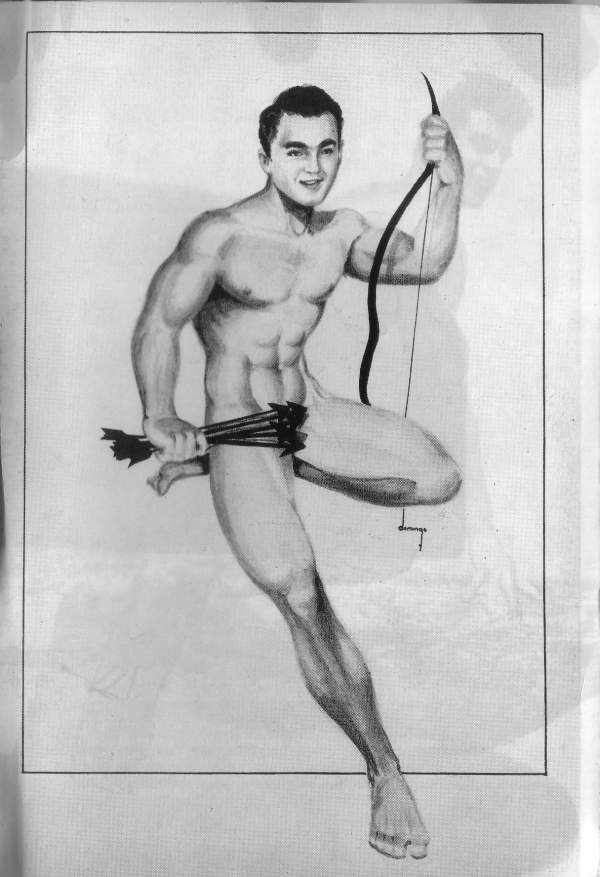
Readers who know Tom of Finland’s hyper-muscular men often miss the other hand in that picture. Domingo Francisco Juan Esteban “Dom” Orejudos, who signed work Etienne and Stephen, drew, wrote, and designed spaces that helped build a gay leather visual language. From the 1950s his leather-themed homoerotic art took part in rewriting how gay men looked on the page. With George Quaintance and Touko Laaksonen (Tom of Finland), he pushed back against the stereotype that gay men were weak and effeminate, and put strong, masculine bodies in its place.
The career starts in Chicago. At McKinley High School he played violin in the school orchestra, served as concertmaster of the All Chicago High School orchestra, and competed in gymnastics. His first erotic drawings appeared while he was still in high school, so he picked a pen name with real flair: Etienne, the French form of his middle name, Esteban. The name does not mean “flair.” He studied drawing for a short time at the School of the Art Institute of Chicago and found the teaching frustrating, then went to work anyway. At twenty, on Oak Street Beach, Chuck Renslow — then twenty-three — asked him to model for photographs. They became lovers and business partners and founded Kris Studios, a physique-photography studio. The studio name honors the transgender pioneer Christine Jorgensen. Kris supplied pictures to gay magazines that could not yet be fully explicit, and the pictures used a coded masculinity that could pass the censors.
Tomorrow’s Man, Triumph, Mars
Commercial drawing began in 1953 with erotic illustrations for Tomorrow’s Man, published by Irv Johnson, who owned the gym where Orejudos trained. To make the output look like more than one artist, he signed most of the work Etienne and signed pen-and-ink sheets in a slightly different style Stephen, the English form of Esteban. Those Stephen drawings became some of the first explicit homoerotic comics, told as storybooks. In 1958 he and Renslow bought Johnson’s gym, renamed it Triumph Gymnasium and Health Studio, and moved the photography upstairs: bodies on the floor below, pictures above them. In 1963 they launched Mars, a magazine that was openly about leather, and Orejudos wrote and directed non-explicit gay 16mm shorts. There was more than one.
Bars, baths, and the IML logo
The rooms mattered as much as the paper. He and Chuck Renslow built those places together. Chuck Arnett helped with the Gold Coast mural. Orejudos designed the International Mr. Leather logo and a large amount of the contest’s advertising and merchandise. His murals covered the walls of the Gold Coast bar, the Man’s Country bathhouse, Zolar’s, the Mineshaft, and Club Baths in Kansas City. Later leather generations have used those pictures to see what 1970s walls looked like. He was also a pen pal of Tom of Finland and introduced Tom to Durk Dehner. Tom and Dehner went on to found the Tom of Finland company and the Tom of Finland Foundation. Dehner called Orejudos his best friend for many years, and said Orejudos was tied to Tom and to him, and therefore to the foundation’s eventual creation.
Eighteen ballets
The drawing and the dancing ran at the same time for decades. He trained on scholarship at the Ellis-DuBoulay School of Ballet, then danced as a principal with the Illinois Ballet Company for nine years and became resident choreographer. After the company closed in 1972 he choreographed for about another decade with Delta Festival Ballet in New Orleans. He made eighteen ballets, staged by some twenty regional companies, including companies in Washington, Atlanta, Houston, and San Francisco, and he received three National Endowment for the Arts grants. His ballet Charioteer opened color broadcasting for Chicago’s WTTW and helped the station win three Emmy Awards. He also danced in touring companies, including West Side Story.
Bob Yuhnke, AIDS, and the archive
Beside the long partnership with Renslow, Orejudos met Robert (Bob) Yuhnke at a leather party in New York in 1969. They kept a long-distance relationship until Yuhnke moved to Chicago in 1979. In 1980 the two of them settled in Eldorado Springs, Colorado. Orejudos still spent time in Chicago until his mother died in 1984. In 1987, while he and Bob were traveling in China, he caught pneumonia. That illness revealed an AIDS diagnosis. His health failed, and he died of AIDS complications on September 24, 1991. His name is on the AIDS Memorial Quilt.
In 1993 he received the Forebear Award at the Pantheon of Leather Awards. In 2013 he entered the Leather Hall of Fame. The Leather Archives & Museum, which Renslow founded, holds the largest collection of original Etienne work. The auditorium, lined with his murals, is named for him. His line influenced later erotic artists, including Bill Schmeling. Dehner called him the quintessential humorist of homoerotic art: gutter dialogue, and bodies under torment as the butt of the joke, carrying a heat that Flash Gordon and Spider-Man never had. Jack Fritscher set him on a gay Mount Rushmore of pioneer pop artists beside Chuck Arnett, A. Jay, and Tom of Finland. In 2018 the fashion label JW Anderson released a collection drawn from the work. Dazed that year wrote that the sexed-up leather boys, with exaggerated anatomy and a parody of masculinity, broke the assumption that masculinity and heterosexuality travel together.