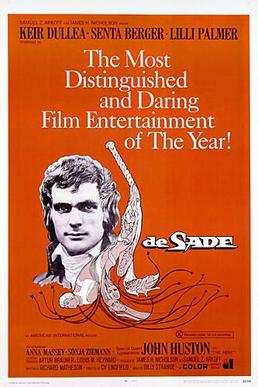
De Sade, released in 1969 under the German title Das Ausschweifende Leben des Marquis De Sade, is an American-German drama from American International Pictures, directed by Cy Endfield and starring Keir Dullea, Senta Berger, and Lilli Palmer. It is not a manual of modern BDSM. It is a period attempt to package the life of the Marquis de Sade as an erotic art film. The advertising was heavy. The film became one of AIP’s famous commercial failures. For adult viewers it plays as a psychological piece about memory, madness, and stage illusion, not as a documentary of SM.
A memory that will not stay in order
The structure is nonlinear. Louis Alphonse Donatien, the Marquis as the film names him, is dying at the ancestral estate of La Coste and remembering out of sequence. The film cuts among middle-aged Louis in the present, parody staged in a theater, and young Louis in the past. At the start his uncle, the Abbé, talks him into watching a castle-theater skit that mocks his parents haggling with the Montreuil family over a marriage. That skit opens onto the younger man, forced to marry the cold Renée while he loves her sister Anne.
The memories keep going: an orgy with prostitutes where he lectures on philosophy, house arrest under his mother-in-law’s custody, a theater he builds at La Coste for the actress La Beauvoisin. His father’s death, a mysterious old man, and the Rose Keller scandal — a widow he ties and flagellates with a sword — become the thread of repeated imprisonments. The old man is Louis’s shadow double. He follows the young Louis through memory, dies in prison, and begs Renée’s forgiveness. Biography turns into a ghost story. Memory, stage performance, and death close into one loop.
Who actually directed it
The project started in 1967, planned as an adaptation of Theatre of Horrors, an unpublished novel by Louis M. Heyward. Roger Corman worked on the script with Richard Matheson. Corman was the one who worried: Sadean fantasies could not be shown, and showing them might still disappoint. He walked. AIP hired Cy Endfield, who turned the fantasies in Matheson’s material into events that “actually” happen inside the story and pulled the chronology into a straighter line. During the shoot Endfield was hospitalized with flu, and Corman was brought in to finish. The finished film mixes Matheson’s intellectual ambition, Endfield’s structure, and Corman’s rescue job. John Huston, who played the Abbé, was annoyed that nobody had asked him to direct. Corman later said AIP underpaid him for the rescue, and that was one reason he left the company.
The cast and the name
After 2001: A Space Odyssey, Keir Dullea plays Louis at every age the memory needs. Senta Berger and Lilli Palmer play the women who define his desire and the cage around him. Huston’s Abbé is written with an obvious Freudian color. A flashback lays Louis’s later cruelty on childhood abuse. The screen name Louis Alphonse Donatien is a dramatized collage of the real confusion over Sade’s names, not a strict biography.
Reviews and the red ink
Reviews were mostly bad. The New York Times said it was not quite as silly as it looked and sounded, but it came very close, and reduced Sade to a figure in a series of tableaux vivants. Variety praised the invention, then warned that real sadomasochists would be disappointed: the orgies were silly, neither obscene nor erotic, and nothing on screen was terrible enough to justify a life sentence. Gene Siskel gave it half a star and called it celluloid garbage. Charles Champlin called Dullea’s performance incredibly phlegmatic. On Rotten Tomatoes the film later sat at about 11 percent, with an average of 3.9 out of 10.
It grossed about $1.25 million, more than many AIP titles, and still lost a large amount because the advertising bill was huge. AIP’s Samuel Z. Arkoff said in 1974 that it was the company’s biggest flop to that date. Billy Strange wrote the score. Capitol Records issued it in 1969, and it has not had a standard CD reissue. Edward Fenton published a novelization of the screenplay under the pen name Henry Clement. Under his own name, Fenton was best known for children’s books.
What kink viewers are actually looking at
For BDSM and adult-film viewers, De Sade is a psychedelic late-sixties packaging of the Marquis. The whipping, including an orgy in which Louis is beaten unconscious, is there for spectacle. It does not show a real power-exchange agreement. Rose Keller’s sword-flagellation, the prison torment, and the stage trial are what happens when literary sadism is squeezed into a studio budget. It is not terrible enough to explain a life sentence, and the soft focus and slow motion make it look tame or camp.
This is pre-consent-culture filmmaking. There is a lot of talk about whipping and very little negotiation. The cruelty of the marriage market and the mother-in-law’s domestic imprisonment are Louis’s main cage. The Freudian uncle flashback is that decade’s shortcut for explaining where a philosophy came from. The dead double thickens the tragedy. As an artifact, De Sade shows how clumsily Hollywood packaged literary sadism before it had a modern D/s vocabulary on screen. It was too timid for the bluntness of an exploitation picture, too lurid for the ambition of an art film, and too expensive to forget.