
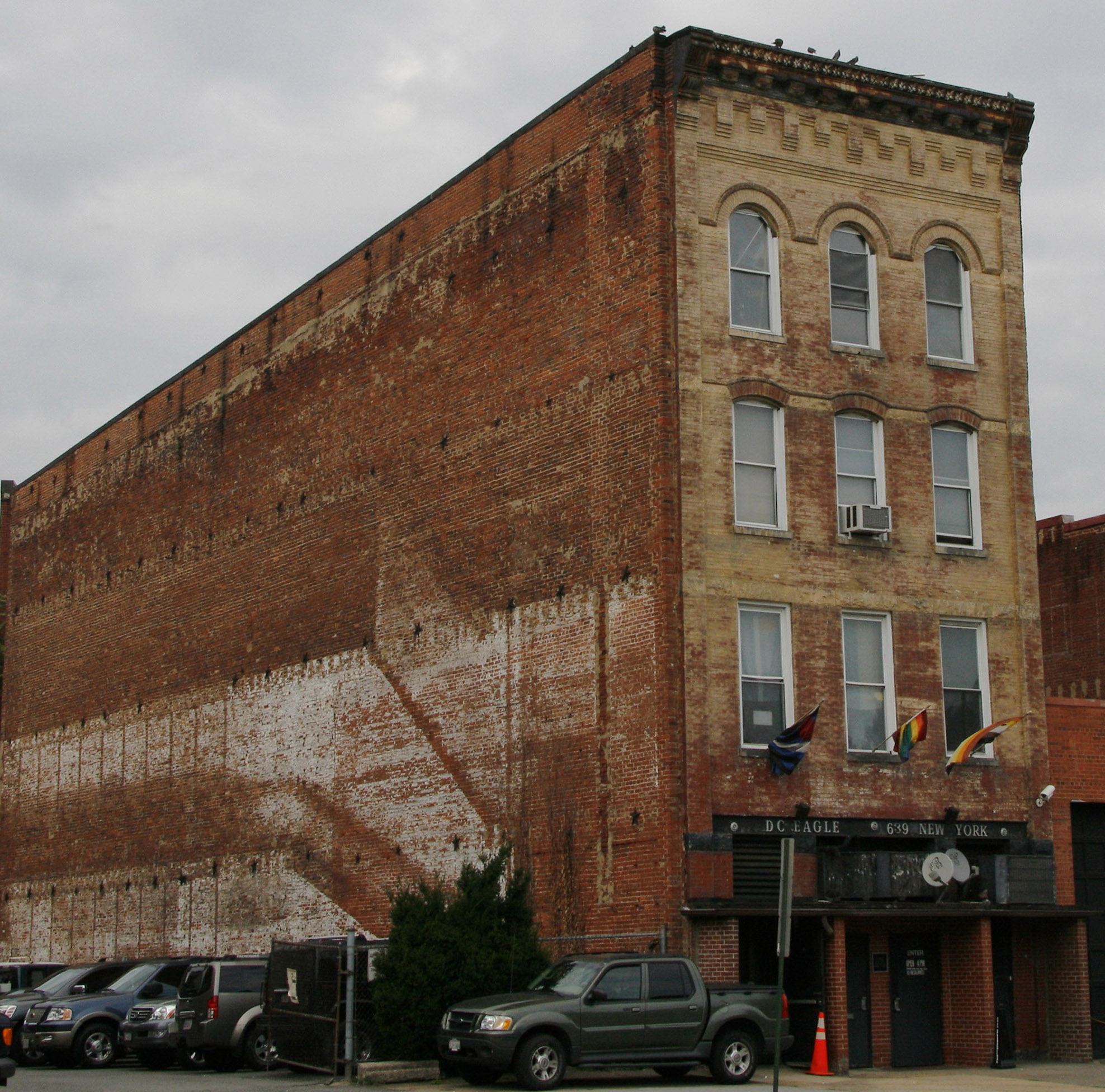
For readers who know BDSM and leather, the D.C. Eagle in Washington was a working record of how American leather infrastructure grew up. The gay leather bar ran from 1971 to 2020. It went from informal motorcycle-club dinners to a bar the club owned, and then into a pipeline toward international title contests. It was not an ordinary gay dance bar with a harness night once a month. Leathermen, motorcycle clubs, bootblacks, and title culture used it as a home base.
The root is Louis’ bar on 9th Street Northwest. Local motorcyclists and leathermen were already eating there informally. After the Spartans MC formed on April 3, 1968, that room became Louis’ Spartan Lounge. Early Spartans president Don Bruce and his brother Eddie, backed by Don’s partner Dick McHugh, opened a club-owned bar in 1971 at 904 9th Street NW. Redevelopment forced more moves. In 1987 Don and Eddie Bruce retired to Florida. Dick McHugh opened Dick’s Place at 639 New York Avenue, in the old Manhattan Transfer Company building. That bar later became known as the D.C. Eagle. Ted Clements and Peter Lloyd became the owners in 2011.
Titles and the bootblack stand
From 1982 the bar held the Mr. D.C. Eagle contest, long billed as the longest continuously running leather title contest in the country. Winners had a path onward to International Mr. Leather in Chicago. Two former Mr. D.C. Eagle winners took the international title: Jason Hendrix, IML 2004, and Ramien Pierre, IML 2014.
Bootblacking was institutionalized there too. The bar had a bootblack stand from at least the mid-1980s and sponsored early International Mr. Bootblack contestants, including the first IMrBB, David Morgan, in 1993, Tim Cousins in 1995, and Robert Ehrlich in 1999. Matthew Duncan, IMrBB 1998, was sponsored by Centaur MC and still bootblacked at the Eagle regularly. Local club networks and the bar floor overlapped.
Colors on the wall
Club colors on the wall told the same history. Besides the Spartans MC, gay motorcycle and leather clubs that showed colors there included the Centaurs, Lost Angels, Scorpions, Shipmates, FFA (Fist-Fuckers Association), Highwaymen, Nine Links, Druids, and Vulcans. The patch wall was a physical map of East Coast leather.
Around 2002 a regular Dyke Night opened a weeknight to a wider crowd and pushed the bar past a closed men’s circle. From 2004, the Eagle Wings fundraiser each November was tied to D.C. Eagle Anniversary Weekend, with the money going to local Washington charities. In 2014 the Eagle moved to a warehouse at 3701 Benning Road NE. After months of financial trouble it closed in 2020, ending nearly fifty years of a continuous leather bar in the capital.
What a leather bar was for
The D.C. Eagle’s arc is the core furniture of leather culture: dinners that started in a motorcycle club, a bar the club owned, a title pipeline toward IML, a bootblack stand, colors from more than one club, a careful try at a broader gender mix, a warehouse chapter, and an economic end in the pandemic years. A leather bar is a title pipeline, a clubhouse wall, and a bootblack classroom. The Spartans, Centaurs, FFA, and Druids patches recorded an East Coast leather community. Washington’s chapter is closed. The contests, clubs, and bootblack tradition it hosted are still part of how U.S. leather culture remembers itself.


![[Art Video] 1656 Fallen to Slave 5 Perverted Young Wife Explosive Defecation Desire Riho Anzai [Exclusive]](https://bdsmwild.com/wp-content/uploads/2026/09/Art-Video-1656-Exclusive.jpg)