
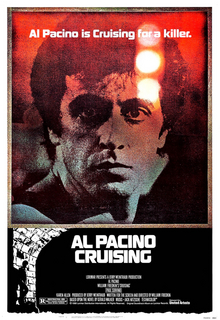
Cruising (1980) is William Friedkin’s crime thriller starring Al Pacino, Paul Sorvino, and Karen Allen—loosely adapted from New York Times reporter Gerald Walker’s novel about a serial killer hunting gay men, especially in the late-1970s leather and S&M bar world. The title doubles: cops cruise in patrol cars; men cruise for sex. Shot and marketed under gay-rights protest, cut down from an X toward an R after Friedkin said he presented the film to the MPAA board dozens of times and deleted roughly forty minutes of mostly club sexuality, and released February 15, 1980 to hostile reviews and modest box office (~$19.8 million), the film later became a cult object for leather historians, queer cinema scholars, and directors who call it a masterpiece of ambiguous dread. Robin Wood, Bill Krohn, and others have argued that open-ended finale choices and rough-cut changes left the narrative incoherent in places. For BDSM and leather viewers it is both document and distortion: a Hollywood thriller that borrowed real Mineshaft-adjacent culture, then got accused of painting that culture as inherently murderous.
Plot
In a sweltering New York summer, male body parts surface in the Hudson. Police link the kills to pickups at West Village leather bars—Eagle’s Nest, Ramrod, Cock Pit—and cheap rooms where victims are bound and stabbed. Captain Edelson recruits Officer Steve Burns, slim and dark like the dead men, to go undercover into Meatpacking District gay S&M life. Burns takes the case as career rocket fuel, rents nearby, and befriends neighbor Ted Bailey, a struggling gay playwright tangled with jealous dancer boyfriend Gregory. The assignment wrecks Burns’s relationship with girlfriend Nancy: he cannot explain the job, and his bond with Ted deepens in the dark.
A wrong turn brings waiter Skip Lee into a brutal police interrogation until fingerprints clear him; Burns recoils and tells Edelson he did not sign up so gays could be beaten for sport. Near quitting, he stays after Edelson reins in the officers. A Columbia University lead points to music graduate student Stuart Richards, who has schizophrenia. Burns finds letters to Richards’s father, cruises him in Morningside Park, and after asking him to drop his pants is attacked—Burns stabs back and arrests him. Prints match one crime scene. Soon Ted is found mutilated; police treat it as a lovers’ quarrel and hunt Gregory. Promoted detective Burns moves back in with Nancy. In the bathroom he shaves; she tries on his leather jacket, cap, and aviators—the killer’s silhouette. He stares into the mirror. The film refuses to say cleanly whether Richards was the only killer, whether Burns himself has killed or will, or how the undercover self has rewritten him.
Production: from novel to leather research
Producer Philip D’Antoni (Friedkin’s French Connection partner) first pitched Walker’s 1970 novel; Friedkin passed, Spielberg interest went nowhere. Years later Jerry Weintraub revived it. Friedkin engaged after real unsolved leather-bar murders and Village Voice reporting by Arthur Bell—ironically the same journalist who later helped drive protests against the shoot. Consultant Randy Jurgensen had done Pacino-style deep cover on earlier gay murders; Paul Bateson (a doctor’s assistant who appeared in Friedkin’s Exorcist) was implicated but not charged in several leather-bar killings while prosecuted for another murder. Jurgensen, Bateson, and French Connection consultant Sonny Grosso advised; Jurgensen and Grosso take bit parts. Friedkin also worked with Mafia contacts who then owned many gay bars.
Richard Gere was Friedkin’s preferred lead for androgyny; Pacino got the role. The novel’s Mineshaft could not be named or fully used on camera; Hellfire Club sets dressed as Mineshaft stand-ins, Mineshaft regulars worked as extras, and Pacino visited the real club for research. The MPAA slapped an X; Friedkin claimed roughly fifty board trips, $50,000 in costs, and about forty minutes cut—mostly graphic club sex with Pacino watching and possibly participating—before an R. He later found United Artists no longer held the trims and believes they were destroyed. A few frames of gay porn still intercut the first murder; some obscured sex remains. Punk band the Germs recorded six songs; “Lion’s Share” made the cut. Rough Trade’s “Shakedown, Breakdown” was written for the film; Jack Nitzsche tried and failed to clear Graham Parker tracks that later sat on The Up Escalator.
John Rechy screened a cut: Friedkin removed “We Are Everywhere” graffiti before the first body-part pull and added a disclaimer that the film targets one small segment of homosexual life, not the whole. Friedkin later called the card a studio/MPAA “dark bargain”; Vito Russo read it as an admission the film would be taken as representative. Pacino and Friedkin clashed in memory: Friedkin found Pacino late and uncreative; Pacino says Friedkin never told him whether the ending meant killer, newly gay, or both—“To this day I don’t know.” Friedkin has hinted a single shot can rewrite a whole plot, implying the ambiguity may not have been fully planned. Clues that Burns could be a killer include early costume matches, his preemptive stabbing of Richards, and the fact that only he sings a nursery rhyme of the sort the killer is said to use.
Protests and release
Summer 1979 brought organized disruption: Arthur Bell urged interference; activists hit rooftops with mirrors, blasted whistles and music, and marched a thousand strong through the East Village demanding the city drop support. Audio often needed looping to scrub protest noise. Pacino said he understood protest but did not see the script as anti-gay, comparing leather bars to the Mafia slice of Italian-American life in The Godfather. In his 2024 memoir Sonny Boy he called the finished film exploitative and refused to promote it. General Cinema Corporation blind-bid then refused to play the final cut. Theatrical release: February 15, 1980.
Reception, then and now
Initial reviews were largely negative; gay activists condemned homophobic politics that tied gay desire to violence. Roger Ebert gave two-and-a-half stars: well made and suspenseful but opaque about Burns’s inner relation to S&M, which is the film’s real subject more than the whodunit. Jack Sommersby faulted motive gaps, exploitation, and Pacino’s work. AfterEllen’s Brian Juergens later argued the movie used gay male sexuality as shock prop and that multiple simultaneous killers implied community-wide pathology despite the disclaimer. TV Guide called the subculture portrait “irredeemably sick and violent.” Raymond Murray’s gay film encyclopedia reframed it as a fascinating if ridiculous Hollywood glimpse of pre-AIDS sexual excess and a record of how a frightened industry treated a minority. Rotten Tomatoes sits near 50% from dozens of reviews: craft and Pacino commitment, troubled sensitivity and justified brutality.
Friedkin later said the film used S&M as murder-mystery background, arrived as gay liberation and the naming of AIDS collided, and should be judged as cinema rather than anti-gay screed—while granting contemporary critics were right that it was not the best foot forward for the movement. Camille Paglia loved its underground decadence beside European high porn. Quentin Tarantino, Nicolas Winding Refn, and the Safdie brothers have praised or cited it. On the DVD featurette Exorcising Cruising, Friedkin notes leather/S&M extras from New York who supported the nightclub shoots.
Violence in the film’s shadow
In The Celluloid Closet, screenwriter Ron Nyswaner recalls being threatened by men who claimed Cruising as motivation. On November 19, 1980—months after release—former transit officer Ronald K. Crumpley attacked near the Ramrod with an Uzi, killing two and wounding others after earlier shots; he ranted about killing gays. He was found not responsible by reason of mental disease and died institutionalized in 2015. Some secondary sources link the attack to the film; contemporary New York Times coverage of the shooting and a 2016 revisit after Pulse did not name Friedkin or Cruising. In Sydney, the unsolved 1981 stabbing murder of Gerald Cuthbert (60+ wounds) was media-linked to sailors allegedly shown the film; police could not confirm. Correlation is not clean causation—but the film’s reputation has always included fear that its images licensed hate.
Home video, remakes of the missing reels, legacy
Warner’s 2007–2008 deluxe DVD is not a director’s cut but restores some unseen material and effects; Friedkin commentary accompanies features on production history and the controversy. The theatrical disclaimer is absent on that edition. Arrow issued Blu-ray (2019) and 4K UHD (2025) restorations. James Franco and Travis Mathews’s Interior. Leather Bar. (2013) uses docufiction to chase the lost forty minutes rather than literally recreate them. American Horror Story’s eleventh season echoes the murder-mystery structure and homages the interrogation scene. Scholarly books (Ercolani/Stiglegger, Nystrom, Savran) keep the film in masculinity, class, and queer cinema syllabi.
Why leather and BDSM viewers still watch
Cruising is one of the few studio thrillers that put gay leather bars, hanky-adjacent dress, and S&M clubs on mainstream screens—with cops, killers, and an undercover protagonist who may be dissolving into the scene. It is also a case study in how Hollywood can harvest subcultural heat, cut the sex that gave it meaning, add a legalistic disclaimer, and still be read as indictment. Accolades were sparse on first release; the lasting “awards” are cult status, academic syllabi, and the Franco/Mathews conceptual remake of the lost footage. Watch it as period leather anthropology mixed with exploitation; hold the protests, the missing reels, Pacino’s later “exploitative” verdict, Friedkin’s defense that it was never meant as a portrait of all gay life, and the ambiguous bathroom mirror in the same frame. The bars were real. The fear was real. Whether Steve Burns is hunter, prey, or both remains the film’s unfinished business—and part of why the leather world cannot quite leave it alone.
Sound, image, and the cut forty minutes
What remains after the MPAA fight is still dense with club bodies, leather uniforms, and murder intercut with sexual ritual. Friedkin’s claims about the missing forty minutes shift between “no story impact” and “clearer hints that Pacino’s character might kill”—a useful reminder that ratings boards and studio vault losses shape queer cinema as much as directors’ intentions. Germs tracks, Rough Trade’s custom cut, and blocked Graham Parker songs place the soundtrack in late-seventies/early-eighties crossover rock rather than disco cliché. The first murder’s flicker of gay porn and the remaining obscured sex acts are traces of a harder film that UA apparently did not keep. Arrow’s later restorations and Warner’s deluxe DVD extras (The History of Cruising, Exorcising Cruising) are now the standard way to study both the theatrical text and the controversy around it.
Leather history inside a studio thriller
For leather and BDSM viewers, the documentary residue matters: Mineshaft regulars as extras, Hellfire dressed as Mineshaft, Pacino’s research visits, Mafia-owned bar logistics, consultants who had lived undercover or been adjacent to real murder cases. The film freezes a pre-AIDS sexual excess that later writers (Murray and others) read with elegiac fascination. It also freezes Hollywood’s fear—serial killer as tour guide through a world the studio will not let speak for itself. That double exposure is why Refn, Tarantino, and the Safdies can call it influential craft while activists still cite it as a wound. Read Walker’s novel, Bell’s journalism, Russo’s critique, and Friedkin’s later interviews as a set; the movie alone is incomplete on purpose and by force.
Teaching and rewatching today
Classrooms use Cruising for masculinity studies, New Hollywood violence, and queer representation debates. Clubs and leather history talks use stills as period dress references—with caveats about fictional murder plots. Home-video culture (DVD commentary, 4K restorations, Interior. Leather Bar.) keeps the missing footage as a ghost project people keep trying to imagine. American Horror Story’s homage shows the interrogation and undercover-leather grammar still read as pop myth. If you program a screening for a kink audience, pair it with discussion of consent culture, hate-crime history, and the difference between SM aesthetics and SM ethics—so the film educates without quietly reinstalling 1980 panic.
Cast, credits, and further reading
Beyond Pacino’s Steve Burns, Paul Sorvino’s Captain Edelson, and Karen Allen’s Nancy, the film’s texture depends on the anonymous club extras and bit players drawn from New York’s leather world. Jerry Weintraub’s producing push, Philip D’Antoni’s earlier interest, and consultants Randy Jurgensen, Paul Bateson, and Sonny Grosso anchor the production lore. Scholarly and critical follow-ups include Eugenio Ercolani and Marcus Stiglegger’s Cruising monograph, Derek Nystrom’s class analysis in 1970s American cinema, David Savran’s work on white masculinity and masochism, Bill Krohn’s “Friedkin Out,” and countless retrospective essays that flip the 1980 consensus. Pair those with Vito Russo and the Celluloid Closet tradition for the activist counter-reading. The bibliography is part of the film’s afterlife: Cruising will not stop being argued because the cut reels are gone and the mirror scene still refuses to confess.
Practical takeaway for BDSM media literacy
Use Cruising as a primary visual document of late-seventies gay leather style on a Hollywood budget—and as a warning about who controls the narrative when subcultures become thriller scenery. Notice what the R-rated cut shows (uniforms, bars, murder) and what it withholds (the explicit consensual sex Friedkin says he filmed). Notice protest tactics that shaped the audio and the disclaimer politics that tried to fence the film off from “the whole” gay community while still selling S&M shock. Notice later reappraisal by directors who care about craft more than 1980 movement strategy. Then decide what your own scene’s image ethics are when cameras enter the dungeon. That decision is the living sequel the film never wrote.
Timeline snapshot
1970: Gerald Walker’s novel published. Mid-to-late 1970s: Real leather-bar murder investigations and Village Voice coverage feed Friedkin’s renewed interest. Summer 1979: Principal photography under protest in New York. February 15, 1980: U.S. theatrical release; ~$19.8M box office; critical hostility. November 1980: Ramrod-area shooting by Ronald Crumpley (linked in some later commentary, not in contemporary Times crime report framing). 2007–08: Warner deluxe DVD with Friedkin commentary and controversy docs. 2013: Interior. Leather Bar. reimagines the lost footage problem. 2019 / 2025: Arrow Blu-ray and 4K restorations. The dates matter because they track both the film’s life and the leather world’s changing relationship to Hollywood representation—from street protest to restoration boutique.