
Follow us:
Contact [email protected] to report invalid posts or discuss commercial cooperation.
BDSM Wild | Bondage, SM, Spanking, Torture, Master-Slave VIDEOS, ARTS & CULTURES
How to download Member-Only Videos.
  • Members-Only BDSM VideoExclusive!
    • Exclusive Videos
    • Most Popular Videos
  • Free BDSM Video
  • Gallary
  • Novels
    • English Novel
    • 中文BDSM小说
    • 日本語小説
  • Blog
    • BDSM blog (English)
    • BDSM blog (中文)
    • BDSM blog (日本語)
No Result
View All Result
  • Members-Only BDSM VideoExclusive!
    • Exclusive Videos
    • Most Popular Videos
  • Free BDSM Video
  • Gallary
  • Novels
    • English Novel
    • 中文BDSM小说
    • 日本語小説
  • Blog
    • BDSM blog (English)
    • BDSM blog (中文)
    • BDSM blog (日本語)
No Result
View All Result
BDSM Wild | Bondage, SM, Spanking, Torture, Master-Slave VIDEOS, ARTS & CULTURES
No Result
View All Result
Home BDSM blog (English)

Corset: Construction, Fashion History, Tightlacing, Health, and Fetish Use

2025年3月9日
A A

A corset is a structured support garment built to hold and train the torso into a chosen shape and posture. Traditional construction uses strong fabric, boning (historically whalebone, later steel), a stiff front busk that locks the torso upright, and lacing that lets the wearer or dresser tighten the shell. Known also as stays in earlier centuries, corsets were essential European women’s underwear from the seventeenth century into the early twentieth. Seventeenth- and eighteenth-century shapes ran conical and straight-sided; the nineteenth century carved the famous hourglass. World wars, material shortages, and shifting gender roles pushed mainstream fashion off rigid corsetry; elastic girdles and bras took over. Fashion still borrows the word “corset” for lace-up tops that only mimic the look, while true steel-boned pieces survive in historical costuming, tightlacing subcultures, medical bracing, and—crucially for this site—fetish and BDSM wardrobes where restriction, posture, and the erotics of the wasp waist still matter. Elasticated girdles and waist trainers shape waist or hips today without classical rigidity; a corset brace is an orthotic cousin used for mild-to-moderate lower-back pain.

Etymology and makers

Corset is a diminutive of Old French cors (“body,” from Latin corpus)—literally a “little body.” The craft is corsetry (also sometimes used as a collective plural); a maker is a corsetier or corsetière, or simply a corsetmaker. English usage of corset for a lighter quilted French waistcoat versus heavier stays appears by 1828 in The Ladies Magazine. The word now covers everything from museum stays to PVC clubwear with plastic bones—so buyers should ask whether a piece is structural steel or costume theater before trusting it for tightlacing.

What corsets are for

Purpose has never been single. Early stiffened underlayers protected expensive, highly adorned outer garments from creasing; the famous use is silhouette control—slimming the waist, lifting or flattening the bust, smoothing the torso under fashion. Corsets also distribute the weight of crinolines and bustles, enforce posture, and, in fetish contexts, restrict breath and movement as deliberate sensation. Medical corset braces support lumbar pain or post-surgical spines with elastic panels and plastic or metal bones. Artist Andy Warhol wore a corset for life after being shot in 1968 and never fully recovering. Overbust styles enclose the torso from just under the arms toward the hips; underbusts begin just under the breasts; longline cuts (overbust or underbust) pass the iliac crest for a longer torso and narrower hip line—common in the 1910s slim-hip fashion and later evolved into elasticated girdles; “standard” length stops short of the hip bone; waist cinchers cover only the midsection from low ribs to just above the hips; rare theatrical pieces reach the knees. Garters may hang from the corset or from a separate belt. Light linen or cotton chemises (shifts) were worn beneath historical corsets to absorb sweat, protect expensive stays from laundry wear, and stop steel bones and eyelets from rusting against skin; they also prevented chafing from stiff, coarse materials. Corset covers (light chemisettes of cotton lawn or silk) smoothed lines under outer clothes. Modern wearers use tee shirts, camisoles, or dedicated liners for the same reasons—and to prevent lace burn when lacing hard.

Construction: boning, busks, and lace

Quality corsets use sturdy nonstretch cloth—coutil is the historical gold standard—with bones (also called ribs or stays) in fabric channels. Eighteenth- and early nineteenth-century makers preferred thin baleen (whalebone); mid-to-late Victorian work shifted to steel. Modern high-end pieces use spring or spiral steel or synthetic whalebone (plastic engineered for corsetry); cheap fashion corsets often use ordinary plastic that will not tightlace safely. Ivory, wood, and cane appear in older experiments. Lacing is usually at the back, tightened top-down, bottom-up, or both (bunny-ears method). Victorian front busks (buttoned or hooked openings) let a loosely laced corset open without fully rethreading; snug wear requires loosening first or the busk breaks under strain. Staymaking emerged as its own French profession in the 1660s; craftsmen (staymakers) cut and fitted while women often sewed pieces—but women were excluded from staymakers’ guilds because the work was coded as too strenuous for them to do “correctly.” By the nineteenth century, corsets became among the first mass-produced women’s garments via factory assembly lines: each step by a different group, often including children; heavy work (cutting, japanning steels against rust) in-house; lighter bone-sewing taken home by pieceworkers who enlisted their children. London corset factory workers ranked among the most poorly paid and often could not cover daily living expenses. Despite male industrial dominance, women inventors and designers such as Roxey Ann Caplin—who consulted her physician husband to respect female anatomy—became known for better patterns. The field raced patents for ever stronger, stiffer corsets less likely to break. “Health corsets” later added wool linings, elastic panels, or steel watch springs instead of solid strips when public anxiety about tightlacing peaked.

Fashion history: bodies, stays, and the Victorian wasp waist

Deep background: Researchers have found evidence of corset-like support in the Minoan civilization of early Crete. For nearly five hundred years of European fashion, bodies, stays, or corsets with reed, whalebone, or metal boning were standard women’s wear.

Sixteenth and seventeenth centuries: In the Tudor period, “bodies” aimed at a tubular straight-up-and-down shape that minimized the bust; worn by women and some men, stiffened with steel, wood, or whalebone, constructed in two parts and fastened at the sides. Bodies evolved into seventeenth-century stays that shaped the torso to the fashionable silhouette—for example, an inverted cone in the 1780s—and prioritized smooth contours and posture over exaggerated bust and waist. Late sixteenth-century “pairs of bodies” used reed or whalebone boning plus busks of wood, horn, whalebone, metal, or ivory; first aristocratic, then wider. Seventeenth-century stays added waist tabs (“fingers”).

Eighteenth century: More whalebone and denser boning; shapes low and wide in front, sometimes high to the upper shoulder in back; strapless or with straps attached in back and tied in front. Purpose: support the bust, create a conical torso, draw shoulders back. Eyelets were stitch-reinforced and staggered for spiral lacing—one lace end knotted at the bottom eyelet, the other wound up and tightened at the top. “Jumps” were looser, unboned variants, sometimes with sleeves like a jacket. Quilted linen front-lacing French corsets without bones covered informal occasions while stays held for court. Women from street vendors to ladies of the court wore stays or jumps. In the 1790s, stays fell from fashion with the French Revolution and neoclassical dress; late-eighteenth and early-nineteenth-century dandies who wore men’s corsets were widely mocked.

Early nineteenth century and the steel revolution: From the late 1700s into the 1820s, neoclassical empire lines favored demi-corsets or short stays ending at or just above the waist—bust support without full torso shaping. Men sporadically laced to slim; a wasp-waisted male ideal roughly 1820–1835 (lingering into the late 1840s in places) sometimes used corsets, then fell out of favor as effeminate. After the early 1800s the wasp waist returned hard for women. Steel eyelets (1827) and steel boning allowed stronger, more durable pieces and greater waist reduction—the curvaceous nipped silhouette most people now picture when they hear “corset.” Gussets for the bust and hip length turned stays into “corsets”; lower tabs gave way to hip gussets with less boning at first, then heavier boning returned in the 1840s as shoulder straps vanished. By 1850 steel boning was popular; eyelets sat opposite each other at the back for conventional lacing; front metal busks became standard. 1850s–60s corsets shortened under hoop skirts and crinolines, then lengthened again after the 1860s as princess and cuirass lines exposed the abdomen. Infants generally wore stiffened waistbands; girls transitioned to corsets before or during adolescence—sometimes in early childhood. An 1881 New York Times fashion note described progressive childhood gear: broad belt with shoulder pieces for undergarment buttons from dress age; more shape and a soft whalebone or steel spring by about seven; another back bone from ten to twelve; young ladies’ corsets with busks, narrow whalebones, and soft springs; ladies’ satin corsets with jointed busks drawn in over the hips and long fronts. When Frances Egbert’s front steels kept breaking under strain, her husband Samuel Barnes designed “reinforced steels,” patented years later; she collected royalties for fifteen years after his death until Egbert v. Lippmann left the patent public.

Dress reform, controversy, and the S-curve

Tightlacing ignited moral, medical, and political war. Dress reformists called the corset vanity and foolishness, blaming damaged organs, compromised fertility, weakness, and general health collapse. Pro-corset voices answered that stylish dress required it and that it offered its own pleasures; Kunzle later theorized that some enthusiasts found sexual pleasure in tightlacing or in rubbing against the front of the corset—fuel for moral outrage. The controversy soaked in social Darwinism and eugenics: damage to uterus, ovaries, and fetus was framed as danger to the “civilized” European race; Western women were cast as weaker and more birth-complicated than “primitive” peoples in looser clothes. Reformers warned that tightlacing could destroy the race; defenders claimed women were less evolved and thus needed external support. American women active in anti-slavery and temperance movements advocated sensible clothing for free movement while often still wearing some corsetry. Supporters said corsets maintained upright “good figure” and social order; reformers saw male conspiracy to cultivate “slave psychology” and believed fashion change could unlock mobility, wages, and independence. Elizabeth Stuart Phelps Ward’s 1873 cry—“Burn up the corsets!”—became a slogan, yet little daily fashion changed before 1900. Most people accepted some support as necessary; relatively few abandoned it entirely. The main reform result was evolution, not extinction: doctors fitted patients and designed “health” and “rational” corsets with wool linings, watch-spring bones, and elastic panels. Roxey Ann Caplin’s anatomically argued designs won wide renown. In the 1890s Inès Gaches-Sarraute designed the straight-front corset to reduce abdominal pressure for gynecological patients; fashion houses turned the resulting S-curve silhouette into the early-1900s look worn roughly 1900–1908.

Twentieth-century decline and later revivals

The corset reached maximum length in the early twentieth century—longline pieces from bust to upper thigh, or underbust longlines that required a separate brassiere and read closer to a modern girdle than to classical stays. From 1908 to 1914, narrow-hipped, narrow-skirted fashion lengthened the lower edge; as bras caught on in the 1910s, fewer corsets included bust support. The new line covered thighs, shifted hip position, and made the waist look higher and wider with narrower hips—forecasting the 1920s flapper silhouette—while demanding elastic strips. Rubberized elastic materials from 1911 helped the girdle replace the corset. In 1910 physician Robert Latou Dickinson published research finding that while some women wore corsets without apparent harm, most users showed permanent deformations and health damage; even “healthier” S-line designs still restricted costal breathing and pressed down on the pelvis. World War I material needs helped abandon longline styles. In the late 1940s and early 1950s a brief “waspie” waist-cincher revival served Christian Dior’s New Look hourglass—mostly haute couture—while most women stayed with girdles; women’s organizations and female British parliamentarians pushed back after wartime rationing had forbidden corsetry. When the New Look softened, waspies faded.

By the 1960s hippie culture, youth rebellion, and feminist protest rejected the wasp waist. At the 1968 Miss America protest, girdles and corsets went into a “Freedom Trash Can” as “instruments of female torture.” Fitness culture, diet, and modern liposuction (mid-1970s) became preferred waist tools; the sexual revolution’s crop tops and athletic figures dropped supportive undergarments. From the 1920s onward in Europe and North America, mainstream daily corsetry was effectively over—surviving as costume, reenactment underwear, and subcultural outerwear. Fetish, BDSM, and Goth scenes kept steel and tightlacing alive; living-history costumers still wear stays for period silhouette; skilled makers reproduce historic shapes or invent new ones. From the late 1980s, haute couture revivals periodically trickled down—Vivienne Westwood’s push-up bust trend through the 1990s, the strong Autumn 2001 pulse timed with Moulin Rouge!, steampunk’s late-Victorian remixes, and early-2020s regencycore lace-up tops inspired by Bridgerton and The Gilded Age (often without real boning). Actresses including Emma Stone, Cara Delevingne, and Simone Ashley have publicly complained about costume-corset discomfort, feeding health debates without restoring daily wear.

Waist reduction and tightlacing

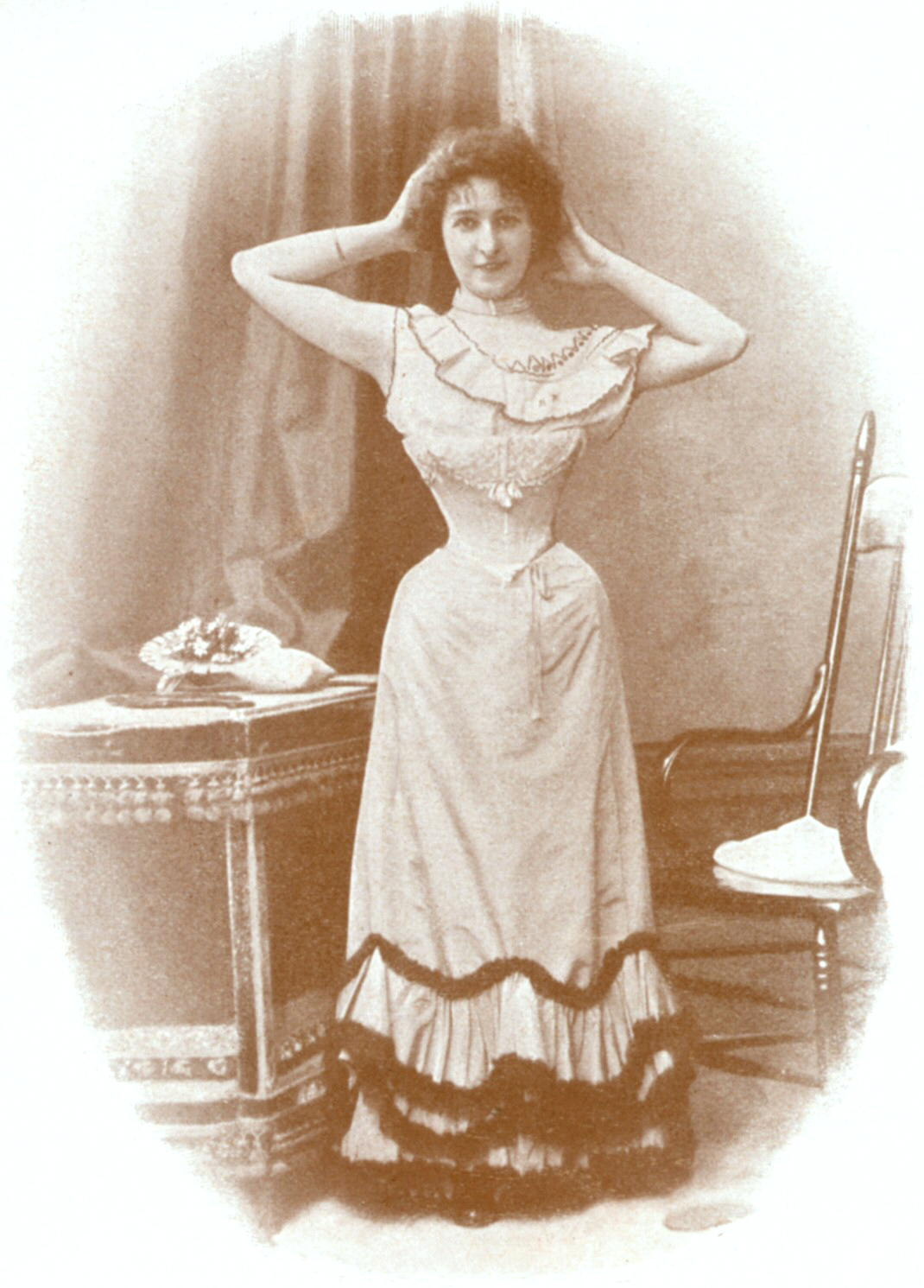
Before steel eyelets, corsets smoothed lines and supported posture more than they crushed circumference. Afterward, beauty writing idolized a small round waist as exaggerated sexual dimorphism; the corset was the primary tool. Dress historian David Kunzle estimated 1880s average corseted waists near 21 inches (53 cm) versus about 27 inches (69 cm) uncorseted, arguing extreme reduction—tightlacing—was largely a middle to lower-middle-class aspirational practice even though “tightlacing” was never precisely defined. A corseted waist of 19 inches (48 cm) counted as “standard” fashion ambition; 13 inches (33 cm) was “severe” but not unheard of. Beauty writer Arnold Cooley complained that natural waists of roughly 28–29 inches were forced toward 24, with 22–20 inches seen in “deluded victims of fashion and vanity.” 1888 statistics suggested average waist sizes had fallen over twenty-five years from tightlacing plus reduced respiration and food intake under constriction. Modern adult starters rarely match historical reduction because eighteenth- and nineteenth-century training usually began in adolescence or earlier; the slimmest recorded figures were often teenage girls and special-occasion measures for dances. Until 1998 Guinness listed Ethel Granger at 13 inches; the category then became smallest waist on a living person, taken by Cathie Jung at 15 inches. Polaire reached about 16 inches; Empress Elisabeth (“Sisi”) of Austria was famed near the same. Tightlacing remains a living fetish and body-modification practice with dedicated communities, custom makers, and risk profiles that echo historical medical warnings.

Health effects—myths and evidence

Victorian women did not routinely remove ribs for fashion—that story is baseless. Real effects of chronic tight corseting are documented across several systems. Moderately laced corsets can reduce lung capacity anywhere from about 2% to 29% (average near 9%) and increase shortness of breath in moderate exercise such as dancing. Smaller-than-average waists may lose more capacity; larger waists may recover more slowly after removal—replicating historical findings. Fainting under dance-tight lacing is considered credible. Doctors warned corseted women against serious exercise even as light calisthenics guides (stretching, dance steps, skipping) appeared for young women presumed laced; later sport corsets with elastic or mesh targeted cycling, tennis, and riding. Corsets were widely blamed for tuberculosis—sometimes as direct cause before germ theory, sometimes as respiratory impairment that worsened outcomes in an era when women died of TB more often than men.

Long wear atrophies core and back muscle: temporary pain relief, then dependence and worse pain standing unbraced. Abdominal weakness may have contributed to forceps-heavy obstetric culture. Skeletal analyses show significant lasting change to spine, ribs, and hips when training starts in childhood or adolescence; adult-onset wear is less permanently sculpting, though temporary change occurs. Pelvic inlet underdevelopment may have complicated birth—consistent with period reports, though study results are mixed. Downward organ pressure fed reproductive controversy: doctors used coded language about wives who had tightlaced; Catharine Beecher broke propriety to discuss uterine prolapse. Corsets were often worn deep into pregnancy to suppress the growing belly; obstetrician Alice Bunker Stockham campaigned against the practice (“The corset should not be worn for two hundred years before pregnancy”). Feminist historian Leigh Summers notes moral panic around the unspeakable idea that tightlacing could induce abortion. “Primitive” women in looser clothes were imagined as healthier birthers. Professor Arthur Cleland reported atrophied ovaries at autopsy more often in upper-class women, shop assistants, and household servants than in “rough” working-class women. Uterine and rectal prolapse occurred at higher Victorian rates that fell as corsets waned; an 1888 doctor claimed uterine “derangement” had risen fifty percent in fifteen years from tight clothing, corsets, and high heels—driving a boom in pessaries that often caused further complications. Corsets decrease stomach size and slow intestinal motility (constipation, indigestion); pelvic-floor pressure can cause urinary incontinence akin to pregnancy; friction abrades or bruises skin; kidney function and blood pressure may suffer; fat redistributes to a lower-belly pooch once the shell comes off, worsened by muscle weakness. “Chlorosis” or green sickness—now read as hypochromic anemia—was once pinned on corsets and menarche’s demands on the “frail” female body; Frederick Parkes Weber noted it never appeared in boys, hit fatter girls more, and improved with bed rest (when corsets came off) rather than seaside trips (when they stayed on). None of this means a carefully fitted, moderately laced modern corset worn a few hours for a scene equals lifelong Victorian damage—duration, tightness, age at start, and recovery time decide risk—but historical health literature is not empty moral panic.

Fetish and BDSM use

Beyond fashion nostalgia, corsets are core fetish clothing. In D/s, a submissive may be ordered into severe lacing as restriction, posture training, endurance ordeal, or punishment; a dominant may wear black couture corsetry as armor, status display, and erotic aesthetic. Open-breast or crotch-exposing designs allow sex, oral service, and impact play without full undress—“vanilla” intercourse or full BDSM scenes with the silhouette still locked on. Dress historian David Kunzle’s Fashion and Fetishism argues historical corseting already carried sexual charge: some wearers reported pleasure; the cinched waist was highly sexualized across genders. Modern tightlacing communities, pro-domme uniforms, rubber-and-steel hybrids, porn tropes, and fetish fashion runways keep that charge explicit. Scene safety: train gradually over months, not hours; use quality steel and proper hip-spring sizing; keep scissors or lace-cut plans for panic; watch for numbness, nausea, dizziness, and color change; never combine extreme reduction with heavy drinking or unsupervised sleep without experience and protocols; schedule toilet breaks and hydration; aftercare for rib ache and emotional drop. Neck corsets and posture collars (stay-reinforced collars) are adjacent toys more often about BDSM aesthetic and short-term posture theater than physiotherapy—though medical neck collars exist separately for injury.

Special forms and related garments

A corset dress (sometimes called a hobble corset for its kinship with hobble-skirt restriction) extends boning down the legs so walking stairs in heels or sitting can become nearly impossible—high-fashion bondage as garment; some modern makers also cut dramatic but wearable fashion versions. Neck corsets and collars display or limit the throat; they are not classical torso corsets and do not create lasting posture change the way people sometimes hope. Medical lumbar braces share the silhouette with kinder materials. Neighboring pieces on the support-to-fetish spectrum include bustiers, waist cinchers, bralettes, Gibson Girl S-curve nostalgia, and Chinese dudou undershirts sometimes nicknamed corsets in translation.

Comfort layers and daily practicality

Historically a woman’s corset almost always rode over a washable chemise so the expensive boned layer could avoid weekly laundry that rusted steels and shortened garment life. In late Victorian years, as health anxiety rose, “health corsets” marketed wool linings and springier bones as safer alternatives while still delivering fashion shape. Modern scene and fashion wearers repeat the liner logic with cotton camisoles and purpose-made corset liners: less sweat against coutil, less lace friction at the back, easier cleaning of the layer that actually touches skin. Toilet access, sitting, and eating change under a longline or tightly laced piece—plan scenes and events around those limits rather than discovering them mid-dinner. Quality fit includes enough hip spring so the bottom edge does not dig into the iliac crest and enough bust/underbust curve so flesh is shaped rather than pinched into numbness.

Cultural afterlife

From Minoan art to Bridgerton merch, the corset is a machine for making bodies readable as class, gender, morality, and sex. Victorian controversy fused medicine, eugenics, feminism, and fashion capitalism; twentieth-century rejection became a feminist symbol even as subcultures reclaimed the lace and steel for pleasure. Fainting-room lore, tightlacing world records, and costume-drama complaints keep the object in popular conversation. Museum collections (Victoria and Albert seminars on corset and crinoline secrets, Chicago History Museum holdings, Te Papa and Symington Fashion Collection pieces) preserve the material culture that blogs and fetish shops only sample. For BDSM and fetish readers the useful takeaway is practical: real corsets change posture, breath, and silhouette; cheap costume “corsets” mostly change Instagram. Choose makers who understand bone placement and hip spring, negotiate wear time like any edge play, and remember that the same garment once sold as female duty is now, at its best, a consensual instrument of shape, power, and heat. Further deep dives: Valerie Steele’s The Corset: A Cultural History (Yale), Kunzle’s Fashion and Fetishism, Norah Waugh’s Corsets and Crinolines, R. Doyle’s Waisted Efforts: An Illustrated Guide to Corset Making, and Larry Utley with Autumn Carey-Adamme’s Fetish Fashion: Undressing the Corset.

Reading list for makers and players

Historical costumers and tightlacers both benefit from primary pattern knowledge: how a conical eighteenth-century stay differs from a curved Victorian hourglass, why spiral steel flexes at the waist while flat steel holds a hard line, and how busk length changes when you sit. Fetish players who only know PVC club cinchers often under-estimate training time—seasoned tightlacers measure progress in months of gradual reduction and rest days, not a single aggressive party lace-up. Medical brace users should follow clinician guidance rather than fashion blogs; a lumbar orthotic is not a play collar with bones. Keep these lanes distinct and the corset remains what it has always been at its best: engineered cloth and steel in service of a chosen body story—whether that story is court fashion, New Look glamour, reenactment accuracy, or a keyholder’s order to stand straighter and breathe shallower until told otherwise.

Silhouette vocabulary for shoppers and scenesters

When buying or commissioning, learn the shorthand: overbust versus underbust, longline versus standard, waspie/waist cincher, front-busk daily wear versus back-lace-only show pieces, spiral steel at high-flex zones versus flat steel for hard lines, coutil versus fashion satin over foam. “Corset top” in fast fashion usually means neither steel nor waist training. Bespoke makers take hip, waist, underbust, and torso-length measurements; off-the-rack fetish pieces often fail at the hips first. For BDSM, add hardware questions—D-rings, locking busks, detachable garters—and negotiate who holds the lace ends. A dominant lacing a submissive is a classic power ritual; a dominant wearing the tighter piece is status display. Both are valid; both need circulation checks.

Corsetry beside neighboring kink gear

Corsets sit next to posture collars, ballet boots, hobble skirts, and full rubber catsuits in the restriction wardrobe. They pair with rope for decorative harness over cloth, with canes for impact on a presented back, and with protocol for formal service. Unlike rope, a well-made corset can be worn under street clothes for stealth training or 24/7 aesthetic. Unlike a cage, it does not directly lock genitals—but combined with chastity and collar it completes a classic owned silhouette. Historical reenactors and fetishists sometimes share makers while wanting opposite outcomes: invisible period shape versus highly visible fetish drama. Say which you want when you order.

Closing the long view

Five centuries of European stays and corsets, a nineteenth-century industrial and medical panic, a twentieth-century feminist rejection, and a subcultural afterlife in Goth, steampunk, haute couture, and BDSM—all of that rides on channels of cloth and steel around a human midsection. Myths (rib removal, universal medieval torment) fall away under scrutiny; real constraints on breath, muscle, and birth remain documented. Modern players inherit both the beauty and the warning labels. Lace with information, not only with lust, and the garment stays a tool instead of a trap.

Quick timeline for reference

Prehistory to 1600s: Minoan support evidence; European “bodies” and early stays with reed/whalebone and busks, conical aristocratic silhouettes spreading down the class ladder. 1700s: Heavy boning, spiral lacing, jumps for informal wear, stays for court; revolutionary neoclassicism loosens the grip. 1800–1850: Short stays and empire lines, then return of the wasp waist; steel eyelets (1827) unlock true tightlacing; factories and patents industrialize production. 1850–1900: Crinoline-length shifts, childhood corseting norms, dress-reform wars, health corsets, Caplin and Gaches-Sarraute designs, eugenic rhetoric on both sides. 1900–1920: Longline and S-curve, bras split the bust, girdles and elastics win, WWI material politics. 1947–1955: Dior New Look waspies in couture. 1960s–70s: Protest trash cans, fitness culture, discard of daily rigid support. 1980s–now: Westwood and couture revivals, fetish/BDSM outerwear, steampunk, Moulin Rouge pulse, regencycore cosplay tops, living tightlace records, and medical braces that only look related. Use the timeline when shopping vintage patterns or writing scene fiction so the silhouette matches the century you think you are quoting.

Safety checklist (scene and training)

Measure twice; commission once. Season new steel slowly. Never sleep in a freshly aggressive reduction without experience and a cutaway plan. Watch lips, fingertips, and toes for circulation hints; dizziness means loosen, not “push through.” Avoid stacking extreme corseting with heavy alcohol, intense cardio you have not trained for, or restrictive gags that compound breath limits. Pregnant wearers should follow medical advice—historical pregnancy corseting is not a recommendation. Aftercare: gentle stretch, hydration, skin check under the lace line, and honest notes on what measurement felt good versus what only looked good in the mirror. That discipline is how fetish corsetry stays hot instead of becoming a preventable injury story.

BDSM → BDSM equipment → Fetish clothing
BDSM Video Overview
BDSM视频概览
BDSMビデオの概要
Tags: BDSMBDSM equipmentFetish clothing
Tweet117ShareShareShare187ShareShare
Previous Post

Cool Devices: Extreme BDSM Hentai OVA Series — Operations Overview

Next Post

Crash (Ballard Novel): Car-Crash Fetishism and Techno-Sexual Obsession

Related Posts

BDSM blog (English)

Stefani Goerlich: Sexologist & Author on Kink-Aware Relationships

2025年3月9日
BDSM blog (English)

The Laughing Woman (1969): Erotic Thriller of a Man Who Toys with Women

2025年3月9日
Erotic Sexual Denial
BDSM blog (English)

Erotic Sexual Denial: Orgasm Control and Chastity

2023年10月11日

Popular Videos

Members-Only Video

DKOS-11 明智伝鬼の世界 Collection 11 大貫希 【Exclusive】

by BDSM wild
2025年2月19日
0

Read moreDetails
Members-Only Video

[不二企画] AR-10 緊縛浪漫10 【Part2】 人妻乳首○待吊り・戦慄なぶり縄 田原敏子 -濡木痴夢男- (緊○浪漫10) O-140 fuji-0179 [Exclusive]

by BDSM wild
2026年1月8日
0

Read moreDetails
Members-Only Video

CS-025 新・縄の世界 二 吊り責め柔肌縛り 夢乃まゆ 高田美幸 [Exclusive]

by BDSM wild
2026年3月26日
0

Read moreDetails
Members-Only Video

COTD-005 凹女凹 ~ボコボコオンナ~ 番外編 [変態志向] hentai-0107 体罰女 番外編 [Exclusive]

by BDSM wild
2026年3月9日
0

Read moreDetails
Members-Only Video

ADV-R0102 淫らなマゾ愛奴 松嶋彩菜 【Exclusive】

by BDSM wild
2025年2月26日
0

Read moreDetails
Members-Only Video

[大洋図書] Clover’s Night vol.5 ボディコン誘拐物語 第5夜 水沢ひとみ [Exclusive]

by BDSM wild
2026年5月31日
0

Read moreDetails
Members-Only Video

COFD-002 雌嬲会 第二期集会 【剣道有段者】 瀬奈ジュン (嬲2) hentai-0141 [変態志向] [Exclusive]

by BDSM wild
2025年12月18日
0

Read moreDetails
Members-Only Video

CORD-010 蹴殴10 -KERU-NAGU- 世間知らずの爆乳娘 hentai-0158 非道10 [変態志向] [Exclusive]

by BDSM wild
2025年12月3日
0

Read moreDetails

Exclusive Videos

Members-Only Video

[不二企画] AR-01 濡木痴夢男の緊美研ビデオ 緊縛浪漫01 【Part1】 人妻つばき全裸股縄・鼻虐蝋まみれ (0-121) 神田つばき (緊○浪漫01) fuji-0237 [Duga.jp] [Exclusive]

by BDSM wild
2025年8月2日
0

...

Read moreDetails
Members-Only Video

MBRBM-026 監禁 ゆめじ [Exclusive]

by BDSM wild
2026年2月25日
0

...

Read moreDetails
Members-Only Video

AXDVD-023R 妊婦の穴 臨月・二穴同時姦 [Exclusive]

by BDSM wild
2026年5月10日
0

...

Read moreDetails

Tags

3P・4P BDSM Bondage | 緊縛 | 捆绑 SM Wax | ろうそく | 滴蜡 Whipping & Flogging | むち打ち | 鞭打 アクメ・オーガズム アナル アナルセックス イラマチオ スレンダー ドラマ ハイビジョン フェラ ベスト・総集編 レズ レズキス 中出し 乱交 人妻 単体作品 女子校生 妄想族 巨乳 強姦 拘束 拷問 放尿 浣腸 淫乱・ハード系 潮吹き 熟女 独占配信 痴女 素人 緊縛 縛り・緊縛 美少女 羞恥 調教 調教・奴隷 辱め 野外・露出 顔射 鬼畜

Site Overview

  1. How to download Member-Only videos from this website
  2. Members-Only BDSM Video Overview
  3. BDSM / Kink Gallary Overview
  4. BDSM Blog (English) Overview
  5. BDSM Blog (Chinese) Overview
  6. BDSM Blog (Japanese) Overview
  7. BDSM / Kink Novels (English) Overview
  8. BDSM / Kink Novels (Japanese) Overview
  9. BDSM / Kink Novels (Chinese) Overview
  10. Free BDSM Video Overview

Follow us

Categories

  • BDSM blog (Chinese)
  • BDSM blog (English)
  • BDSM blog (Japanese)
  • BDSM Gallary
  • English Novel
  • Free Video
  • Members-Only Video
  • Uncategoriezed
  • 中文BDSM小说
  • 日本語小説

Archives

  • August 2026
  • July 2026
  • June 2026
  • May 2026
  • April 2026
  • March 2026
  • February 2026
  • January 2026
  • December 2025
  • November 2025
  • October 2025
  • September 2025
  • August 2025
  • July 2025
  • June 2025
  • May 2025
  • April 2025
  • March 2025
  • February 2025
  • January 2025
  • December 2024
  • November 2024
  • October 2024
  • September 2024
  • August 2024
  • July 2024
  • June 2024
  • May 2024
  • April 2024
  • March 2024
  • February 2024
  • January 2024
  • December 2023
  • November 2023
  • October 2023
  • September 2023
  • August 2023
  • July 2023
  • June 2023
  • May 2023
  • April 2023
  • March 2023
  • February 2023
  • Members-Only BDSM Video
  • Free BDSM Video
  • Gallary
  • Novels
  • Blog

© 2023 BDSMwild - download BDSM videos.

Welcome Back!

Login to your account below

Forgotten Password?

Retrieve your password

Please enter your username or email address to reset your password.

Log In

Add New Playlist

No Result
View All Result
  • Members-Only BDSM Video
    • Exclusive Videos
    • Most Popular Videos
  • Free BDSM Video
  • Gallary
  • Novels
    • English Novel
    • 中文BDSM小说
    • 日本語小説
  • Blog
    • BDSM blog (English)
    • BDSM blog (中文)
    • BDSM blog (日本語)
How to download Member-Only Videos.

© 2023 BDSMwild - download BDSM videos.