
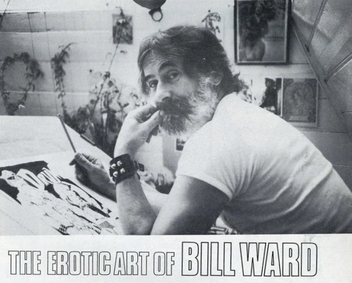
Bill Ward (1927–1996) was a London-born erotic artist whose inked, bear-like men became a visual language of gay leather. Leather readers know him best for The Adventures of Drum in Drummer — thick-bodied, sexual, unmistakably British in line even when the pages ran in San Francisco. He is not the American pin-up cartoonist of the same name. Before the explicit work he spent years drawing children’s weeklies for Fleetway; the Thriller series is the commercial credit that stuck, and that adventure-comics training shows in the later erotic pages.
His eye took composition and musculature from Burne Hogarth’s Tarzan, page architecture from Hal Foster’s Prince Valiant, and inked atmosphere from Milton Caniff. Those influences stay visible later: deep shadows, heroic anatomy, a sequential beat that still reads like a Sunday page even when the subject is a leather fuck. Before fully explicit work, some erotic drawings appeared discreetly in the British physique title Male Classics and in the American Physique Pictorial. Before 1967, gay sex and images that portrayed or encouraged it were illegal in Britain. The physique market was the legal grey zone — beefcake as fitness, with the leather and locker-room charge smuggled in the lighting.
Underground strips and the Drummer years
In the 1970s Ward worked at the Mansell Collection, a commercial picture archive at 42 Linden Gardens. By day he handled the archive; by night he drew what he could not yet sell over the counter. He lived on the same property with actor Brian Rawlinson. The house belonged to Louie Boutroy and was run with her unofficially adopted son and protégé George Anderson and Anderson’s partner Harold. From about 1976 Ward began producing strips — starting with the character King — for British and American gay magazines. In Britain they ran in Him and Zipper, and also in Sam and Daddy. What made him internationally known was the American leather press: Manifest Reader, Stroke, and above all Drummer.
In Drummer the recurring figures included Drum, a muscular sexual adventurer and the bear-like type Ward is remembered for; Zeke, a comic foil; and Rogan, a space cop. His art appeared in Drummer issue 24, September 1978 — the same number that carried Robert Mapplethorpe’s first commissioned cover — under editor Jack Fritscher. That single issue puts Ward inside the magazine’s classic leather moment. Alternate Publishing in San Francisco later issued The Adventures of Drum and The Fantastic Adventures of Bill Ward; work also appeared under the Meatmen imprint. He corresponded with Al Shapiro (“A. Jay”), Bill Schmeling (“The Hun”), and Harry Bush. The artist Rex met him, admired him, and owned original work.
AIDS, lost originals, and what survived
In the 1990s Ward was living in Stratford with his then-partner Stephen Helliwell, a silver expert at Christie’s. Both were diagnosed with AIDS and died within a few months of each other in 1996. Most of his original drawings for the American Drummer strips vanished during a change of magazine ownership. He tried, with John Embry’s help, to get them back and failed. Some work stayed with Rawlinson in the Linden Gardens studio. When that room finally had to be cleared, the houseclearers were ready to throw the explicit drawings into the skip with the junk. Robert Bremner (1947–2003) — the model for Drum, and a fellow member with Ward of the London MSC leather club — heard about the clearance with a day to spare. With Rawlinson’s blessing and the help of artist Guy Burch, they sifted the material and pulled out an archive. Bremner also died of AIDS.
Burch kept the surviving work together, though the explicit content made display and publication difficult. He later supplied information for Comics Unmasked: Art and Anarchy in the UK at the British Library, which presented Ward as one of two British gay erotic comic illustrators. Ward’s work was included in Model Men, a 2017 exhibition marking the fiftieth anniversary of the 1967 Sexual Offences Act. Japanese manga artist Gengoroh Tagame cites Ward as an influence.
Where the drawings live now
The bulk of the surviving archive is held by the Bishopsgate Institute in conjunction with the Queer Britain museum. Other holdings sit at the Leather Archives and Museum in Chicago, the Tom of Finland Foundation, The Collection of Male Art, and the Australian Lesbian and Gay Archives. Guy Burch’s essay “The Bill Ward Archive” appeared in Photography and Culture in November 2014. For leather and bear readers, Ward is the British counterpart to the California Drummer look: not the slim Tom of Finland cadet, but a heavier, hairier, club-night body drawn by someone who had already spent a career learning how adventure comics move. He drew the men he wanted to see, in a city where that drawing had been a crime until he was forty.