
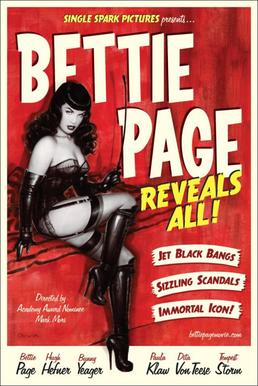
Bettie Page Reveals All, released in 2013, was directed by Mark Mori and written by Doug Miller. The documentary follows 1950s pin-up Bettie Page through her life and the cultural afterlife that followed. Irving Klaw’s bondage stills kept her a cult figure for fetish readers long after she left the business. A large part of the narration is Page herself, taken from audiotape interviews. The film’s pitch is that her unapologetic posing helped push the weather that became America’s sexual revolution. For kink viewers the reason to watch is simpler: the bondage pin-up queen tells the story in her own low Southern voice, and the photographs and talking heads sit around those tapes.
Commentators and peers on screen include Dita Von Teese, Hugh Hefner, Rebecca Romijn, Tempest Storm, Bunny Yeager, Paula Klaw, Jessicka, Mamie Van Doren, and Naomi Campbell. The wider roll adds Tricia Helfer, Stacy Burke, Christina Aguilera, Beyoncé, Rihanna, Madonna, Lady Gaga, Katy Perry, and others — some as sit-down interviews, some as the culture the movie wants Page credited with unlocking. Mori wraps her first-person life in Klaw stills, archive footage, and interviews, including the years after she vanished and the years after she found religion.
As of 2014 Rotten Tomatoes had the film at 75 percent fresh — 21 positive, 7 negative, average 6.8/10. Reviews circle Page’s voice, Mori’s affection, a messy structure, and a sexual-revolution argument some found too neat. Variety treated it as a crowd-funded picture from a veteran documentary producer that could have been packaged with more style and landed with a routine mid-level-cable feel; the content still engaged, including a lift from the exploitation cheapie Married Too Young when Page talks about a disastrous first marriage. The New York Times credited Mori, writer Douglas Miller, and — “best of all” — Page narrating in her low, gruff Southern drawl. The material had been told elsewhere, but Mori seemed to have liked Page: he shows the bad with the good without giggles, judgment, or cheap sensationalism, and the results are absorbing if sometimes unhappy. Time Out saw awkward transitions, including on the soundtrack, that make the film lurch as if Mori were still figuring out how to piece it together.
Time Out also saw two Bettie Pages: the squirmy 1950s pin-up who brought a mile-wide wink to bondage scenes, and the older Page recorded on tape before her 2008 death, looking back on the limelight and what came after. The magazine said it takes a facile grasp of sociocultural history to claim her niche eroticism kicked off the sexual revolution — even if Hefner is the one saying it. Her hasty exit from the industry, the FBI investigation, and her conversion to evangelical Christianity deserved franker scrutiny. Mori’s interview with the older Page was a coup and still frustrating: it reveals less than “all,” and he could not push a paradoxically modest person past skin-deep significance. RogerEbert.com made the voice the case for a ticket. The structure is mainly conventional and sometimes sloppy; any time the movie leaves tired talking heads — Hefner and Von Teese needlessly explaining why she matters — and goes back to Page talking, it finds its footing.
The film won the Jury Award for Best Feature Documentary at the 2013 Garden State Film Festival. That does not settle whether a bondage model’s grin caused a revolution. It does confirm Mori’s picture played as a serious documentary, not a novelty reel of vintage rope. Watched as fetish history, you get Page’s own voice recorded before 2008 sitting on the stills; Paula Klaw as a living link to the bondage studio; Bunny Yeager as the photographer of the Florida color work; Tempest Storm as a burlesque peer; Von Teese as the later performer who built a career on the look; Hefner as the man who put her in Playboy and then spent decades claiming the credit. The rest of the famous names are the culture the film wants to hang on her smile. The structure lurches, and “reveals all” oversells the tapes. When Page is talking, the movie is doing the one job a documentary about the Dark Angel actually has: letting the woman in the ropes speak.
![[Art Video] 1973 ADV-0032 Beautiful Tits Slender Girl Slut Training Raw Meat Love Slave. Yuma Yuma Motoki](https://bdsmwild.com/wp-content/uploads/2026/09/Art-Video-1973-ADV-0032.jpg)