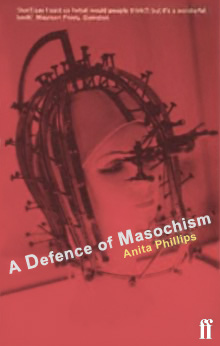
In 1998 London house Faber & Faber published a slim nonfiction book, A Defence of Masochism, by Anita Phillips (ISBN 0-571-19697-7). At the time most BDSM writing stayed in underground circuits; nonfiction that reached a mainstream literary press was scarce. Phillips writes as a defender, not a clinician. She makes a clear, cool case for adults who want to be hurt, used, or overcome: masochism is not only a disease or a moral panic. It can be thought through as a virtue.
Before Phillips, medicine and psychology often treated the wish to be hurt as a defect or a symptom — something to diagnose, classify, and cure. In this book the masochist is a thinking subject again: an adult negotiating erotic life, including the wish to be marked, pressed down, or used as an object. Phillips argues those desires are not chaos. They have an inner logic worth taking seriously.
The cover uses a beauty calibrator, the old device for measuring a “correct” face. The joke is about standards: who decides what a body is for? When society looks at masochists through pathology, Phillips points out that pain can be a chosen investment, not only passive victimhood. In the late 1990s that mattered, because the default story still ran “masochism equals unhealthy.”
The defence is not grand. It is enough. Desire for surrender and pain can be diagnosed, or it can be understood. The book itself is a quiet pushback against “masochism means something is wrong with you,” aimed at readers used to medical labels for erotic preference.