
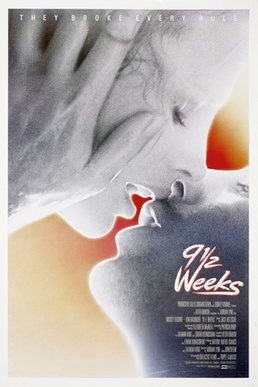
9½ Weeks (1986) is the American erotic drama that pushed a studio-scale BDSM-style affair into mainstream cinemas. Hollywood distributors sanded the most explicit edges for a mass audience, but for kink viewers who know dominance, humiliation, and negotiated collapse, it is still the film that shot adult power exchange that naked. The story is a short, consuming affair between SoHo gallery employee Elizabeth and Wall Street broker John, who wants control of her clothes, food, hair, and orgasms. The screenplay adapts Austrian-American writer Ingeborg Day’s 1978 memoir of the same name (pseudonym Elizabeth McNeill), by Sarah Kernochan, Zalman King, and Patricia Louisianna Knop.
On screen: locked door to riding crop
Elizabeth works at a SoHo gallery. She meets Wall Street arbitrageur John Gray at a Chinese grocer and again at a street fair. His control shows fast: he gives her an expensive gold watch and tells her to think about him touching her at noon every day; she does, and masturbates at work on that schedule. He will only see her in the evenings and tells her to keep her friends for daylight. Alone in his apartment she finds a photograph of him with another woman, April Tover. When she admits she went through his things, he says he will punish her. Behind a locked door he orders her to face the wall for a spanking. She tries to leave; he slaps her; she slaps him back; he rapes her. After that she falls in love with him, begins to enjoy the dominance, and they have sex on a clock tower.
John takes over what she wears, eats, how he brushes her hair, how he feeds her. Her dependence deepens and her sense of self thins. He has her cross-dress for a meeting at a bar in the Algonquin Hotel; afterward they are mistaken for a gay couple and attacked by tramps in an alley. High on the violence, Elizabeth stabs one attacker in the buttocks, shows wet underwear at the crime scene, and they have sex there. Then he puts the power exchange in public: he dares her to shoplift a necklace and she does; in Bloomingdale’s bedding department he tells her to “spread your legs for daddy” in front of the saleswoman; in an equestrian shop he hits her leg with a riding crop and tells the salesman, “I’ll take this one.” That night she does a striptease in his apartment. Later in his office he throws money on the floor and orders her to crawl and pick it up. She refuses at first; he takes off his belt and whips the floor, almost hitting her; she cries, finally crawls, then throws the money in his face and says she hates the game.
Blindfold, South American sex worker, adult venue
At work Elizabeth withdraws and thinks about her ex-husband Bruce, who has started seeing her co-worker and roommate Molly. She goes to the country to visit elderly artist Farnsworth and lock in an exhibit. At the Hotel Chelsea, John has her wear a blindfold; after a brief touch, a South American sex worker comes in and caresses Elizabeth while John watches. Elizabeth panics. When the woman takes the blindfold off, John takes the woman into the next room and starts undressing her. Elizabeth attacks, then flees; John follows. They end up in an adult venue. During a live sex show Elizabeth kisses the man next to her; John comes to her and they embrace. At Farnsworth’s gallery opening she is in tears in a corner, dependent on John for emotional balance, and calls him wearing a metal bracelet cuff. The next morning she tries to leave his apartment. He confesses his feelings to keep her. She walks away into the street crowd crying. He starts a mental countdown, sure she will come back before he finishes.
How the studio SM film got made
Director Adrian Lyne wanted to adapt Ingeborg Day’s book and at first thought a studio picture about sadomasochism was impossible. He directed Flashdance (1983) specifically to prove he could get that film greenlit. TriStar Pictures came on board, then pulled out just before principal photography over creative differences; Lyne later said the pressure came from principal stakeholder The Coca-Cola Company over the content. Shooting went ahead with money from the Producers Sales Organization. They shot in New York from 30 April to 10 August 1984 on a $15 million budget, then slipped two weeks and another $500,000 because leads Kim Basinger and Mickey Rourke fought constantly with Lyne. He used monochromatic film, smoke machines, and grey sets to imitate black-and-white, with locations including Trinity Church, the Canal Street Flea Market, and Coney Island. He refused rehearsals for the two leads so the first on-screen meeting would be the first working meeting — real unease as fuel for a dominance story. Basinger left the audition crying after being asked to play the crawl-for-money scene; Lyne sent roses and kept after her until she changed her mind. Rourke said the on-set tension made the conflict more convincing.
U.S. cuts, overseas cult
U.S. test screenings went badly and the MPAA gave an X rating. To buy an R, MGM cut about three minutes from the North American theatrical version, softening the scene in which John snaps his belt and forces Elizabeth to crawl for cash — the scene that made about two-thirds of a test audience walk out. North America flopped: about $6.7 million against a $17 million budget. Uncut, overseas — especially Australia, Canada, France, Germany, and the United Kingdom — it made around $100 million worldwide, sold a soundtrack, and became a rental-and-DVD cult object. In France it ran five years in a Paris cinema. In São Paulo, Cine Belas Artes played it thirty months from 1986 to 1989. In 1998 MGM Home Entertainment issued an uncut, uncensored 117-minute DVD; Warner Home Video put it on U.S. Blu-ray in 2012. The version kink viewers watch is the one that still has the belt and the crawl.
Score, novel, sequels
John Taylor of Duran Duran and Jonathan Elias wrote music for the score; the single “I Do What I Do” reached No. 23 on the Billboard Hot 100. The soundtrack included Joe Cocker’s “You Can Leave Your Hat On,” Devo, Eurythmics, and others. The U.S. cut of the movie failed; home video warmed later viewers. The memoir is darker: John forces Elizabeth into a violent mugging in an elevator, and the book ends in a quasi-rape that leaves her in a psychiatric hospital he never returns to. The movie kept the crop, the belt, the crawl, and the locked door, and dropped the hospital abandonment. Pop citations followed — a Soda Stereo song, a Seinfeld line, Sheena Easton’s “Days Like This” video restaging scenes. In 1997 the direct-to-video sequel Love in Paris paired Rourke with Angie Everhart; in 1998 the prequel The First 9½ Weeks arrived. The 1986 Golden Raspberry Awards nominated it for Worst Actress and two other categories; all three lost. Roger Ebert gave it three and a half stars out of four and argued that Rourke and Basinger make the people and the relationship more human than the usual erotic-film mannequins. The 1986 feature is still the studio film that used Flashdance as a ticket to shoot spanking, a locked door, rape after a slap, a necklace theft, a riding crop, a belt, and a crawl for cash — and the distributor that cut the crawl so America would buy a ticket.
![[Taiyo Tosho] 605516 The Scandal 16 Rose-Colored Madam Feast of Shame Yuki Okakura [Exclusive]](https://bdsmwild.com/wp-content/uploads/2026/09/605516-Exclusive.jpg)