
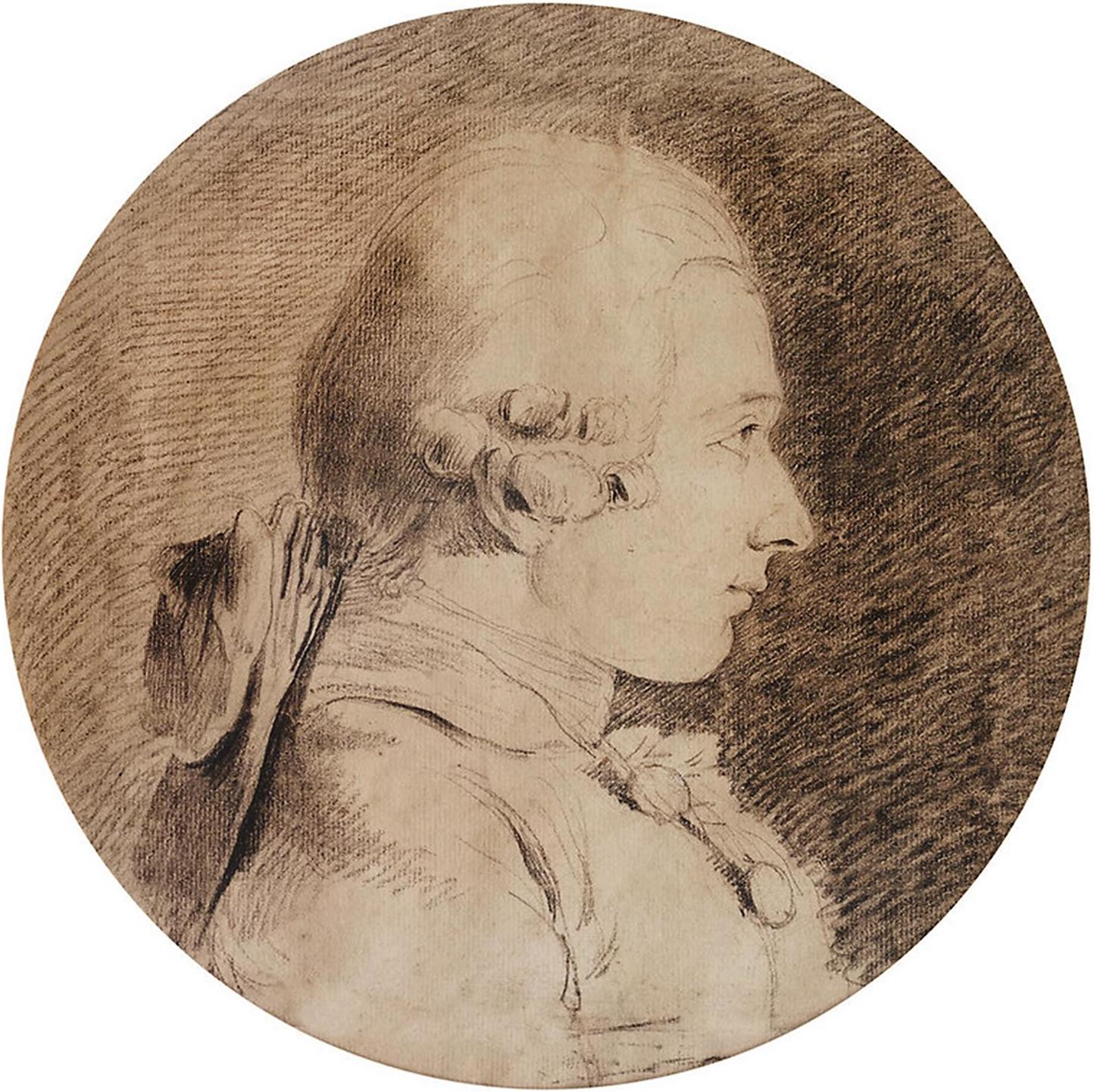
Donatien Alphonse François, Marquis de Sade (2 June 1740 – 2 December 1814), was a French nobleman, officer, writer, libertine, and political operator. He is known for libertine novels and for repeated detention over sex scandals, blasphemy, and pornography. The word sadism comes from fictional characters who take pleasure in other people’s pain.
He was born at the Hôtel de Condé in Paris to Jean-Baptiste François Joseph, Count de Sade, and Marie-Éléonore de Maillé de Carman, from a junior Bourbon-Condé line related by blood to the French king. The family claimed provincial nobility back to the thirteenth century. Spoiled and violent as a child, he went to his grandmother in Avignon in 1744, then to his uncle the Abbé de Sade at Saumane, with Abbé d’Amblet as tutor. In 1750 he entered the Jesuit college Louis-le-Grand. Military school followed in 1754; on 14 December 1755, aged fifteen, he was commissioned sub-lieutenant in the King’s Foot Guard, then rose through the Seven Years’ War to captain in the Burgundian Cavalry in 1759. Gambling, womanizing, and refusal to please superiors stuck to his name. Discharged when the war ended in 1763, he was steered into marriage with Renée-Pélagie of the wealthy Montreuil family after a failed courtship of Laure de Lauris. He later called his strictly Catholic wife too cold and too devout. Their children were Louis-Marie (1767), Donatien-Claude-Armand (1769), and Madeleine-Laure (around 1771).
Scandals piled up. In October 1763 prostitute Jeanne Testard accused him of blasphemy, forcing her to trample a crucifix, and threats after she refused to beat him; Louis XV jailed him at Vincennes and freed him within weeks after his father’s plea. On Easter 1768, beggar widow Rose Keller said he lured her to Arcueil, tied and whipped her, cut her, and poured hot wax; his mother-in-law paid her to drop the complaint, a lettre de cachet locked him up, and a royal pardon followed—Sade claimed she was a willing prostitute and denied the knife and wax. In June 1772 in Marseilles he and servant Latour staged an orgy with prostitutes involving flagellation; witnesses also alleged anal sex. Anise pastilles laced with Spanish fly sickened Marianne Laverne and Marguerite Coste; Coste went to police on sodomy and poisoning charges. He was sentenced to death in absentia and burned in effigy, fled to Italy, was locked in the Fortress of Miolans, and escaped on 30 April 1773. His long imprisonment from 1777 to 1790 is when he wrote much of the work his wife smuggled out.
After the Revolution he legally separated from his wife in 1790 and began a lasting relationship with actress Marie-Constance Quesnet. Calling himself “Louis Sade, man of letters,” he published Justine, or the Misfortunes of Virtue anonymously in 1791; the play Oxtiern closed after two performances amid uproar. Politics moved from constitutional monarchy toward open republicanism. He served as health and charity commissioner for the Section des Piques, delivered the 1793 funeral oration for Marat and Le Peletier, and carried an anti-religion petition that alienated Robespierre’s circle. Arrested for “moderatism” and related charges, he was listed for execution on 27 July 1794 (9 Thermidor) but survived by bribery or paperwork error and left prison that October. Later anonymous books included Philosophy in the Bedroom and Aline and Valcour (1795) and early volumes of The New Justine and Juliette (1797–99). Debt forced the sale of La Coste. Crimes of Love (1800), under his own name, drew hostile reviews that also pinned Justine and Juliette on him.
In March 1801 he was arrested at his publisher’s office; police minister Joseph Fouché ordered detention without trial. After Sainte-Pélagie and Bicêtre he was moved to Charenton asylum, where Quesnet lived with him under the cover of being his illegitimate daughter. Director Abbé de Coulmier ran a humane “moral treatment,” let Sade write and stage plays, and in 1805 built a theater seating about two hundred that drew Napoleonic society. The ten-volume libertine novel Les journées de Florbelle, finished in 1807, was seized by police; he also wrote three more conventional historical novels there. Solitary confinement and a ban on pens hit in 1810; Coulmier eased them back. In 1813 the government ordered shows stopped. Sade died on 2 December 1814 of “prostrating gangrenous fever.” He wanted burial at Malmaison without autopsy or pomp; the land was already sold, so he was buried at Charenton with religious rites. His skull was later taken for phrenology. Son Claude-Armand burned remaining unpublished manuscripts, including Florbelle.
Books, afterlife, and kink readers
Major libertine novels: The 120 Days of Sodom (written 1785, first published 1899), Justine (1791 and 1797–99 versions), Philosophy in the Bedroom (1795, in dialogue), and Juliette (1797–99). Other work includes the 1782 Dialogue between a Priest and a Dying Man, the epistolary Aline and Valcour, Crimes of Love, plays, and more than two hundred prison letters to his wife that many readers find more revealing than the fiction.
Twentieth-century readers split hard. Apollinaire called him the freest spirit yet; Breton claimed him for surrealism; Simone de Beauvoir asked whether we must burn Sade; Barthes, Angela Carter, and Camille Paglia read power and sexuality in him; Andrea Dworkin and Roger Shattuck attacked the rehabilitation as a celebration of violence against women. Stage and film keep recycling him: Weiss’s Marat/Sade, Pasolini’s Salò, Kaufman’s Quills. Descendants such as Xavier de Sade later opened family papers; Pierre Cardin bought and partly restored Lacoste for festivals.
Peter Marshall and others note that Sade’s known acts—beating a housemaid, orgies with prostitutes—sit far from a clinical picture of active sadism; Dworkin asks whether one believes Sade or the women who accused him. The novels pile rape, torture, and murder into unequal, coerced scenes. That is not the same thing as today’s negotiated adult BDSM. For kink readers he is the writer whose name labeled sadism—a literary and etymological figure, not a how-to.