
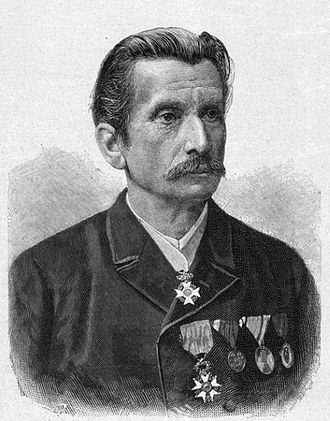
Leopold Ritter von Sacher-Masoch (27 January 1836 – 9 March 1895) was an Austrian nobleman, journalist, and writer, known for romantic stories of Galician life and as the namesake of masochism. The Austrian psychiatrist Richard von Krafft-Ebing coined the term from his surname; Masoch did not approve. In his lifetime he was a man of letters with utopian leanings who pushed socialist and humanist ideas in fiction and non-fiction. Most of his work is still untranslated into English.
He was born in Lemberg, capital of the Kingdom of Galicia and Lodomeria in the Austrian Empire, into a Roman Catholic family. His father, Leopold Johann Nepomuk Ritter von Sacher (1797–1874), was an Austrian civil servant and imperial police commissioner in Lemberg; his mother, Charlotte Josepha von Masoch (1802–1870), was a Ukrainian noblewoman and the last of her line. At her family’s request the father combined surnames; the emperor then granted the noble title Sacher-Masoch. Leopold studied law, history, and mathematics at Graz University, took a doctorate in history in 1856, and lectured there.
Early non-fiction dealt with Austrian history; he then turned to Galician folklore, left teaching, and wrote full time. Within a decade short stories and novels outpaced his historical prose, though history still ran through the fiction. Panslavist ideas were common, and he liked vivid types among Galicia’s ethnic groups. From the 1860s to the 1880s he published volumes of Jewish Short Stories, Polish Short Stories, Galician Short Stories, German Court Stories, and Russian Court Stories.
In 1869 he planned a large cycle, Legacy of Cain, to carry his aesthetic outlook. It opened with the manifesto The Wanderer and brought in misogynist themes that stayed in his work. Of six planned volumes only the first two were finished; he dropped the project by the mid-1880s. The published volumes include his best-known stories, above all Venus in Furs (1870). The novella lays out his fantasies of dominant women in fur; he tried to live them with mistresses and wives.
The inspiration was Fanny Pistor, a beginning writer who contacted him under the name Baroness Bogdanoff for help making her work publishable. Venus im Pelz is what later fed the word masochism. In 1873 he married Angelika Aurora von Rümelin; they practiced the fantasies from the book together.
Later life brought mental decline. In 1874 he wrote Die Ideale unserer Zeit (The Ideals of Our Time), a portrait of German Gründerzeit society. In his late fifties his health failed and his last years were under psychiatric care. Official reports place his death in Lindheim in 1895 (Lindheim later joined Altenstadt in 1971); another claim puts him in a Mannheim asylum in 1905. He was the great-uncle of Eva von Sacher-Masoch, Baroness Erisso, mother of Marianne Faithfull.
In 1886 Krafft-Ebing named masochism in Psychopathia Sexualis. He wrote that he felt justified in calling the anomaly Masochism because Sacher-Masoch had made this then little-known bent the ground of his writing, on the model of Daltonism from Dalton. Facts had been advanced, he said, showing that Sacher-Masoch himself had the anomaly; those proofs were given to him without restriction, but he would not publish the details. He refused the charge that he had tied a revered author’s name to a sexual perversion: as a man, Sacher-Masoch lost nothing among cultured readers for an anomaly of feeling; as an author he was injured whenever the perversion drove the work, and without it he might have reached real greatness — a case of how the sexual life can steer the mind. Sacher-Masoch disliked Krafft-Ebing’s claims.
Private life stayed obscure until Aurora von Rümelin’s memoir Meine Lebensbeichte (1906) appeared in Berlin under the pen name Wanda v. Dunajew — the lead name in Venus in Furs. A French translation, Confession de ma vie (1907), credited “Wanda von Sacher-Masoch” and was issued by Mercure de France. RE/Search Publications brought out an English version from the French in 1991 as The Confessions of Wanda von Sacher-Masoch.
For kink readers he is the writer whose name labeled masochism; Venus in Furs is a fur-and-female-dominance fantasy, not a how-to.
Selected titles
1858 A Galician Story 1846; 1865 Kaunitz; 1866 Don Juan of Kolomiya; 1867 The Last King of Hungary; 1870 The Divorcee; 1870 Legacy of Cain Vol. 1: Love (includes Venus in Furs); 1872 Faux Ermine; 1873 Female Sultan; 1873 The Messalinas of Vienna; 1873–74 Russian Court Stories in four volumes; 1873–77 Viennese Court Stories in two volumes; 1874/76 Liebesgeschichten aus verschiedenen Jahrhunderten in three volumes (including Bloody Wedding in Kyiv and Ariella); 1874 Die Ideale unserer Zeit; 1875 Galician Stories; 1877 The Man Without Prejudice; 1877 Legacy of Cain Vol. 2: Property; 1878 The New Hiob; 1878 Jewish Stories; 1878 The Republic of Women’s Enemies; 1879 Silhouettes; 1881 New Jewish Stories; 1883 Die Gottesmutter; 1886 Eternal Youth; 1886 Stories from Polish Ghetto; 1886 Little Mysteries of World History; 1886 Bloody Wedding in Kyiv; 1887 Polish Stories; 1890 The Serpent in Paradise; 1891 The Lonesome; 1894 Love Stories; 1898 Entre nous; 1900 Catherina II; 1901 Afrikas Semiramis; 1907 Fierce Women.