
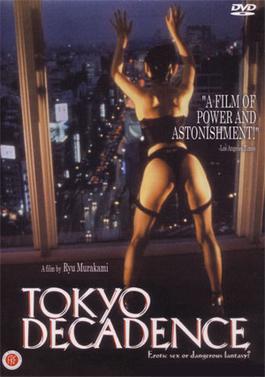
Tokyo Decadence, Japanese title トパーズ (Topāzu), also released as Topaz, was shot in 1991 and opened at the start of 1992. Novelist Ryū Murakami directed it. Ryuichi Sakamoto wrote the music. The film adapts Murakami’s own story material. The scenes are cruel and graphic enough that Australia and South Korea banned it. It is a pink film with an arthouse surface, not softcore tickling dressed up as art. For adult viewers who know BDSM and fetish, it is not a consent-culture manual and not a club-lifestyle guide. It is a raw picture of commercial power exchange and emotional hunger.
The point is that the SM is paid. Miho Nikaido plays Ai, a timid twenty-two-year-old college student working for an exclusive Tokyo escort agency whose clients are rich and perverse. Her job is to take elaborately staged sexual humiliation, light bondage, and light sadomasochism. Here SM is labor, the price of staying employed, not an identity negotiated in a club. While she absorbs that, she is also worn down by feeling. She is in unrequited love with a married gallery artist, and that longing is the only relief she can find inside numb work.
In a world that offers almost nothing else, superstition becomes how she stays alive. She goes to a fortune-teller played by the artist Yayoi Kusama and gets a string of odd instructions: find a “pink stone” and make it into a ring, put a telephone directory under the television, and stay away from a gallery in the east. When the ring is lost, Ai risks her life to get it back. That thread runs through the film. Kusama’s words are the spine Ai uses to move.
The gallery artist is the unrequited love, not a client. There is also a female dominant who is herself a sex worker. Ai admires her and gets attached. The dominant tells her she has to live fully or live in regret, and that she has to face this part of her life if the future is going to be hers. Ai then takes an unnamed drug the client gives her, said to be “for the courage of lions,” gets dangerously intoxicated, and fails when she tries to meet her ex. She meets the artist’s wife, said to have been a great singer and now “crazy.” The wife sings for an audience of one and calls it a fine performance. She says they were rivals once; the artist is now in dementia, the rivalry is over, and they can be friends. A nurse collects the wife and warns that if anything happens to her, the nurse will be held responsible. After that, Ai tries to break into the artist’s house. The police take her in. The artist’s wife gets her out.
Cast, bans, and the dance after the credits
The writer Shimada Masahiko appears on screen. Kusama’s fortune-teller does more than push the plot; the advice is what Ai acts on. Sayoko Amano plays Saki. Chie Sema plays the “Opera Lady.” Murakami’s direction and Sakamoto’s score give the pink-film frame a literary cruelty. The double title, Topaz / Tokyo Decadence, marks both the Japanese story and the export package sold to international cult audiences.
The Ontario Film Review Board banned the film. Director David Cronenberg protested in public: “even by their own rules, which they invented, it’s clearly acceptable.” The Australian and South Korean bans show how hard the paid SM and humiliation read to censors. Nathaniel Thompson’s DVD Delirium lists it among international oddities on home video.
For most of the running time Ai moves stiffly, timid, posture demure. After the credits she dances on stage, bold and fluid. The body that has been rented out takes a choreography of its own. What is there to watch is concrete: the client scenes, Kusama’s pink-stone instructions, the dominant worker’s talk, and that dance.
![[Art Video] 1786 Slave Dispatch No.6 Secret Record of a Masochist Woman (20) with a Desire for Masochistic Perversion Coming to Tokyo Manami Mizuki [Exclusive]](https://bdsmwild.com/wp-content/uploads/2026/08/Art-Video-1786-Exclusive.jpg)