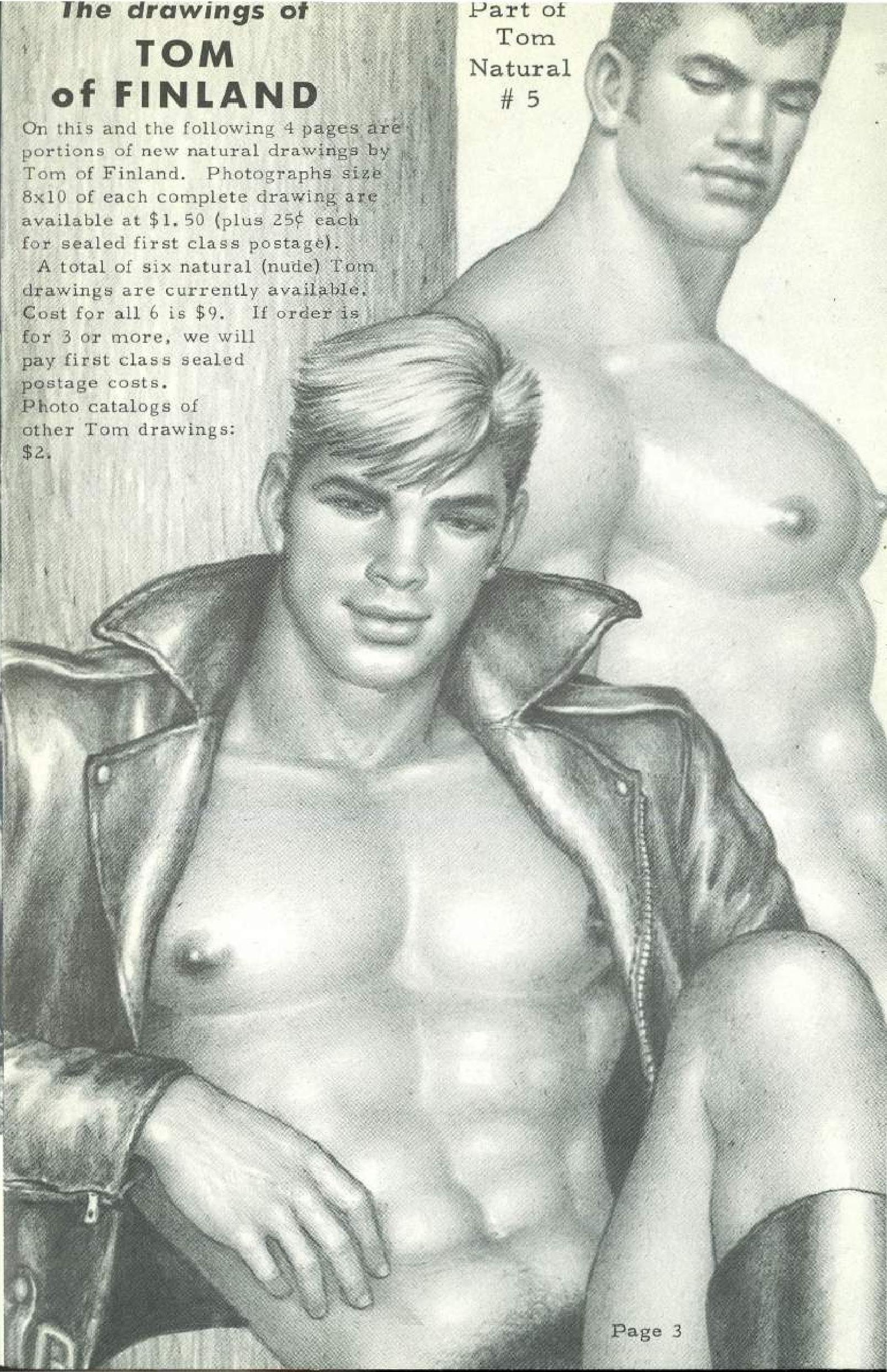
Touko Valio Laaksonen, known as Tom of Finland, made the most influential gay pornographic images of the twentieth century. He was born on 8 May 1920 into a middle-class family in Kaarina, near Turku, Finland. Both parents taught at the local grammar school. In 1939, at nineteen, he went to Helsinki to study advertising and in his spare time drew erotic pictures for his own pleasure, men who labored, the kind he had watched since he was a child. He hid those early drawings. He destroyed them at least before he went into the army.
In 1940 he was conscripted as a second lieutenant in the Finnish Army’s anti-aircraft service. That time in uniform fed a fetish for uniformed men, especially the kit of the German Wehrmacht. He hated the racial ideas in Nazism. He still said it plainly: “In my drawings I have no political statements to make, no ideology. I am thinking only about the picture itself. The whole Nazi philosophy, the racism and all that, is hateful to me, but of course I drew them anyway—they had the sexiest uniforms!” After he left the army in 1945 the drawings were still soft: mild middle-class men, not yet the exaggerated muscle and the confident pose that became the brand. His partner, the dancer Veli “Nipa” Mäkinen, was with him for twenty-eight years, until Mäkinen’s death in 1981. In 1988 Tom of Finland was diagnosed with emphysema. Side effects of the medication made his hands shake, so he gave up pencil for pastel. In 1991 he died of a stroke brought on by the emphysema.
The career rose alongside gay law reform and the political arrival of the communities. In 1956 he sent work to the American magazine Physique Pictorial. The Spring 1957 issue ran it under the name Tom. In the Winter issue that year the editor Bob Mizer credited him as Tom of Finland. The Spring cover was a lumberjack picture: two men at work, a third watching. The lumberjack, an icon of Finnish masculinity, became a homoerotic sign in a gay context. Postwar biker culture offered gay men a stylized masculinity that was rebellious and dangerous. He took in bikers, cops, and soldiers, and marked them with leather and denim as untamed, physical, self-empowered men, against the sad, passive, sissy homosexual of mid-century psychology.
From the 1950s into the early 1960s, American censorship limited “overt homosexual acts,” and his published style bent around that wall. He used the beefcake market of the time. Those magazines put muscular young men in athletic poses and, under that cover, sold erotic fantasy to gay readers. The drawings were mostly filed as jack-off material. Rob Meijer, who ran a leather shop in Amsterdam, said: “These works are not conversation pieces, they’re masturbation pieces.” They were drawn to get men hard. They also changed what gay masculinity was allowed to look like. In 1962 the U.S. Supreme Court, in MANual Enterprises v. Day, held that nude male photographs were not inherently obscene. Softcore magazines and fully nude films followed. In the late 1960s the beefcake market collapsed, and his work got more explicit, more fantastical, with genitals and muscle pushed to an extreme. Also in the late 1960s he created the comic character Kake. Across twenty-six comics from 1968 to 1986, that leatherman keeps the smile, the jacket, and a cock that does not apologize. He is not the tragic invert of older stories.
In 1973 Tom of Finland entered the art world with erotic comic books and mainstream exhibitions, and the same year he quit his full-time job at the McCann advertising office in Helsinki. He wrote: “Since then I’ve lived in jeans and lived on my drawings.” In the mid-1970s the style turned photorealistic. Many drawings are based on photographs. None is an exact copy. The photo supplies a believable pose. He then exaggerates it toward an ideal of masculine beauty and sexual pull. In 1979 he and the businessman Durk Dehner founded the Tom of Finland Company to protect copyright that had been widely pirated. With Lou Thomas he published Target by Tom; The Natural Man, photographs mixed with drawings. The adult performers include Bruno, Jeremy Brent, Chuck Gatlin, and Steve Sartori.
Nazi uniforms in the work have stayed a fight. They are a small part of the catalogue, but the flattering way they are drawn led some viewers to infer sympathy for Nazism. Later he tried to disavow that work and to pull himself and the drawings off fascist or racist ideology. Sheila Jeffreys’s radical-feminist critique in Unpacking Queer Politics (2003) is not the art criticism. The art criticism is split on its own. Some call him a “master with a pencil.” A review in the Dutch paper Het Parool called the work “illustrative but without expressivity.” Inside leather culture those images are read as a fetish for the authority of the uniform, continuous with his cops and soldiers. The fetish carries a historical stain. Saying the stain is not there is also part of the history. Robert Mapplethorpe is a different path. Mapplethorpe photographed real SM at the Mineshaft for museums. Tom of Finland drew fantasy muscle for magazines and bars. The two were friends. The routes stayed parallel.
In 1984 he founded the nonprofit Tom of Finland Foundation to preserve his catalogue and to support erotic art in general. Headquarters is TOM House in Echo Park, Los Angeles, Durk Dehner’s house, where Tom of Finland lived for about ten years at the end of his life. The basement has a dungeon open by invitation only. The backyard is the Pleasure Park. In the 1980s, while he was living in Los Angeles, he and the artist Bill Schmeling held artist salons in their own homes. The Foundation holds about 1,500 works by Laaksonen, the largest group of them. The mission later widened into a safe haven for all erotic art. It runs a competition for emerging artists and work toward a museum of erotic art. In 1995 the Tom of Finland Clothing Company launched a fashion line, trying to balance the masculine eroticism of the drawings with mainstream fashion. The company and the Foundation are close. They are run separately.
The influence reaches fashion, music, and film. That confident leather look reached artists including Robert Mapplethorpe and Raymond Pettibon, and it entered the clothes of Jean-Paul Gaultier and Thierry Mugler and the look of Freddie Mercury of Queen. In 1991 the documentary Daddy and the Muscle Academy was released. The next year it won a Jussi Award. The film sets reference photographs next to finished drawings. Treating Tom as a gay-pride icon is the film’s line. The person who said the work also looks like S&M pornography and like fascist art, and that the film leaves that out, was a critic. In 2013 Dome Karukoski took on the biopic Tom of Finland. It opened in 2017. In 2014 the Finnish postal service issued three first-class stamps using his nudes. Pre-orders came from 178 countries. It became the best-selling stamp set in that service’s history.
The drawings made more explicit gay art possible. He did not invent the motorcycle jacket or the cop fantasy. He set a visual grammar for gay erotica: a smile instead of a tragic droop, friendliness inside the brutality, SM gear as a uniform of belonging. The men in the pictures are rarely isolated victims. They cruise each other in abundance. He drew a world in which everyone could fuck and be fucked in leather without shame. That was not the world that conscripted him in 1940. Posters in leather bars, a cop and a prisoner, are a lookbook. They are also how the pictures kept moving. The argument about the Nazi uniforms has not stopped. The rest of the record is still there: Kake’s twenty-six comics, the lumberjack icon, the Foundation, the dungeon at TOM House, and stamps sold around the world. Finland treats him as a national hero. Those are the pieces.
![Legend of Shima 114 Legend of Shima 114 Mania Secret Records Married Woman Slave VOL.18 Momoko Sugiyama -Shiko Shima- [Shima Planning] SS-0295](https://bdsmwild.com/wp-content/uploads/2026/08/Legend-of-Shima-114-SS-0295.jpg)