
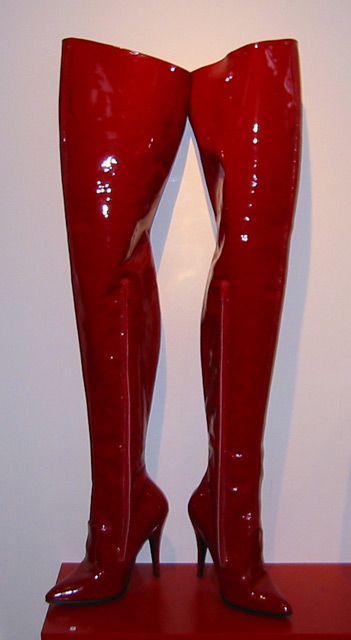
Thigh-high boots—also called thigh-length boots or simply thigh boots—are boots that climb above the knee to at least mid-thigh. Related names include over-the-knee boots (OTK), a label that originally described fifteenth-century men’s riding boots, and pirate boots when the shaft is cuffed. Length ranges from just over the knee to nearly crotch level (crotch boots / crotch-high boots). Materials run from leather and synthetics (vinyl, sheet latex) to fabrics (silk, polyester microfiber). Closures may be zippers or pure pull-on construction. Heels run flat or high (often over three inches / 7.5 cm), from metal spikes to chunky blocks; platforms appear on many fetish and fashion models.
For kink culture these are not neutral shoes. Thigh boots sit at the crossroads of boot fetishism, shoe fetishism, leather fetishism, and rubber/PVC fetishism. Cheaper pairs are common costume for models, sex workers, and professional dominatrices, which is why the silhouette reads as trade iconography and as a visual cue of sadomasochistic power. Couture houses still sell extreme shafts because implied eroticism sells. Many people also read thigh-highs as symbols of female power, authority, and sex appeal—the Domme uniform of popular imagination even when the wearer is only going to brunch.
Visual effect depends on leg length. As Samantha Clark notes in Outfits in Minutes, shorter wearers show less bare thigh above the boot line; a very high heel can fake height, but when there is more boot than leg the eye foreshortens the body. That optical fact is why runway OTK and dungeon OTK often use aggressive heel and tight shaft to keep the proportion “long” rather than “stumpy.”
From Victorian Street to 1960s Kinky Boots
Laced leather boots were fashionable for women through the Victorian era. By the late nineteenth century, over-the-knee laced leather began to trend among London prostitutes who wanted a look that would speak to foot fetishists and to clients shopping for a dominatrix. Commercial sex and specialty desire already drove length and lace upward decades before TV spies made the style famous.
In the 1960s, kinky boots—fetish boots—meant patent leather, high stilettos, and extreme drama: very high heels, thigh- or crotch-high shafts, unusual colors and materials. The look was coded for prostitute or dominatrix glamour. Honor Blackman’s thigh-high leather as Cathy Gale in The Avengers became the pop-culture template, immortalized in the 1964 song “Kinky Boots” by Blackman and co-star Patrick Macnee. Television leather and chart novelty fused the boot with British spy kink and mainstream fashion curiosity at once.
Fashion Cycles, Price Tiers, and Design Houses
In women’s fashion, thigh boots cycle through popularity and silhouette. Several writers note that the film Pretty Woman (1990) temporarily damaged the style’s “respectable wardrobe staple” credibility by locking black vinyl OTK to street-sex costume. Even so, almost every fall season some designer or retailer bets on the shaft again. Distribution channels split by price and construction:
- Couture fashion designers — highest price points; boots tied to a seasonal theme
- Fashion designers — similar logic at a lower tier
- Couture shoe houses — premium specialist makers who regularly include thigh boots
- Boutique brands — often Italian specialists with steep retail tags
- Fashion and shoe retailers — high-street and mall price bands
Couture shoe names frequently seen with thigh boots include Brian Atwood, Manolo Blahnik, Jimmy Choo, Christian Louboutin, Sergio Rossi (Gucci Group), Stuart Weitzman, and Giuseppe Zanotti (Vicini). Fashion houses often commission these shoemakers for runway boots. Italian boutique brands that treat OTK as a staple include Gianmarco Lorenzi, Left and Right, Le Silla, Loriblu, and Icône—prices can be extreme in boutiques, softer through eBay and clearance. High-street regulars that cycle thigh boots include Aldo, bebe, and Victoria’s Secret.
Runway Seasons: 2001–2010 Highlights
The early 2000s through the end of the decade repeatedly put OTK on the boardwalk of ready-to-wear:
Autumn 2001 — Roberto Cavalli showed many looks with four-inch-heel, pointed-toe thigh boots.
Autumn 2003 — Narciso Rodriguez caused a stir when nearly half his models wore pointed, four-inch OTK with the collection. Phoebe Philo at Chloé showed leather and suede thigh boots in red and green as well as black and brown.
Autumn 2005 — Karl Lagerfeld put Chanel black leather thigh boots on many looks; actress Anne Hathaway later wore the style in The Devil Wears Prada, turning the boot into a makeover icon rather than only a street-sex sign.
Autumn 2006 — Lagerfeld styled the entire Autumn 2006 Chanel lineup with thigh boots in black suede, blue denim shades, and other finishes—OTK as total-look signature, not accent.
Autumn 2008 — Fendi backed a chunky suede thigh boot with metallic leather accents at ankle and heel top, stocked in black, brown, taupe, and gray across multiple retailers.
Spring 2009 — Givenchy kicked the trend off-season with a western-style black leather thigh boot.
Autumn 2009 — Thigh-highs became a declared fashion trend. US Vogue’s September 2009 issue used them in two feature layouts. High-street and ready-to-wear piled on. Miuccia Prada pushed margins with fashion thigh boots, one version even using garters from a belt to suspend the tops. Stella McCartney showed three crotch-length synthetic boots (animal-friendly uppers) with snipped toes and extreme stilettos; one multi-patterned pierced upper. Other houses showing OTK that season included Alexander McQueen, Catherine Malandrino, Celine, Chloé, Gucci, Halston, and Louis Vuitton.
Among shoe specialists, Christian Louboutin alone marketed at least four Autumn 2009 styles: front-lacing mid-thigh with sculpted heel and hidden platform (Supra Fifré); a crotch-length skin-tight hidden-platform boot; the chunky mid-thigh Contente; and a chunky platform mid-thigh. Jimmy Choo offered a heeled thigh boot with elastic cuff above the knee plus two flat OTK pairs in couture, and a limited H&M capsule mid-thigh black leather with a four-inch heel.
Autumn 2010 — The style repeated as a highlight after 2009. Houses showing thigh boots included Burberry Prorsum, Christian Dior, Hermès, and Vionnet.
Celebrity Media and 2010s Demand
Thigh-highs stayed visible on celebrities; Ariana Grande folded many OTK styles into her signature look, driving magazine and retail coverage and a demand surge. That spike also rode the late-2010s revival of 1990s fashion codes. Pop stardom and trend cycles kept re-legitimizing a silhouette that fetish culture never abandoned. Stage costumes, music-video stills, and red-carpet OTK all feed the same feedback loop: once a megastar normalizes the shaft, high-street knockoffs and fetish retailers both sell harder.
Fashion editors still treat each autumn’s OTK revival as a “trend story,” even when boot fetishists never left. That double market—magazine legitimacy plus dungeon demand—is why the same silhouette can cost under fifty dollars in PU or over a thousand in Italian leather with a red sole. Construction quality, shaft stretch, calf fit, and heel stability matter more to people who wear the boots for hours of standing, dancing, or scene work than to a single runway walk. Serious boot buyers talk last shape, zipper reliability, and whether the top stays up without a garter—practical fetish engineering dressed as fashion talk.
Fetish History: Klaw to Vinyl vs Couture
As fetish clothing, thigh boots date at least to the 1950s, when Irving Klaw costumed women in them for bondage and pin-up photography. They became staples of adult and fetish stills: Bob Guccione shot 1982 Penthouse Pet of the Year Corinne Alphen in black leather thigh boots; Dwight Hooker photographed Playboy’s 25th Anniversary Playmate Candy Loving in white leather over-the-knee boots. Those centerfold and specialty layouts trained a generation of viewers to read shiny long shafts as erotic punctuation—before mainstream fashion fully reclaimed them.
Until the 2000s, fetish OTK usually looked more extreme than fashion OTK—higher heels, taller platforms, more aggressive proportions, sometimes crotch-high with lockable details or extreme point toes. In the late 2000s some couture designers (notably Louboutin) chased similar extremes, so the old fashion/fetish split by silhouette softened. The remaining divide is often material and price: fetish market pairs lean polyurethane (PU) or vinyl (often mislabeled patent leather), mass-produced in China at low cost, while specialized European cobblers still build higher-priced fetish thigh boots for serious boot lovers and pro players. Dommes and models who live in boots often mix both tiers: cheap shine for messy play or travel, custom leather for signature look and long wear. Boot worship scenes, foot-and-shaft polishing rituals, and “heels only” protocols all keep OTK central to modern BDSM wardrobe language even when the rest of an outfit is street casual.
Screen Iconography
Motion pictures have hard-coded the boot’s meanings:
- Pretty Woman (1990) — Julia Roberts as Vivian Ward spends early reels in black vinyl thigh boots as a symbol of sex work.
- The Devil Wears Prada (2006) — Anne Hathaway’s Andy Sachs completes her ugly-duckling-to-swan turn by walking into the office in Chanel black leather thigh boots, styled by Patricia Field—OTK as fashion power, not street trade.
- 101 Dalmatians / 102 Dalmatians — Glenn Close’s Cruella wears red PVC thigh-highs and black PVC thigh/crotch boots, later stained with molasses and mud: cartoon villain glamour through shiny extreme footwear.
Those three poles—sex work, fashion authority, cartoon villain—still frame how audiences “read” a thigh shaft before a single line of dialogue.
Why Kink Wardrobes Never Drop OTK
Thigh-high boots condense boot worship, Domme silhouette, leather/PVC shine, and leg-as-sculpture into one garment. They work as daily fashion when soft and flat, and as scene armor when patent, platformed, and laced. On a kink site they also function as instant role signal: the long shaft says authority, objectification, or both, depending on who is wearing them and who is kneeling. Related topics: boot fetishism, over-the-knee boots, fuck-me shoes, jackboots, go-go boots, knee-high boots, and the permanent runway-vs-dungeon conversation about how high is high enough. Whether you buy Louboutin, a Chinese PU pair, or a custom European fetish last, the message is the same: power starts at the ankle and does not stop at the knee. From Victorian street trade through Cathy Gale leather, Chanel makeover boots, and Ariana-era pop OTK, the thigh-high remains one of fetish fashion’s most durable icons—equipment as much as accessory.