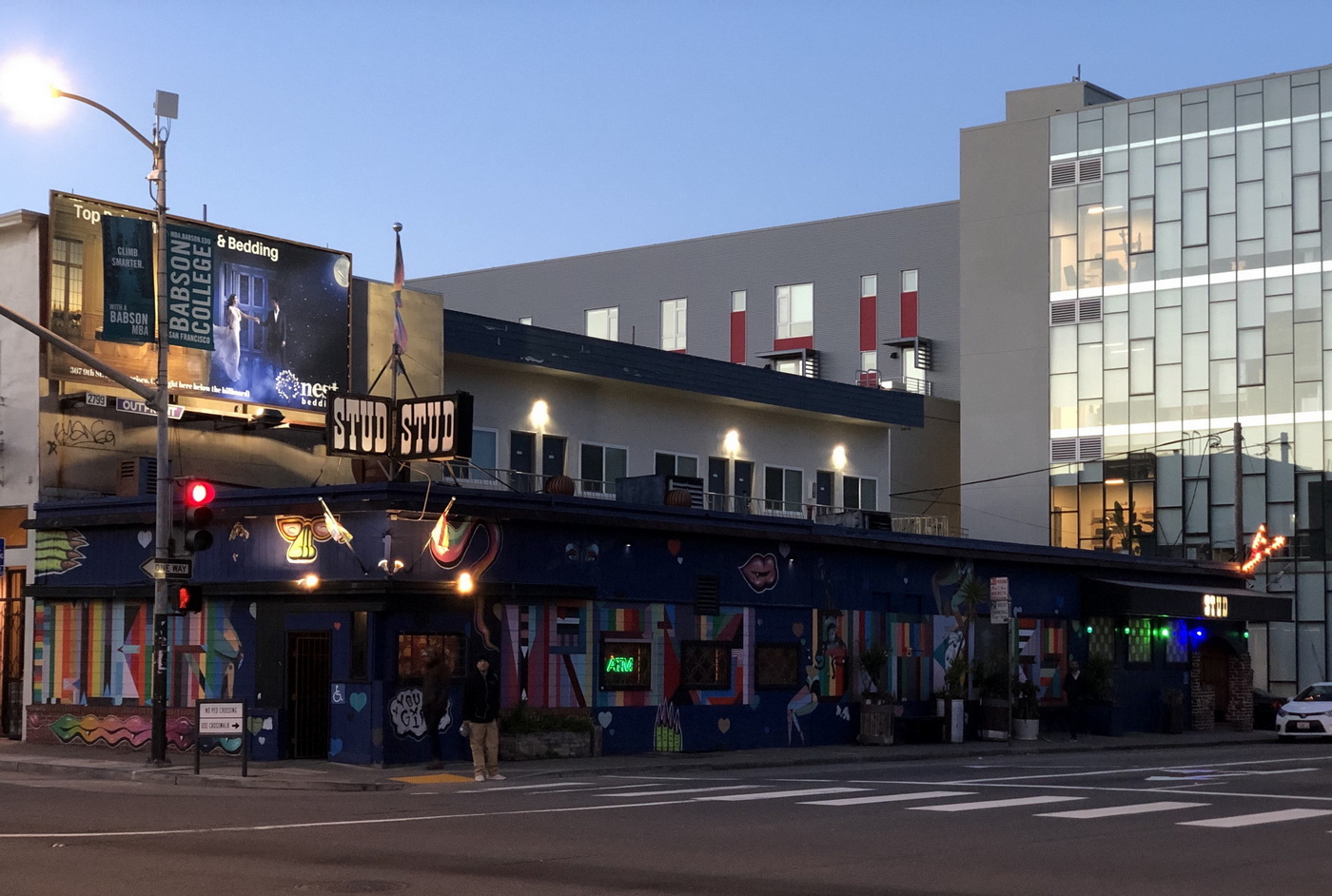
The Stud, at 1123 Folsom Street in San Francisco, is a gay bar and a living piece of South of Market leather culture and LGBTQ nightlife. George Matson and Alexis Muir opened it on 27 May 1966. Muir was a transgender woman, then known as Richard Conroy. The surname Muir may refer to her great-uncle, John Muir. Matson’s line for the place was that it was “a bar for people, not just pretty bodies.” That is the difference he wanted from a room that existed only to cruise.
The address moved with the city’s gay map. The bar started at 1535 Folsom Street and in 1987 went to Ninth and Harrison. In the 1960s, once The Tool Box was the first leather bar in the area, SOMA became a leather hub. The Stud and Febe’s, opening in the same period, took root on Folsom with the other leather bars and gave early gay San Francisco a place to gather. The Stud was also a Hell’s Angels hangout at the start. By 1969 it was a dance bar for people on the edge of the leather scene and for hippies. Chuck Arnett’s psychedelic black-light mural was on the wall: leather, motorcycles, and a hippie dance floor in one room.
Ownership tracks the long shadow of AIDS. In the early 1970s George Matson sold his half to Alexis Muir, and Muir then sold on to Jerry “Trixie” Jones, Heidi Steffan, and Jan Hill. Trixie was also a part owner of Hamburger Mary’s, the restaurant across the street, so the block worked as a SOMA social center. In 1974 Jim “Edie” Fleckenstein bought the bar. When he died in 1994 he left it to his partner and resident DJ Larry Holloway, known as LaRue, and to the accountant Ben “Fiesta” Guibord. LaRue died in the 1990s of complications from HIV/AIDS. Guibord died in 2011 of the same, at sixty-three. The chain is real estate, and it is also how the epidemic hit gay bars.
The Stud was a queer stage as well as a leather-neighborhood bar. From 1996 Heklina, a well-known San Francisco drag queen, ran Trannyshack there, one of the city’s longest-running drag shows. Contestants from RuPaul’s Drag Race, and RuPaul, played the room. The word “tranny” drew controversy. Heklina ended the show and rebranded. In 2008 Trannyshack’s run at The Stud stopped. Folsom’s leather-adjacent bars doubled as rooms for queer performance.
In the summer of 2016 a steep rent increase led the owner, Michael McElheney, to retire. A group of nightlife workers formed a collective and bought the bar to keep the room. Members included Honey Mahogany, Siobhan Aluvalot, Vivvyanne Forevermore, and Rachel Ryan, a mix of artists, DJs, and performers. The collective took over on 30 December 2016. Member Nate Allbee called it “the very first co-op nightclub in the United States.” In May 2020 the financial collapse of the COVID-19 shutdown closed it again. On 20 April 2024 The Stud reopened at 1123 Folsom Street.
The city has marked the history in public. In 2017 cofounder Alexis Muir was named with other figures on the bronze bootprints of the San Francisco South of Market Leather History Alley. The Leather and LGBTQ Cultural District came the next year. The Board of Supervisors established it, the mayor signed the law on 9 May 2018, and a ribbon was cut outside The Stud on 12 June 2018. A dance bar with leather roots was being treated as civic heritage, not as a storefront the rent could swap out. For adult readers it is still the Folsom bar that said it was for people rather than for pretty bodies, and that came back after rent, plague, and time.